Bookbinding Methods: Perfect Binding Uses Glue, Not Thread
Fold, Knot & Bind Published
In brief
Bookbinding methods differ in where they grip the paper: the fold, the side, or the cut edge. The binding the book trade calls “perfect” uses no thread at all; a 1982 Library of Congress dictionary lists it as another name for adhesive binding.
Materials: Paper leaves, folded or cut. One holder: thread, wire staples, or adhesive. No boards unless the book gets a hard cover.
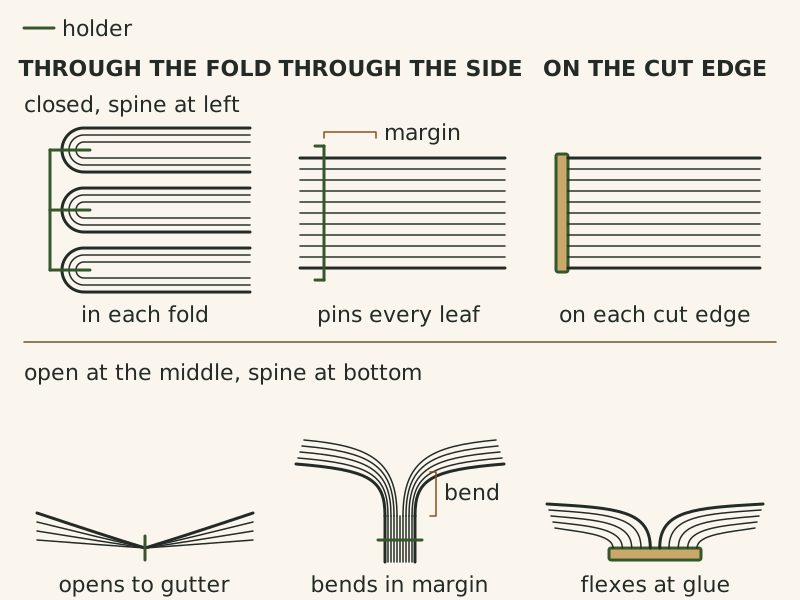
Where each binding grips the paper, seen from the head: closed above, opened below, holder in green.
Check level Schematic, not to scale, after Roberts and Etherington (1982); no geometric check.
"Where a binding grips the paper" by Fold, Knot & Bind — https://foldknotbind.com/bookbinding/bookbinding-methods/ — licensed under CC BY 4.0: https://creativecommons.org/licenses/by/4.0/
Perfect binding holds single leaves together with adhesive along their cut edge. Bookbinding is the work of holding a stack of leaves together at one edge and giving it a cover, often with thread, wire staples, or adhesive. Where the holder grips the paper shapes two things: how far the book opens, and how it breaks.
Look along your own shelf. Open a thin magazine at the middle: staples in the fold are saddle stitching, the method that dictionary describes for “a periodical issue or pamphlet.” In a paperback sewn in sections, thread shows at the center of each section. If neither shows, adhesive is the likely holder.
Where can a binding grip the paper?
A binding can grip paper in three places: through the fold of a folded sheet, through the side of the whole stack, or on the cut edges of single leaves. A 1982 Library of Congress dictionary of bookbinding terms, by Matt Roberts and Don Etherington, splits sewing the same way: through the folds or through the sides. Adhesive adds the third. A section, or signature, is usually one printed sheet folded into a group of pages.
Through the fold: saddle stitching and sewn sections
When a few sheets are folded in half, nested, and stapled through the crease, the result is saddle stitching. The dictionary credits it, and its threaded twin saddle sewing, with full openability right to the gutter, where facing pages meet. Openability is its word for how flat the open leaves lie with no weight on them. The limit is size: how many leaves one fold can take depends largely on paper thickness.
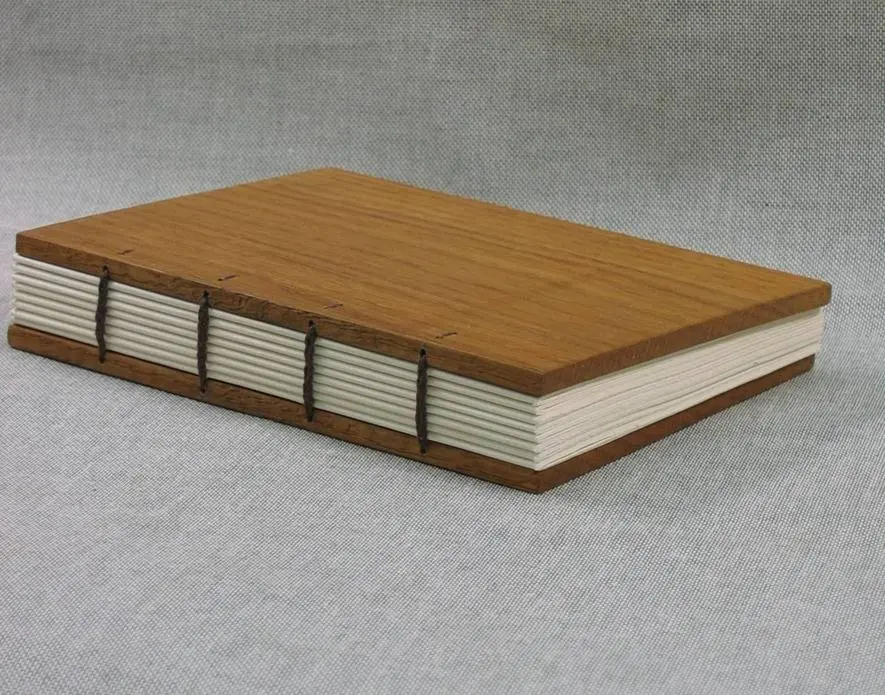
Thicker books use many sections, each sewn through its own fold and linked to the next. Binders in Europe sewed sections onto cords as early as the 8th century, a method the dictionary calls one of the strongest forms of hand sewing known. Coptic binding leaves the links in view, as chain stitches across the spine. In the United States, machine book sewing is nearly synonymous with David McConnell Smyth, who patented sewing machines in 1868 and 1879.
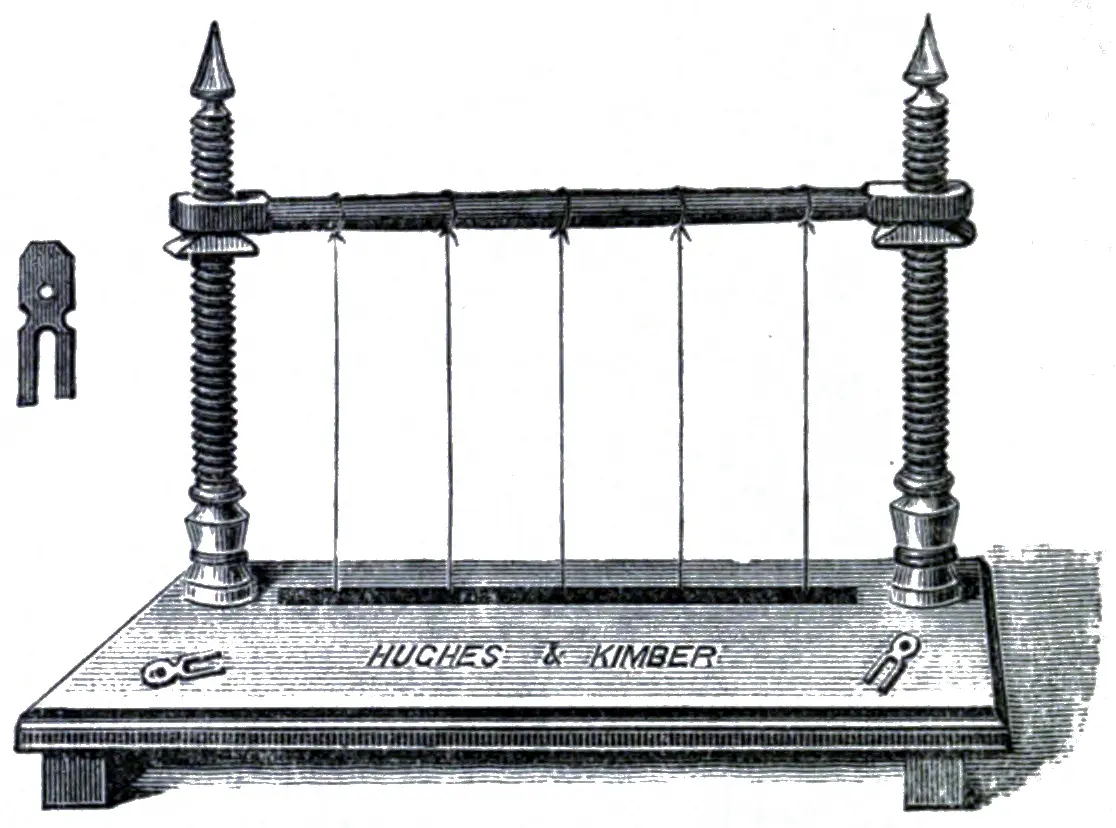
A sewing press from Zaehnsdorf’s 1890 bookbinding manual, with five cords stretched upright between the crossbar and the base.
"Sewing press, from The Art of Bookbinding" (1890), Joseph William Zaehnsdorf — https://commons.wikimedia.org/wiki/File:Art_of_Bookbinding_p056_Sewing_Press.png — Public domain in US: published 1890 (George Bell and Sons, London, second edition; first edition 1879), before 1931; DE/FR: published 1890 in a book by Joseph William Zaehnsdorf (d. 1930), engraver not named, so both life + 70 and 70 years from publication have expired
Through the side: strong, but stiff at the gutter
Side sewing and side stitching push thread or staples straight through the whole stack, near the spine. The dictionary calls side sewing “an extremely strong form of sewing” and side stitching “one of the strongest forms of construction.” By the same dictionary, side sewing gives very little openability, and side stitching almost none. Side sewing does better only with a very wide inner margin, very flexible paper, or a very large book.
A side-stitched book has to be designed around this, with wider margins and more flexible paper. Paper logic, the rigid-sheet model this site uses for folded paper, shows why: in it, a leaf can turn only at a crease. A side-sewn book has no crease at its stitch line, so in the model it could not open at all. Real paper bends in the margin past the stitches, and that bend is how each page turns.
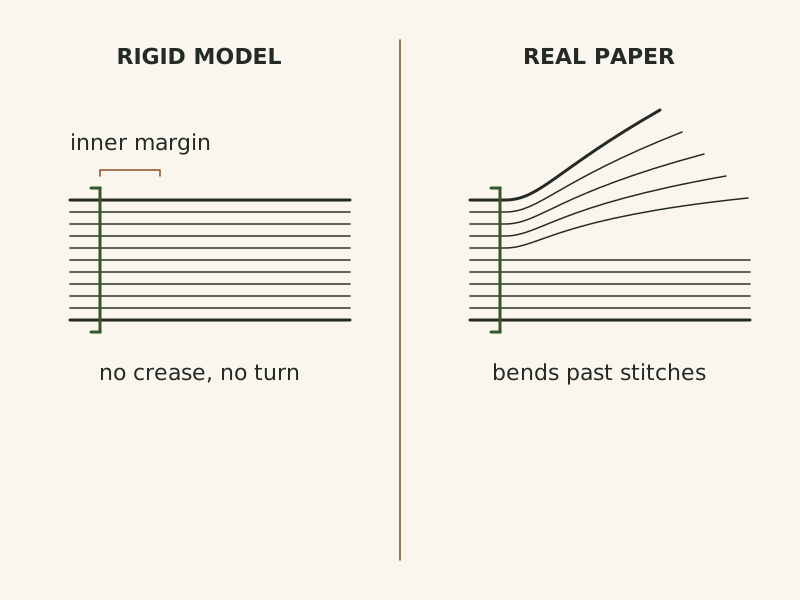
A side-sewn stack seen from the head, stitch line in green: in the rigid-sheet model no leaf can turn, while real paper bends in the margin past the stitches.
Check level Schematic, not to scale, after Roberts and Etherington (1982); no geometric check.
"Side sewing in the rigid-sheet model and in real paper" by Fold, Knot & Bind — https://foldknotbind.com/bookbinding/bookbinding-methods/ — licensed under CC BY 4.0: https://creativecommons.org/licenses/by/4.0/
Library binders use a related method: oversewing. It cuts away the folds and sews small stacks of leaves through their edges. It also uses up about 5/16 to 6/16 inch (about 8 to 9.5 mm) of inner margin.
On the cut edge: what “perfect” binding really is
Perfect binding works on single leaves. The dictionary defines adhesive binding as a way of “securing loose leaves” with adhesive instead of sewing, and lists “perfect binding” and “unsewn binding” as other names for it. Some binders fan the clamped leaves so the adhesive reaches a short way onto each one, which the dictionary says forms “a more secure bond.”
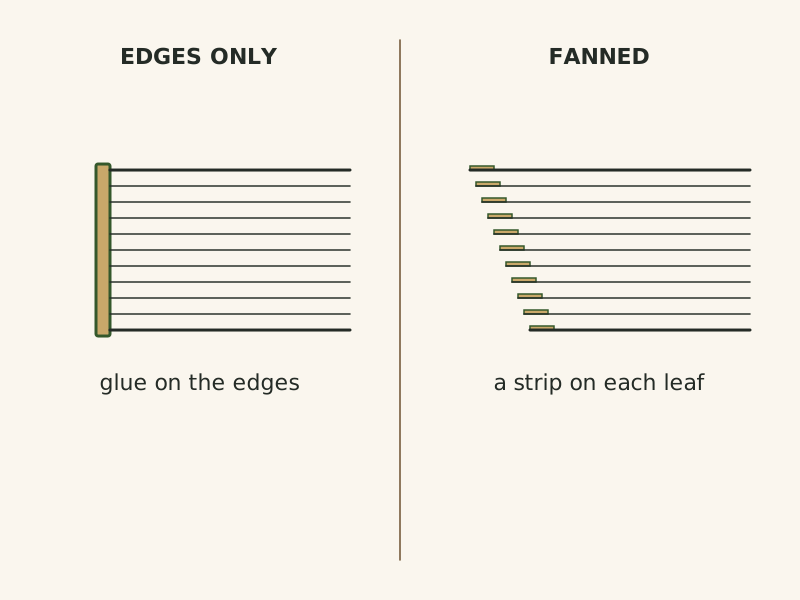
Adhesive binding seen from the head, glue shaded: on the clamped edges only, or on fanned leaves so it reaches a short way onto each.
Check level Schematic, not to scale, after Roberts and Etherington (1982); no geometric check.
"Adhesive on the edges, and on fanned leaves" by Fold, Knot & Bind — https://foldknotbind.com/bookbinding/bookbinding-methods/ — licensed under CC BY 4.0: https://creativecommons.org/licenses/by/4.0/
Glue earns its place. The dictionary says adhesive binding generally opens easily and lies flat, costs relatively little over long runs, and suits heavy use over a short life, like a phone directory. Library binders also use it to rebind books on paper that is breaking down. Still, its 1982 verdict was mixed: generally thought inferior to sewing, with permanence “yet to be demonstrated.”
Here the adhesive signs for every leaf on its own. Each leaf is held only along a narrow strip at its cut edge, so that strip does the whole job.
The glue-only book is older than it looks. In 1836 William Hancock patented a rubber version, the caoutchouc binding, which the dictionary calls probably the first adhesive binding. From about 1840, large numbers were made in England and the United States, and at the time they were believed to last. They depended on the rubber staying flexible, and it did not: most caoutchouc bindings have since fallen apart.
Is a hardcover book sewn?
Not necessarily. Case binding is one way to make a hardcover. Its case, the boards and their covering, is made separately and glued on through the pastedowns, the endpaper leaves nearest the boards.
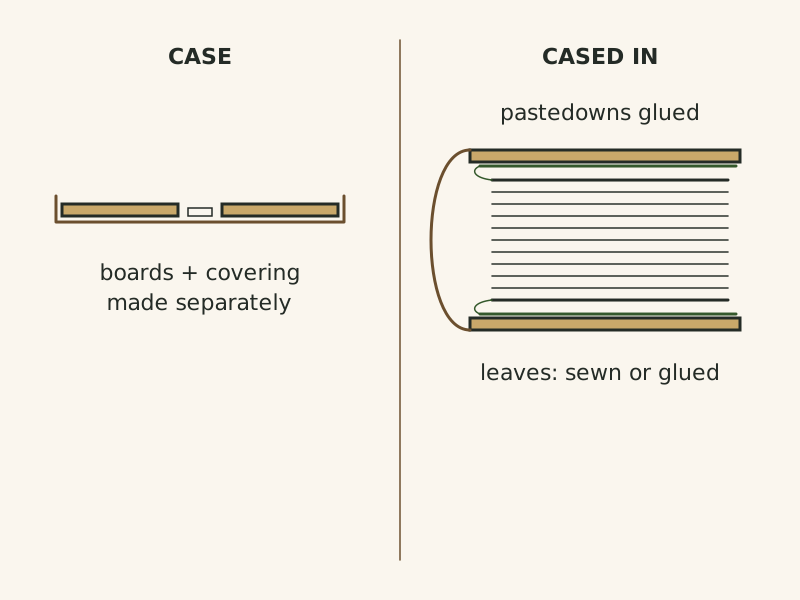
A case binding seen from the head: the case of boards and covering is made separately and glued on through the pastedowns, in green; the leaves inside may be sewn or glued.
Check level Schematic, not to scale, after Roberts and Etherington (1982); no geometric check.
"A case binding: the case and the pastedowns" by Fold, Knot & Bind — https://foldknotbind.com/bookbinding/bookbinding-methods/ — licensed under CC BY 4.0: https://creativecommons.org/licenses/by/4.0/
The dictionary dates case binding to 1820s Britain. Its 1982 entry calls case binding “the principal method employed in both edition and library binding.” Edition binding means binding identical copies in quantity for a publisher.
The case shows how the cover goes on. It says nothing about how the leaves are held: in library binding, they may be oversewn or glued.
How it fails: where each binding gives way
A binding's failures say more about it than its successes do. In a sewn book, the third hand, a name for the hidden holder that keeps a part in place once the hands let go, is the thread's tension. Loose sewing can cause both sewn-book failures below.
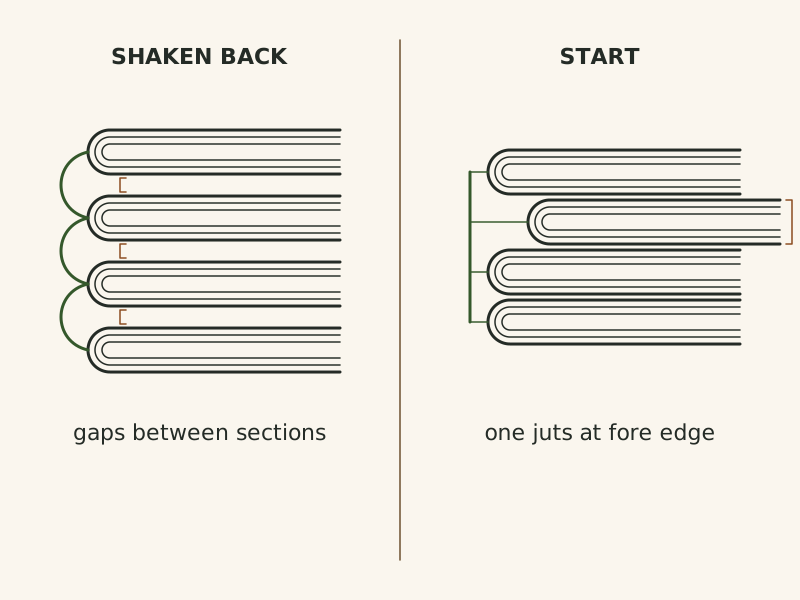
Two failures of sewn sections, seen from the head: a shaken back, with gaps between sections, and a start, with one section jutting out at the fore edge.
Check level Schematic, not to scale, after Roberts and Etherington (1982); no geometric check.
"Shaken back and start" by Fold, Knot & Bind — https://foldknotbind.com/bookbinding/bookbinding-methods/ — licensed under CC BY 4.0: https://creativecommons.org/licenses/by/4.0/
| Where it grips | How it fails | What the dictionary blames |
|---|---|---|
| Through the fold, one section | Only so many leaves fit in one fold | Paper thickness |
| Through the fold, many sections | Shaken back: gaps open between sections. A start: one section juts out at the fore edge, opposite the spine | Loose sewing, brittle spine glue, weak lining, careless use; sections too thick or too many |
| Through the side | Pages barely lie open | Stitches pin every leaf near the spine |
| On the cut edge | Adhesive may not grip coated paper | Coating dust left on the paper |
| On the cut edge, rubber (1836) | Most have fallen apart | The rubber stopped being flexible |
One problem cuts across every method: grain. Machine-made paper has a grain, the direction most of its fibers lie. A well-made book runs it from head to tail, parallel to the spine. Folded the other way, the paper refuses to settle: the fold runs across the fibers, and the leaves are less inclined to lie flat.
Which binding for which job?
Each row below follows the 1982 dictionary, and the CSV gives the dictionary entry behind every value.
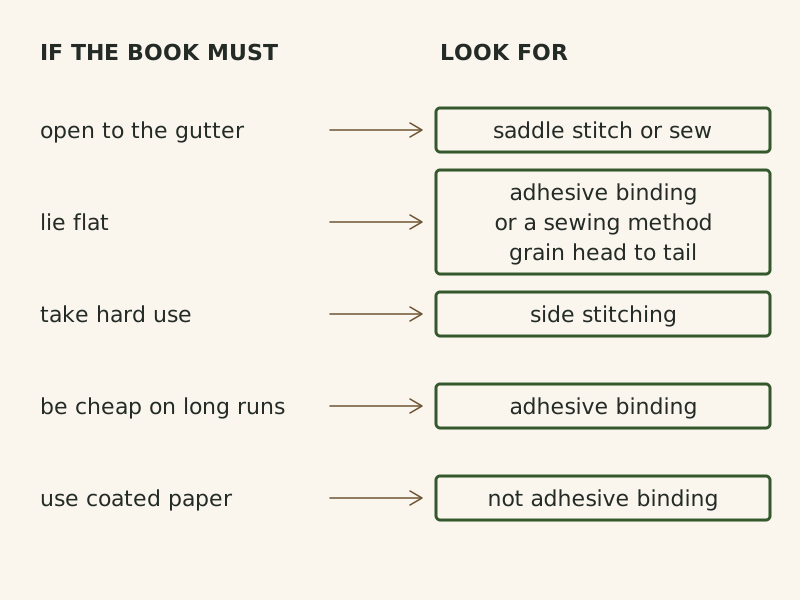
Five jobs and the binding to look for in each; the table below gives the same rows with the reasons.
Check level Each row taken from this page’s CSV; source: Roberts and Etherington (1982).
"Which binding for which job" by Fold, Knot & Bind — https://foldknotbind.com/bookbinding/bookbinding-methods/ — licensed under CC BY 4.0: https://creativecommons.org/licenses/by/4.0/
| If the book has to… | Look for | Why, per the 1982 dictionary |
|---|---|---|
| Open right to the gutter, with few leaves | Saddle stitching or saddle sewing | Full openability to the gutter; number of leaves limited mainly by paper thickness |
| Lie flat for music, photocopying, or writing in | Adhesive binding, or a sewing method chosen for openability; grain head to tail | Generally opens easily and lies flat; openability depends to a considerable degree on paper weight and thickness, grain direction, and the method of sewing; leaves more inclined to lie flat when the grain runs head to tail, parallel to the spine |
| Survive hard use, like a textbook | Side stitching | One of the strongest forms of construction; frequently used in binding textbooks; needs wider margins and more flexible paper |
| Stay cheap over a long run | Adhesive (perfect) binding | Relatively economical especially for long runs; very practical for heavy use over a relatively short period (e.g. telephone directories) |
| Use coated paper | Not adhesive binding | Not satisfactory for coated papers (coating or loading dust left on the paper can stop the adhesive adhering well) |
Download the comparison table (CSV) (what the file holds)
Questions readers ask
Is perfect binding bad?
The 1982 verdict on it was mixed. Perfect binding is adhesive binding by another name, and a 1982 Library of Congress bookbinding dictionary says it generally opens easily and lies flat, at low cost over long runs. Its weak points are coated paper, where leftover coating dust can keep the adhesive from gripping well, and permanence, which the dictionary called unproven. Sewing was generally rated higher.
Why won't my book stay open?
Check three things. Side-sewn and side-stitched books barely lie open unless made with wide margins and very flexible paper, because the stitches pin every leaf near the spine. The grain may run across the spine instead of along it. Heavy, thick paper also resists, since how flat a book lies depends on paper weight and thickness, grain direction, and the sewing method.
Sources
- Matt T. Roberts and Don Etherington, Bookbinding and the Conservation of Books: A Dictionary of Descriptive Terminology (Washington: Library of Congress, 1982; Supt. of Docs. no. LC 1.2:B64/3; electronic edition prepared by Walter Henry, Stanford University Libraries, 1994), notes on the electronic edition cool.culturalheritage.org/don/tn/tn6.htmlRead: full page (notes on the electronic edition)
- Roberts and Etherington, Bookbinding and the Conservation of Books (1982), “adhesive binding” cool.culturalheritage.org/don/dt/dt0044.htmlRead: full entry
- Roberts and Etherington, Bookbinding and the Conservation of Books (1982), “perfect binding” cool.culturalheritage.org/don/dt/dt2546.htmlRead: full entry
- Roberts and Etherington, Bookbinding and the Conservation of Books (1982), “caoutchouc binding” cool.culturalheritage.org/don/dt/dt0574.htmlRead: full entry
- Roberts and Etherington, Bookbinding and the Conservation of Books (1982), “one-shot method” cool.culturalheritage.org/don/dt/dt2374.htmlRead: full entry
- Roberts and Etherington, Bookbinding and the Conservation of Books (1982), “hot-melt adhesive” cool.culturalheritage.org/don/dt/dt1771.htmlRead: full entry
- Roberts and Etherington, Bookbinding and the Conservation of Books (1982), “saddle stitching” cool.culturalheritage.org/don/dt/dt2950.htmlRead: full entry
- Roberts and Etherington, Bookbinding and the Conservation of Books (1982), “saddle sewing” cool.culturalheritage.org/don/dt/dt2948.htmlRead: full entry
- Roberts and Etherington, Bookbinding and the Conservation of Books (1982), “sewing” cool.culturalheritage.org/don/dt/dt3038.htmlRead: full entry
- Roberts and Etherington, Bookbinding and the Conservation of Books (1982), “section” cool.culturalheritage.org/don/dt/dt3005.htmlRead: full entry
- Roberts and Etherington, Bookbinding and the Conservation of Books (1982), “signature” cool.culturalheritage.org/don/dt/dt3109.htmlRead: full entry
- Roberts and Etherington, Bookbinding and the Conservation of Books (1982), “flexible sewing” cool.culturalheritage.org/don/dt/dt1365.htmlRead: full entry
- Roberts and Etherington, Bookbinding and the Conservation of Books (1982), “Coptic bindings” cool.culturalheritage.org/don/dt/dt0830.htmlRead: full entry
- Roberts and Etherington, Bookbinding and the Conservation of Books (1982), “Smyth, David McConnell” cool.culturalheritage.org/don/dt/dt3181.htmlRead: full entry
- Roberts and Etherington, Bookbinding and the Conservation of Books (1982), “side sewing” cool.culturalheritage.org/don/dt/dt3103.htmlRead: full entry
- Roberts and Etherington, Bookbinding and the Conservation of Books (1982), “side stitching” cool.culturalheritage.org/don/dt/dt3104.htmlRead: full entry
- Roberts and Etherington, Bookbinding and the Conservation of Books (1982), “oversewing” cool.culturalheritage.org/don/dt/dt2412.htmlRead: full entry
- Roberts and Etherington, Bookbinding and the Conservation of Books (1982), “openability” cool.culturalheritage.org/don/dt/dt2382.htmlRead: full entry
- Roberts and Etherington, Bookbinding and the Conservation of Books (1982), “lying flat” cool.culturalheritage.org/don/dt/dt2130.htmlRead: full entry
- Roberts and Etherington, Bookbinding and the Conservation of Books (1982), “case binding” cool.culturalheritage.org/don/dt/dt0596.htmlRead: full entry
- Roberts and Etherington, Bookbinding and the Conservation of Books (1982), “casing-in” cool.culturalheritage.org/don/dt/dt0603.htmlRead: full entry
- Roberts and Etherington, Bookbinding and the Conservation of Books (1982), “endpapers” cool.culturalheritage.org/don/dt/dt1192.htmlRead: full entry
- Roberts and Etherington, Bookbinding and the Conservation of Books (1982), “shaken back” cool.culturalheritage.org/don/dt/dt3060.htmlRead: full entry
- Roberts and Etherington, Bookbinding and the Conservation of Books (1982), “start” cool.culturalheritage.org/don/dt/dt3317.htmlRead: full entry
- Roberts and Etherington, Bookbinding and the Conservation of Books (1982), “against the grain” cool.culturalheritage.org/don/dt/dt0053.htmlRead: full entry
- Roberts and Etherington, Bookbinding and the Conservation of Books (1982), “machine direction” cool.culturalheritage.org/don/dt/dt2135.htmlRead: full entry
- Roberts and Etherington, Bookbinding and the Conservation of Books (1982), “edition binding” cool.culturalheritage.org/don/dt/dt1155.htmlRead: full entry
- Roberts and Etherington, Bookbinding and the Conservation of Books (1982), “gutter” cool.culturalheritage.org/don/dt/dt1682.htmlRead: full entry
- Roberts and Etherington, Bookbinding and the Conservation of Books (1982), “fore edge” cool.culturalheritage.org/don/dt/dt1410.htmlRead: full entry
Cite this page
“Bookbinding Methods: Perfect Binding Uses Glue, Not Thread.” Fold, Knot & Bind. Published Nov. 15, 2026. https://foldknotbind.com/bookbinding/bookbinding-methods/. Accessed on the date you read it.
How diagrams and claims are checked All corrections Report an error on this page (contact@foldknotbind.com)
Next on the bench:
- Japanese stab binding: Another way of sewing straight through the side, one the 1982 dictionary pairs with very flexible paper.
- How pop-up books work: If a leaf can turn only at a crease, how does a pop-up rise off the page?
More in Bookbinding
Bookbinding
Japanese Stab Binding: Sewn Through, and Hard to Open Flat
Picture credit
"Ehon Azuma asobi (Picture Book of Amusements of the Eastern Capital), cover" by Kitagawa Utamaro (attributed), Metropolitan Museum of Art — https://commons.wikimedia.org/wiki/File:%E7%B5%B5%E6%9C%AC%E5%90%BE%E5%A6%BB%E9%81%8A-Ehon_Azuma_asobi-Picture_Book_of_Amusements_of_the_Eastern_Capital_(Ehon_Azuma_asobi)_MET_JIB41_001.jpg — CC0 1.0 (https://creativecommons.org/publicdomain/zero/1.0/)
Bookbinding
Coptic Binding: Each Section Is Chained to the Next
Picture credit
"Model Coptic binding" by Ratbasket at English Wikipedia — https://commons.wikimedia.org/wiki/File:Coptic_flat.jpg — CC BY 2.5 (https://creativecommons.org/licenses/by/2.5/); modified: lightly smoothed to reduce file size
Bookbinding
Saddle Stitching: Each Folded Sheet Adds Four Pages
Picture credit
"Morrison Perfection A Stitcher (stapler), c. 1890 - American Bookbinders Museum - San Francisco, CA" by Daderot — https://commons.wikimedia.org/wiki/File:Morrison_Perfection_A_Stitcher_(stapler),_c._1890_-_American_Bookbinders_Museum_-_San_Francisco,_CA_-_DSC08204.jpg — CC0 1.0 (https://creativecommons.org/publicdomain/zero/1.0/); modified: cropped