Coptic Binding: Each Section Is Chained to the Next
Fold, Knot & Bind Published
In brief
Open a Coptic-bound notebook and the thread shows along the spine, chaining each section to the next. Each folded section is sewn through its own fold, and a 1998 paper by Gary Frost credits these flexible chains of stitches with letting the book open flat.
Materials: Folded paper sections, thread and two boards. Thread alone links each section to the next.
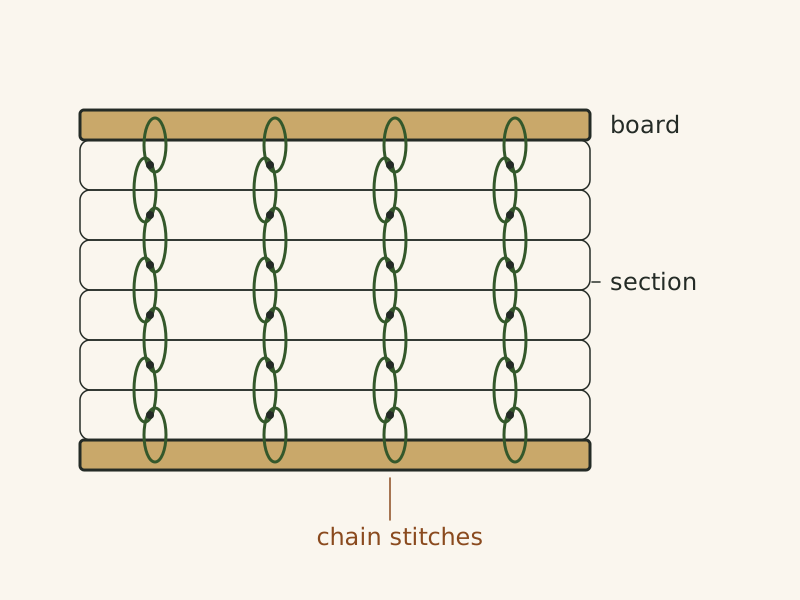
Six sections between two boards, seen from the spine. At each of four sewing stations, loops of thread link every section to the one below it, and the end sections to the boards.
Check level Schematic, not to scale, after Roberts and Etherington (1982) and Frost (1998); no geometric check.
"Coptic binding: chain stitches across the spine" by Fold, Knot & Bind — https://foldknotbind.com/bookbinding/coptic-binding/ — licensed under CC BY 4.0: https://creativecommons.org/licenses/by/4.0/
A section, also called a signature, is a group of pages folded together, usually from one sheet of paper but sometimes from one and a half or two. In the three-way split used in bookbinding methods, a Coptic binding grips the paper through the fold.
What is a Coptic binding?
A 1982 Library of Congress dictionary of bookbinding terms, by Matt Roberts and Don Etherington, names Coptic bindings for the people who made them: the Copts, or Egyptian Christians. It describes their sewing as chain-stitch links “appearing as so many braids across the spine.” The same entry says the covers were often sewn or laced to the text by hinging loops.
The book in the photograph is a modern reproduction made in 2003, with wooden boards, paper sections and linen thread. Its spine is left bare, so four columns of chain stitches show. Frost's 1998 paper describes the old sewn book being covered in pasted leather afterward, and in that form the chains sat under the cover.
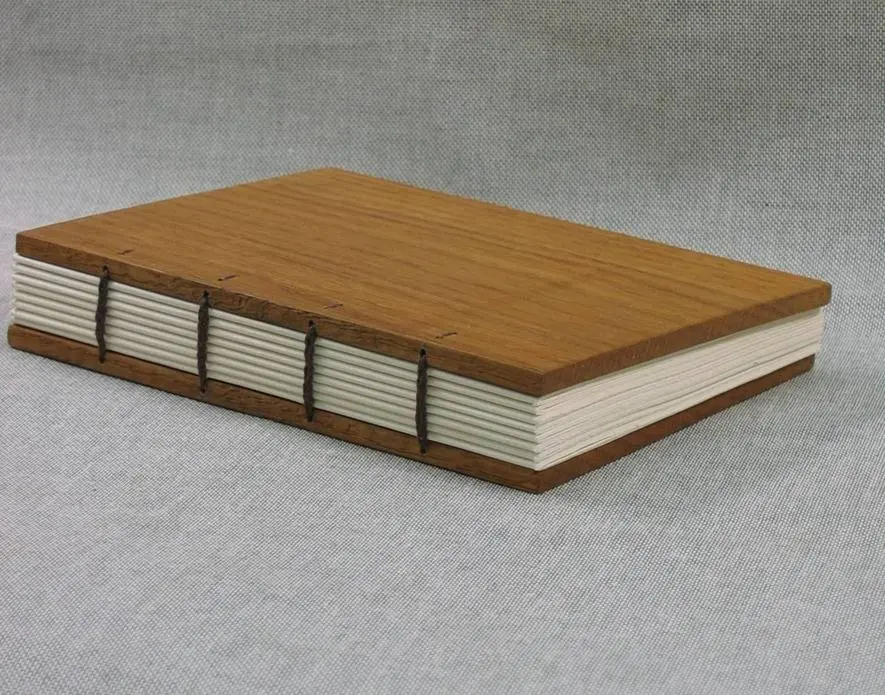
A modern reproduction of a Coptic binding, made in 2003: wooden boards, paper sections and linen thread, with the sewing left bare on the spine.
"Model Coptic binding" by Ratbasket at English Wikipedia — https://commons.wikimedia.org/wiki/File:Coptic_flat.jpg — CC BY 2.5 (https://creativecommons.org/licenses/by/2.5/); modified: lightly smoothed to reduce file size
How the chain stitches link the sections
Trace one column of stitches with a finger, from the bottom board up. Frost's 1998 paper gives the path. The thread runs inside the fold of a section, comes out at a sewing station, drops down to catch a stitch below, and climbs into the next section. A quire, or gathering, is another name for a section, and the book grows one quire at a time.
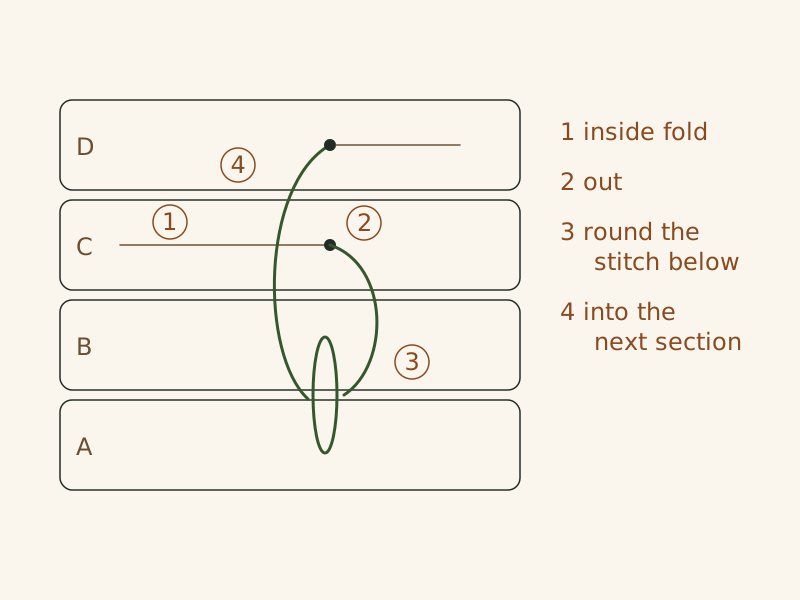
One sewing station, close up. The thread runs inside the fold of section C (1), comes out (2), passes round a stitch already made below (3), and climbs into the next section, D (4).
Check level Schematic, not to scale, after Frost (1998); no geometric check.
"Coptic binding: how one section is chained to the next" by Fold, Knot & Bind — https://foldknotbind.com/bookbinding/coptic-binding/ — licensed under CC BY 4.0: https://creativecommons.org/licenses/by/4.0/
The dictionary compares this to the machine sewing used for edition books in its own day, which also forms chain-stitch links. Crochet has a chain stitch too: Thérèse de Dillmont's Encyclopedia of Needlework describes crochet as loops drawn one through another (see crochet vs knitting). No source read for this page compares the two structures, so the shared name is all this page claims.
Why it opens flat
In the early codex books of north and east Africa, Frost (1998) credits this sewing with a calm, flat opening and puts it down to the flexible chains of stitches. In a note, he points to pictures as support. Early Church mosaics show books opened all the way, while later medieval illuminations show books sewn on heavy cords or thongs opening only part way.
A chain bends at every link, and on this page's reading that is why each section can swing open on its own. The dictionary adds a caution: openability, its word for how flat the leaves lie with no weight on them, depends on the paper's weight, thickness and grain as well as on the sewing. So the chains are one factor, not a promise that any Coptic book lies flat.
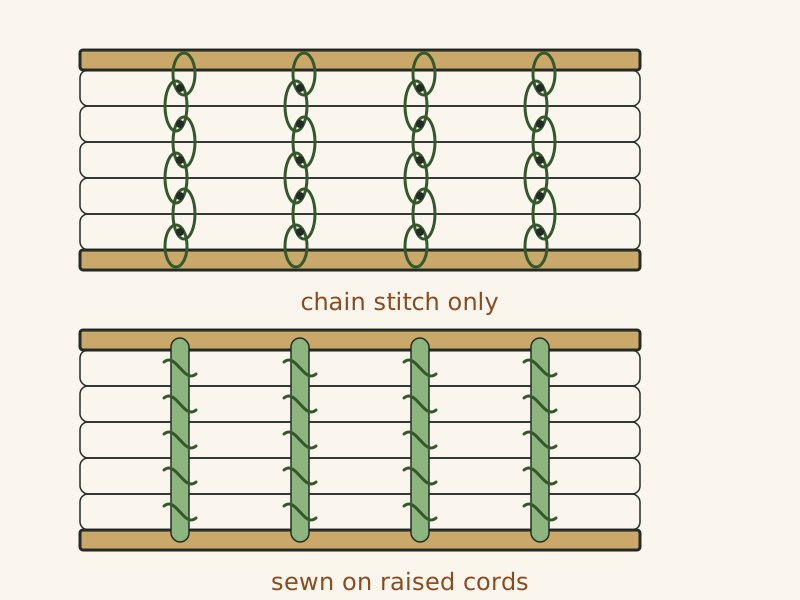
Two spines seen from the back. In the first, chain stitches alone link the sections. In the second, each section is sewn around raised cords that run across the spine, as in flexible sewing.
Check level Schematic, not to scale, after Roberts and Etherington (1982); no geometric check.
"Chain-stitched spine and spine sewn on raised cords" by Fold, Knot & Bind — https://foldknotbind.com/bookbinding/coptic-binding/ — licensed under CC BY 4.0: https://creativecommons.org/licenses/by/4.0/
Kettle stitch: the chain stitch inside other books
Books sewn on cords carry a small chain too, at the head and tail. Joseph Zaehnsdorf's manual The Art of Bookbinding (second edition, 1890) calls it the kettle stitch. As each new section is sewn, its thread is linked to the sections below, “thus fastening each sheet to its neighbour by a kind of chain stitch” (p. 25).
Zaehnsdorf also guesses at the name: “I believe the term ‘kettle stitch’ is only a corruption of ‘catch-up stitch,’ as it catches each section as sewn in succession.” That is one binder's view, not a recorded history.
Put the two structures side by side and the difference is where the chain works. In a book sewn on cords, the chain sits only at the two ends, and in between the thread wraps round each cord. In a Coptic binding, every sewing station is a chain.
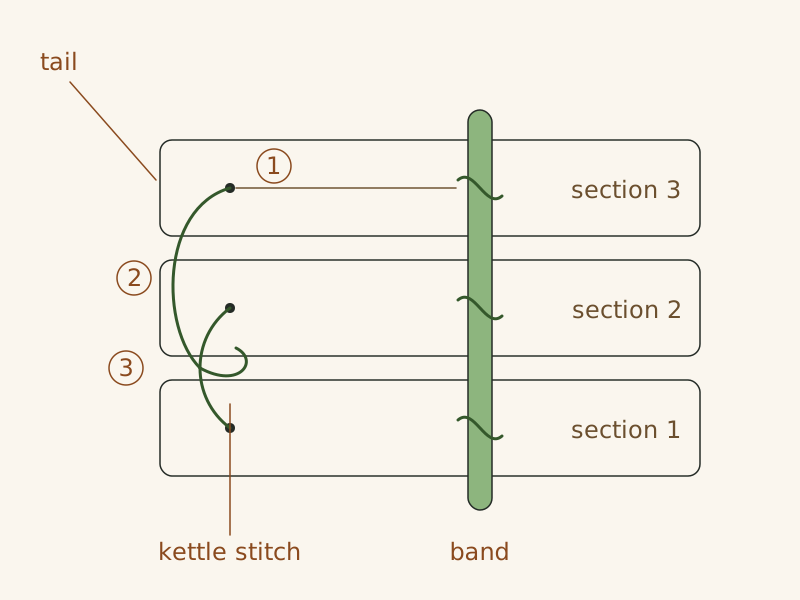
The tail end of a book sewn on bands. The thread comes out of section 3 at the kettle stitch (1), passes between sections 1 and 2 (2), and is drawn round the thread to lock the new section on (3).
Check level Schematic, not to scale, after Zaehnsdorf (1890); no geometric check.
"Kettle stitch at the tail of a book sewn on bands" by Fold, Knot & Bind — https://foldknotbind.com/bookbinding/coptic-binding/ — licensed under CC BY 4.0: https://creativecommons.org/licenses/by/4.0/
How it fails: slack thread and loose sections
In sewn sections, the third hand is the thread's tension, which keeps each section pressed to the next after the sewing is done. Zaehnsdorf's 1890 manual warns from both sides. Drawn too tight in making the chain, “the thread will break in backing”; without “a proper tension,” “the sheets will wear loose” (p. 28). If the thread is not properly fastened off at the kettle stitch, “the sections will work loose in course of time” (p. 25).
Roberts and Etherington name what loose sewing looks like. A start is a section that juts out past the others at the fore edge, the edge opposite the spine, and one cause they list is sewing thread that is too loose. Their entry for shaken back, gaps opening between sections, lists loose sewing among its causes too.
These warnings cover sewn sections and the kettle stitch in general. No source read for this page tests a Coptic binding itself. Since its chains are kettle-style links at every station, this page reads the same risk as applying along the whole spine.
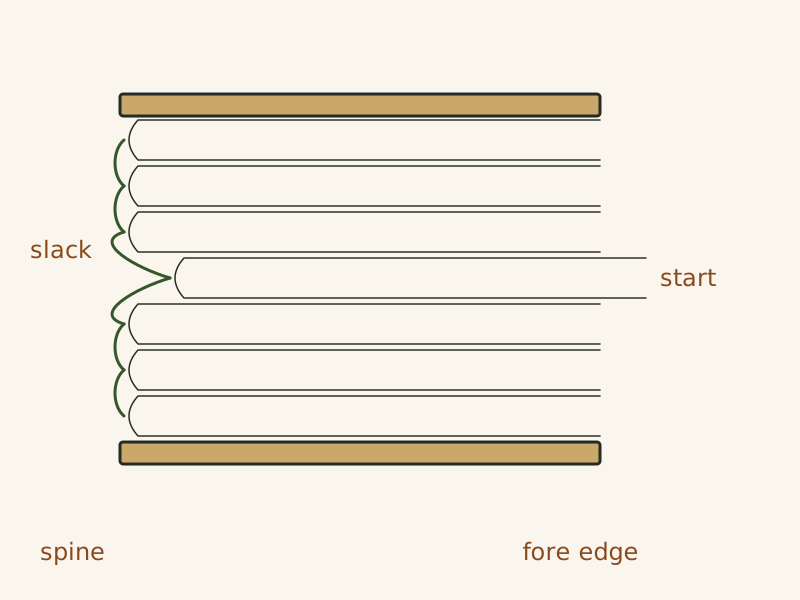
Seen from the head, with the spine on the left. With a slack link at the spine, one section slides out past the others at the fore edge: a start.
Check level Schematic, not to scale, after Roberts and Etherington (1982); no geometric check.
"A start: one section jutting out at the fore edge" by Fold, Knot & Bind — https://foldknotbind.com/bookbinding/coptic-binding/ — licensed under CC BY 4.0: https://creativecommons.org/licenses/by/4.0/
Sources
- Matt T. Roberts and Don Etherington, Bookbinding and the Conservation of Books: A Dictionary of Descriptive Terminology (Washington: Library of Congress, 1982; Supt. of Docs. no. LC 1.2:B64/3; electronic edition prepared by Walter Henry, Stanford University Libraries, 1994), notes on the electronic edition cool.culturalheritage.org/don/tn/tn6.htmlRead: full page (notes on the electronic edition)
- Roberts and Etherington, Bookbinding and the Conservation of Books (1982), “Coptic bindings” cool.culturalheritage.org/don/dt/dt0830.htmlRead: full entry
- Roberts and Etherington, Bookbinding and the Conservation of Books (1982), “sewing” cool.culturalheritage.org/don/dt/dt3038.htmlRead: full entry
- Roberts and Etherington, Bookbinding and the Conservation of Books (1982), “section” cool.culturalheritage.org/don/dt/dt3005.htmlRead: full entry
- Roberts and Etherington, Bookbinding and the Conservation of Books (1982), “flexible sewing” cool.culturalheritage.org/don/dt/dt1365.htmlRead: full entry
- Roberts and Etherington, Bookbinding and the Conservation of Books (1982), “openability” cool.culturalheritage.org/don/dt/dt2382.htmlRead: full entry
- Roberts and Etherington, Bookbinding and the Conservation of Books (1982), “start” cool.culturalheritage.org/don/dt/dt3317.htmlRead: full entry
- Roberts and Etherington, Bookbinding and the Conservation of Books (1982), “shaken back” cool.culturalheritage.org/don/dt/dt3060.htmlRead: full entry
- Gary Frost, "Adoption of the Codex Book: Parable of a New Reading Mode," The Book and Paper Group Annual 17 (1998). cool.culturalheritage.org/coolaic/sg/bpg/annual/v17/bp17-…Read: full text (online edition, unpaginated)
- Joseph W. Zaehnsdorf, The Art of Bookbinding: A Practical Treatise, 2nd ed. (London: George Bell and Sons, 1890). archive.org/details/artofbookbinding00zaehi…Read: pages 24, 25 and 28, checked against the page images
- Thérèse de Dillmont, Encyclopedia of Needlework, English edition (Dornach, Alsace: Th. de Dillmont, undated), Project Gutenberg eBook 20776. gutenberg.pglaf.org/cache/epub/20776/Read: full text of the Knitting chapter's opening sections (through fig. 387 and casting off), the Crochet Work chapter's opening sections and Tunisian crochet section, and the Macramé chapter's opening through fig. 531, with fig. 548 (Macramé fringe) and its caption; the eBook has no page numbers
Cite this page
“Coptic Binding: Each Section Is Chained to the Next.” Fold, Knot & Bind. Published Nov. 15, 2026. https://foldknotbind.com/bookbinding/coptic-binding/. Accessed on the date you read it.
How diagrams and claims are checked All corrections Report an error on this page (contact@foldknotbind.com)
Next on the bench:
- Japanese stab binding: Another binding with its thread on show, but this one passes straight through the whole stack.
- Saddle stitching: With only one section, a single row of stitches through the fold is enough.
More in Bookbinding
Bookbinding
Bookbinding Methods: Perfect Binding Uses Glue, Not Thread
Picture credit
"Sewing press, from The Art of Bookbinding" (1890), Joseph William Zaehnsdorf — https://commons.wikimedia.org/wiki/File:Art_of_Bookbinding_p056_Sewing_Press.png — Public domain in US: published 1890 (George Bell and Sons, London, second edition; first edition 1879), before 1931; DE/FR: published 1890 in a book by Joseph William Zaehnsdorf (d. 1930), engraver not named, so both life + 70 and 70 years from publication have expired
Bookbinding
Japanese Stab Binding: Sewn Through, and Hard to Open Flat
Picture credit
"Ehon Azuma asobi (Picture Book of Amusements of the Eastern Capital), cover" by Kitagawa Utamaro (attributed), Metropolitan Museum of Art — https://commons.wikimedia.org/wiki/File:%E7%B5%B5%E6%9C%AC%E5%90%BE%E5%A6%BB%E9%81%8A-Ehon_Azuma_asobi-Picture_Book_of_Amusements_of_the_Eastern_Capital_(Ehon_Azuma_asobi)_MET_JIB41_001.jpg — CC0 1.0 (https://creativecommons.org/publicdomain/zero/1.0/)
Bookbinding
Saddle Stitching: Each Folded Sheet Adds Four Pages
Picture credit
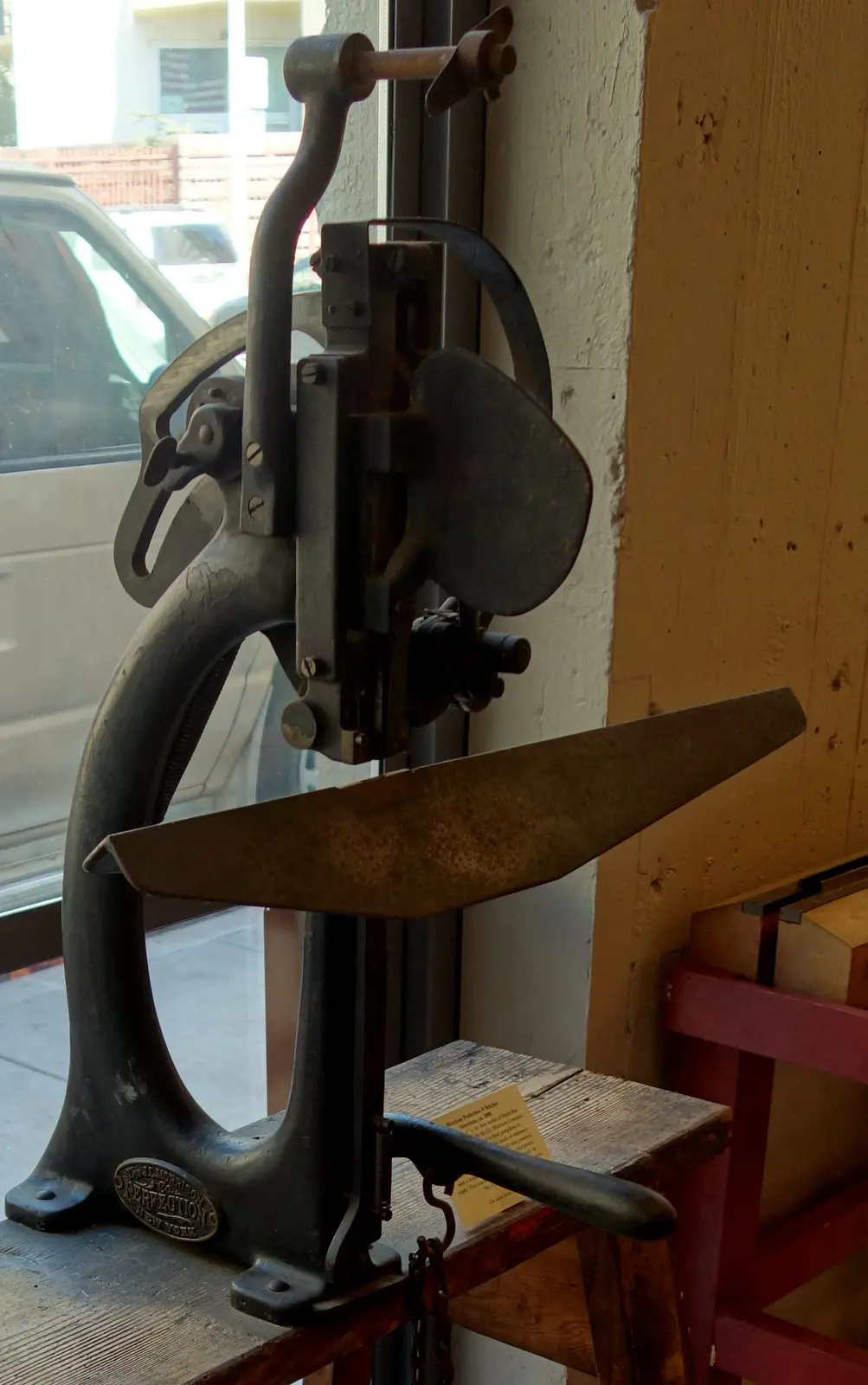
"Morrison Perfection A Stitcher (stapler), c. 1890 - American Bookbinders Museum - San Francisco, CA" by Daderot — https://commons.wikimedia.org/wiki/File:Morrison_Perfection_A_Stitcher_(stapler),_c._1890_-_American_Bookbinders_Museum_-_San_Francisco,_CA_-_DSC08204.jpg — CC0 1.0 (https://creativecommons.org/publicdomain/zero/1.0/); modified: cropped