Crochet vs Knitting: Knitting Holds a Whole Row of Loops
Fold, Knot & Bind Published
In brief
Count the open loops between stitches: a knitting needle holds a row; a standard crochet hook holds one. Standard crochet closes each stitch before the next begins, while Tunisian crochet, in Thérèse de Dillmont's needlework encyclopedia, gathers a whole row the way knitting does.
Materials: One yarn and its tool: two needles for knitting, a hook for crochet, a long knobbed hook for Tunisian crochet.
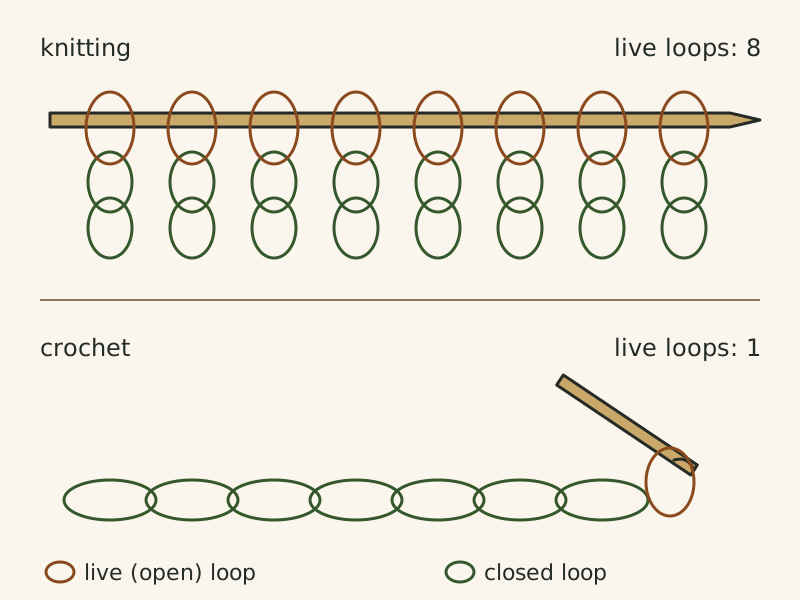
The same row of eight stitches between stitches: knitting keeps all eight loops open on the needle, while standard crochet keeps only the last one open on the hook.
Check level Schematic of loop structure, after de Dillmont's description; not to scale.
"Live loops: a knitting needle and a crochet hook" by Fold, Knot & Bind — https://foldknotbind.com/knit-and-stitch/crochet-vs-knitting/ — licensed under CC BY 4.0: https://creativecommons.org/licenses/by/4.0/
A live loop, on this page, is an open loop still held on the tool and not yet locked into the fabric. Both crafts are built from loops pulled through loops, and they differ in how many loops stay open while the work goes on, a count that shapes how each fabric starts, ends and comes apart.
What is the difference between crochet and knitting?
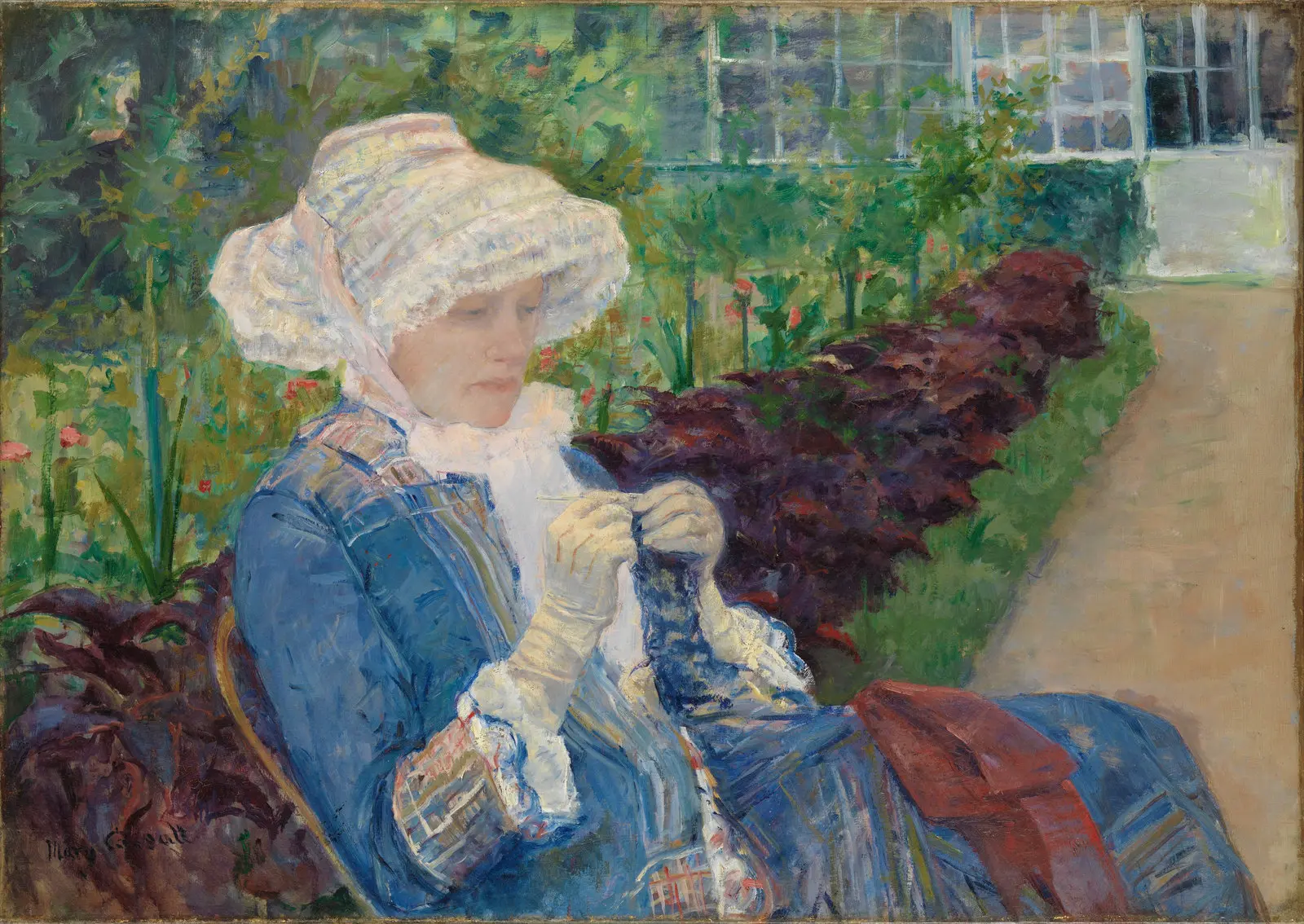
Lydia Crocheting in the Garden at Marly, painted by Mary Cassatt in 1880: one gloved hand holds a thin hook, and the other holds a strip of blue work.
"Lydia Crocheting in the Garden at Marly (Metropolitan Museum of Art 65.184)" by Mary Cassatt — https://commons.wikimedia.org/wiki/File:Lydia_Crocheting_in_the_Garden_at_Marly_MET_DP165250.jpg — CC0 1.0 (https://creativecommons.org/publicdomain/zero/1.0/); modified: cropped (black border, color bar and copyright line removed), resized to 1600 px wide
Thérèse de Dillmont's Encyclopedia of Needlework, read here in its English edition, defines both crafts by their loops. Knitting, she writes, “consists of loops, or stitches, as they are generally called, formed by means of a thread and two needles.” Crochet, she says, has really only one stitch, since all of it “consists of loops made by means of the hook or needle,” which are “connected together by being drawn the one through the other.”
Neither definition mentions a knot. In a knot such as the square knot, two strands wrap around each other, while a knitted or crocheted loop holds because the next loop passes through it. So the split this page draws between the two crafts is a count: how many loops wait on the tool, still open.
One loop or a whole row
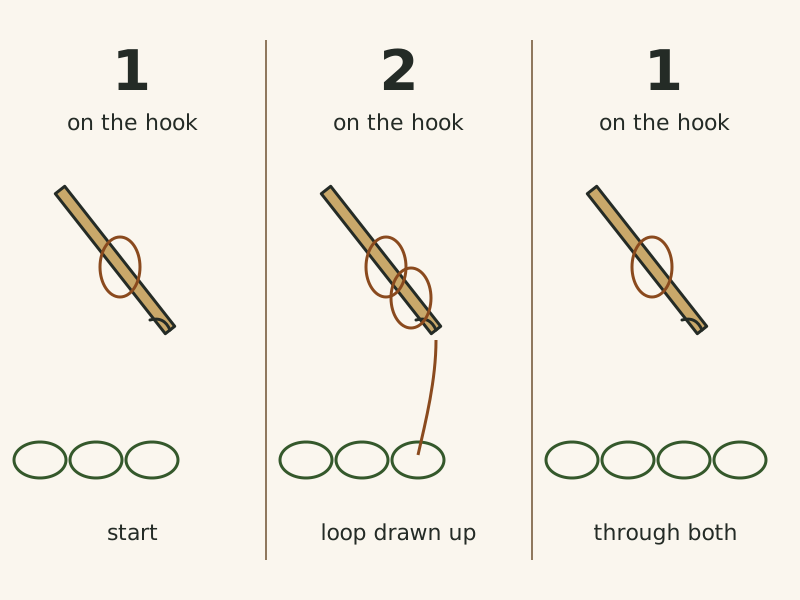
One crochet plain stitch, step by step: one loop on the hook, then two once a loop is drawn up through the stitch below, then one again after the yarn goes through both.
Check level Schematic of loop structure, after de Dillmont's description; not to scale.
"Loops on the hook through one crochet plain stitch" by Fold, Knot & Bind — https://foldknotbind.com/knit-and-stitch/crochet-vs-knitting/ — licensed under CC BY 4.0: https://creativecommons.org/licenses/by/4.0/
In standard crochet, each basic stitch in de Dillmont's steps starts and ends with one loop on the hook, which she calls a needle. Her plain stitch draws a loop up through the stitch below, which makes two loops, then pulls the yarn “through both loops on the needle,” which leaves one.
Taller stitches gather more loops for a moment. A treble wraps the yarn once, draws up a loop and so holds three, then works them off two at a time, back down to one. The count rises inside a stitch, then comes back to one before the next stitch begins.
Knitting does not close the row that way. Casting on, in de Dillmont's words, is “the formation of the first row of stitches,” and from then on the whole row sits on the needles. Each plain stitch draws a new loop through a loop on the left needle and drops the old loop off; with eight stitches in a row, eight loops stay live from the first stitch to the last.
The exception: Tunisian crochet
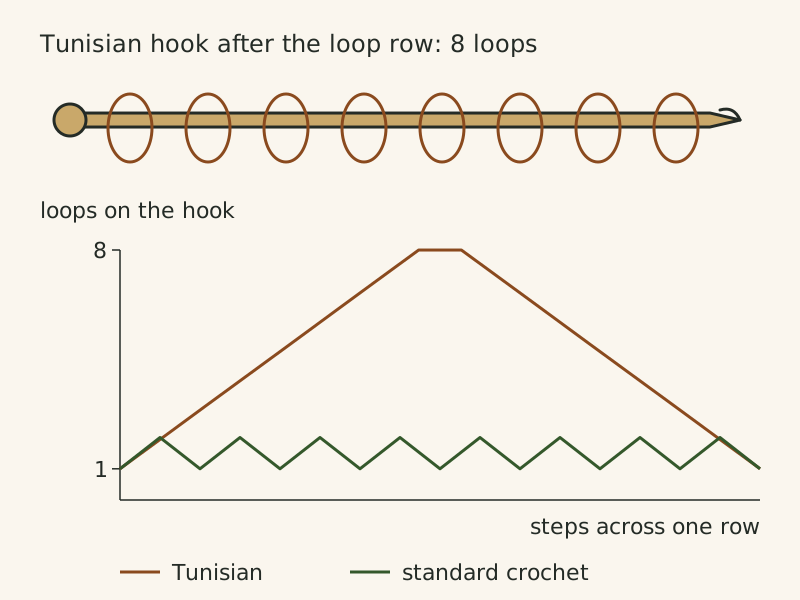
One row of eight stitches in plain Tunisian crochet: the loop count on the hook climbs to eight, then falls back to one as the loops are worked off two at a time. The plain stitch of standard crochet, drawn for comparison, only swings between one and two.
Check level Schematic of loops on the hook, step by step, after de Dillmont's description of plain Tunisian crochet; loops not to scale.
"Tunisian crochet: loops on the hook across one row" by Fold, Knot & Bind — https://foldknotbind.com/knit-and-stitch/crochet-vs-knitting/ — licensed under CC BY 4.0: https://creativecommons.org/licenses/by/4.0/
De Dillmont splits crochet into two kinds, “German crochet, and Victoria or Tunisian crochet.” The second kind breaks the one-loop rule, and she notes that it “is also called crochet-knitting because, you have to cast on all the first row of stitches, as in knitting.”
The tool shows the difference: Tunisian crochet uses “a long straight needle, with a knob at one end,” long enough to hold a full row. In the first pass, a loop is drawn up through each chain stitch and kept on the hook. In the second pass, the yarn goes “through two loops” again and again until one loop is left.
Is Tunisian crochet a kind of knitting, then? In de Dillmont's grouping, no: it is the second kind of crochet. It borrows knitting's row of live loops but works them with a hook, and she adds that it “can only be worked on the right side.”
How it fails: what happens when a stitch drops
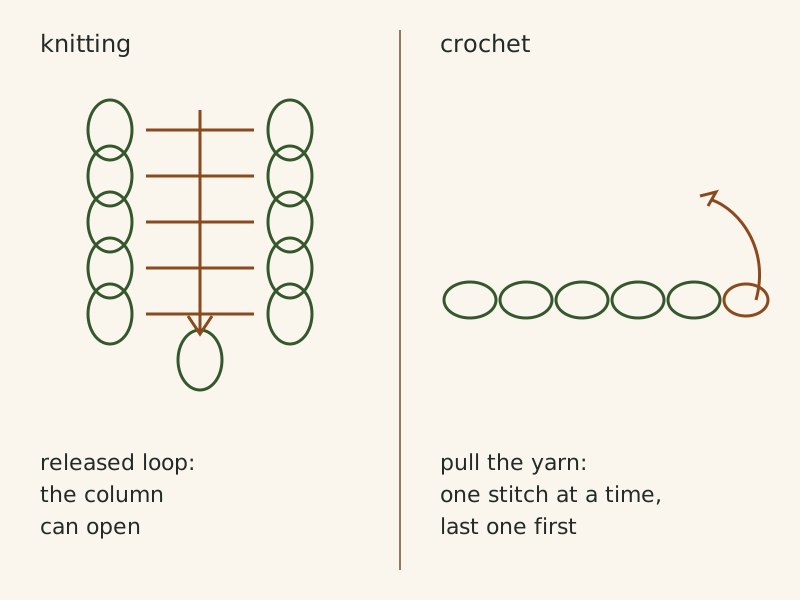
What a released loop can undo, read from the structure: in knitting, the column of loops below can open; in crochet, pulling the yarn opens the last stitch first, one stitch at a time.
Check level Schematic of loop structure, after de Dillmont's description; the release is this page's reading of the structure, not a test; not to scale.
"A released live loop in knitting and in crochet" by Fold, Knot & Bind — https://foldknotbind.com/knit-and-stitch/crochet-vs-knitting/ — licensed under CC BY 4.0: https://creativecommons.org/licenses/by/4.0/
A live loop is the weak point in both crafts, because nothing passes through it yet. In knitting, each loop in a column is held by the loop drawn through it from the row above. Read from that structure, a loop that slips off the needle has no holder, and the loop below it is next. By the same reading, a whole column can open down to the cast-on row.
De Dillmont's knitting chapter guards against this: stitches are cast off, she writes, “to prevent the stitches from unravelling,” passing each loop over the next “so that only one remains on the needle.” Her fig. 387, a knitting pattern with dropped stitches, even drops loops on purpose: its rows say to “drop the 2 overs,” the extra wraps of yarn, and later to “take up the dropped stitch.”
Standard crochet has only one live loop to lose. By its structure, pulling the free yarn would unravel the work only one stitch at a time, last stitch first, because each earlier stitch was closed before the next began. This page could not read a source that tests this, so it stays an inference, one that fits de Dillmont's way to finish crochet: “cut the thread and draw the end through the last loop.”
Crochet or knitting: which for what?
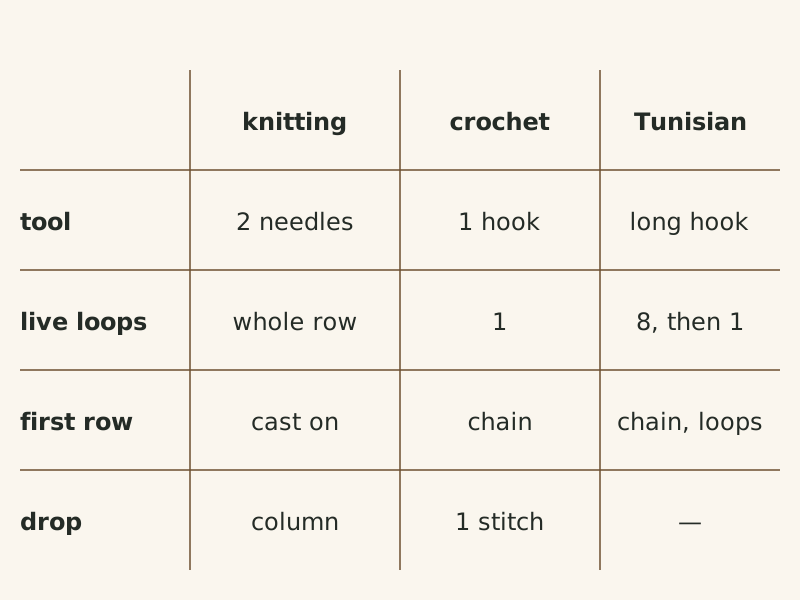
The comparison table below as a grid: the tool, the live loops between stitches, the first row and what a dropped loop can undo, by this page's inference.
Check level Each row taken from this page's CSV; sources in the table.
"Knitting, crochet and Tunisian crochet compared" by Fold, Knot & Bind — https://foldknotbind.com/knit-and-stitch/crochet-vs-knitting/ — licensed under CC BY 4.0: https://creativecommons.org/licenses/by/4.0/
De Dillmont gives each craft its own uses. Knitted loops, “connected together in unbroken continuity,” make “a very elastic fabric,” which she calls “specially suitable for making warm, and closely-fitting wearing-apparel.” Crochet “can be applied to the domestic requirements of every-day life, to wearing apparel, house-linen and upholstery.” Among her Tunisian crochet patterns is a counterpane, fig. 476.
| Property | Knitting | Standard crochet | Tunisian crochet |
|---|---|---|---|
| Tool | Two needles | One hook | Long straight hook with a knob |
| Live loops between stitches, row of 8 | 8 | 1 | 8 after the loop row, 1 at the end of the second row |
| Most loops during one stitch | 9: the row plus the new loop | 3 in a treble, 2 in a plain stitch | 8 |
| First row | Cast on | Chain stitches | Foundation chain, then a loop row |
| Sides worked | Not compared | To and fro, or all from one end | Right side only |
| Finishing | Cast off, one stitch left on the needle | Thread drawn through the last loop | Not compared |
| A released live loop (this page's inference) | The column below can open | One stitch at a time, last first | Not compared |
Download the comparison table (CSV) (what the file holds)
Speed and difficulty are left out, because this page could not read a source that compares the two crafts on either. Thread can also hold a pattern with no loops at all: sashiko hitomezashi builds its grid from running stitches set one at a time.
Sources
- Thérèse de Dillmont, Encyclopedia of Needlework, English edition (Dornach, Alsace: Th. de Dillmont, undated), Project Gutenberg eBook 20776. gutenberg.pglaf.org/cache/epub/20776/Read: full text of the Knitting chapter's opening sections (through fig. 387 and casting off), the Crochet Work chapter's opening sections and Tunisian crochet section, and the Macramé chapter's opening through fig. 531, with fig. 548 (Macramé fringe) and its caption; the eBook has no page numbers
Cite this page
“Crochet vs Knitting: Knitting Holds a Whole Row of Loops.” Fold, Knot & Bind. Published Nov. 15, 2026. https://foldknotbind.com/knit-and-stitch/crochet-vs-knitting/. Accessed on the date you read it.
How diagrams and claims are checked All corrections Report an error on this page (contact@foldknotbind.com)
Next on the bench:
- Knit stitch vs purl: one knitted loop, seen from the front and from the back.
- Coptic binding: a book whose sections are joined by chain-stitched thread across the spine.
More in Knit, Stitch & Loop
Knit, Stitch & Loop
Sashiko: Hitomezashi Grids Always Split Into Two Colors
Picture credit
"Sashiko jacket, Japan, second half of the 19th century (Metropolitan Museum of Art 67.172.1)" by Unknown author — https://commons.wikimedia.org/wiki/File:%E6%97%A5%E6%9C%AC%E3%81%A8%E7%B1%B3%E5%9B%BD%E3%81%AE%E5%9B%BD%E6%97%97%E3%82%92%E7%BA%8F%E3%81%A3%E3%81%9F%E6%97%A5%E6%9C%AC%E5%A5%B3%E6%80%A7-Sashiko_Jacket_MET_DP330768.jpg — CC0 1.0 (https://creativecommons.org/publicdomain/zero/1.0/); modified: metadata stripped (embedded staff names and camera data removed; image unchanged)
Knit, Stitch & Loop
Knit Stitch vs Purl: One Loop, Seen From Opposite Sides
Picture credit
"Old woman knitting (Interieur paisible), pen drawing, Rijksmuseum SK-A-3621" by Alexander Hugo Bakker Korff — https://commons.wikimedia.org/wiki/File:Breiende_oude_dame_Interieur_paisible_(titel_op_object),_SK-A-3621.jpg — CC0 1.0 (https://creativecommons.org/publicdomain/zero/1.0/)
Knit, Stitch & Loop
Kumihimo: How Symmetry Limits Kongō Gumi’s Color Patterns
Picture credit
"Sageo cord for a tachi, made of kumihimo, with Tokugawa family crests (Tokyo National Museum I-1406)" by ColBase: Integrated Collections Database of the National Institutes for Cultural Heritage, Japan — https://commons.wikimedia.org/wiki/File:Sageo_cord_for_tachi_made_of_kumihimo,_%E7%B5%84%E7%B4%90%E3%81%A7%E4%BD%9C%E3%82%89%E3%82%8C%E3%81%9F%E4%B8%8B%E7%B7%92_(%E7%B6%9A%E5%B9%B3%E7%B7%92).jpg — CC BY 4.0 (https://creativecommons.org/licenses/by/4.0/); modified: metadata stripped (camera data removed; image unchanged)