Sashiko: Hitomezashi Grids Always Split Into Two Colors
Fold, Knot & Bind Published
In brief
Hitomezashi, a sashiko stitch pattern, always splits its grid into regions that two colors can fill. No two touching regions share a color, and the fill is unique up to swapping the two colors, as a 2022 mathematics paper states and the calculation on this page checks.
Materials: Cloth marked with a square grid, and one thread worked in straight running stitch. No curves, and no stitch crosses another.
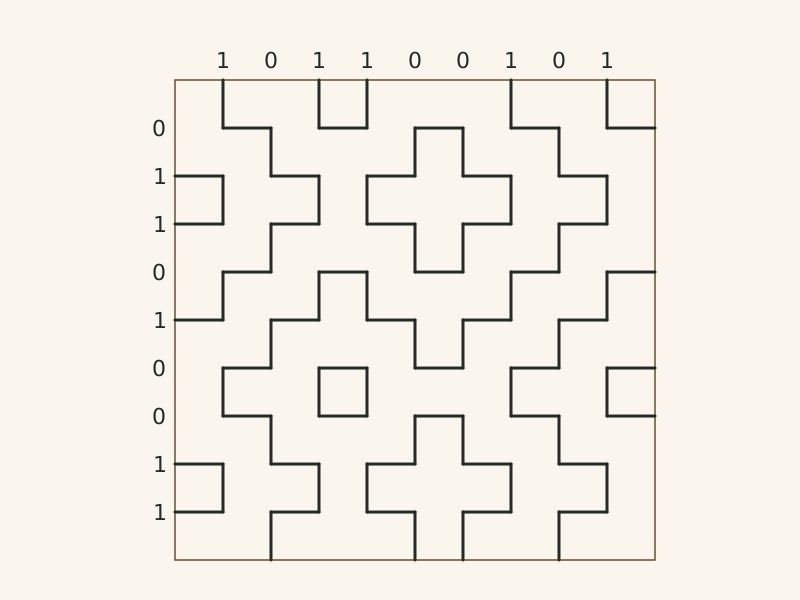
"Hitomezashi grid: stitches" by Fold, Knot & Bind — https://foldknotbind.com/knit-and-stitch/sashiko-hitomezashi/ — licensed under CC BY 4.0: https://creativecommons.org/licenses/by/4.0/
Data: Computed by Fold, Knot & Bind (hitomezashi-grid 1.0.1), 2026-11-15
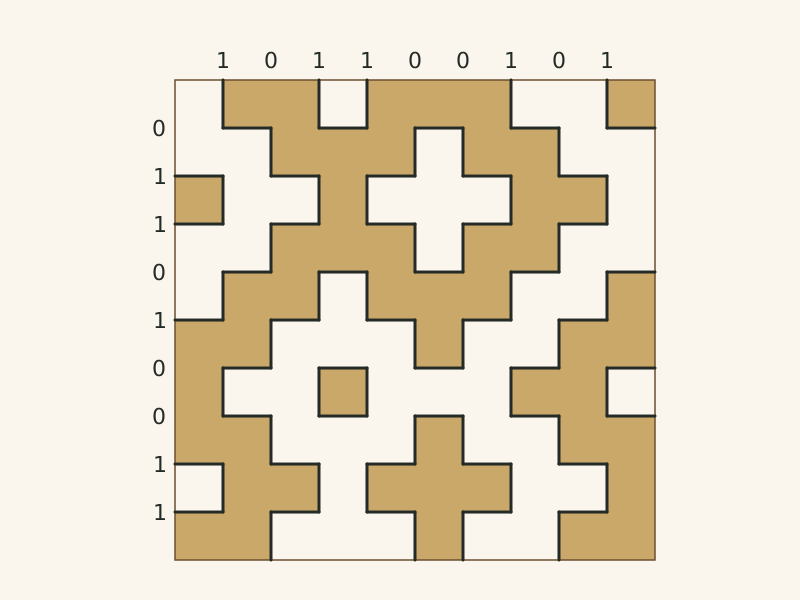
"Hitomezashi grid: two-coloring" by Fold, Knot & Bind — https://foldknotbind.com/knit-and-stitch/sashiko-hitomezashi/ — licensed under CC BY 4.0: https://creativecommons.org/licenses/by/4.0/
Data: Computed by Fold, Knot & Bind (hitomezashi-grid 1.0.1), 2026-11-15
The same on-or-off choices drawn twice: first as stitches alone, then with the regions filled in two colors. A 1 starts a grid line with a stitch, and a 0 starts it with a gap.
Check level Two-coloring computed for this grid.
Choose on or off for every row and column, and the stitches decide the rest. In hitomezashi, each line of the grid carries a row of running stitch, and the only choice is whether that row begins with a stitch or with a gap. After that, stitch and gap take turns to the far edge. The opening grid comes from 18 such choices, nine for the column lines and nine for the row lines.
What is hitomezashi?
Sashiko is Japanese embroidery worked in running stitch, a line of short stitches where the thread passes over the cloth and then under it. According to a 2022 paper by the mathematicians Colin Defant and Noah Kravitz, the word sashiko translates as little stabs, for the stitches pushed through the cloth. They describe hitomezashi, a name they translate as one-stitch, as one type of sashiko that builds geometric patterns on a grid from a few simple rules.
In the hitomezashi patterns that paper studies, and on this page, every stitch is one square long and lies on a grid line. Where the front of the cloth shows a gap, the thread is passing underneath. Because every stitch runs straight along the grid, these patterns have no way to draw a curve or a slanting line.
Curves are the plainest sign that a sashiko pattern follows some other rule. The museum data on the image page dates the jacket below to the second half of the 19th century. The same data describes it as indigo-dyed cotton, quilted and embroidered with white cotton thread. Its stitches trace circles, arcs and diamond lattices, so many of its patterns could not come from this grid rule.
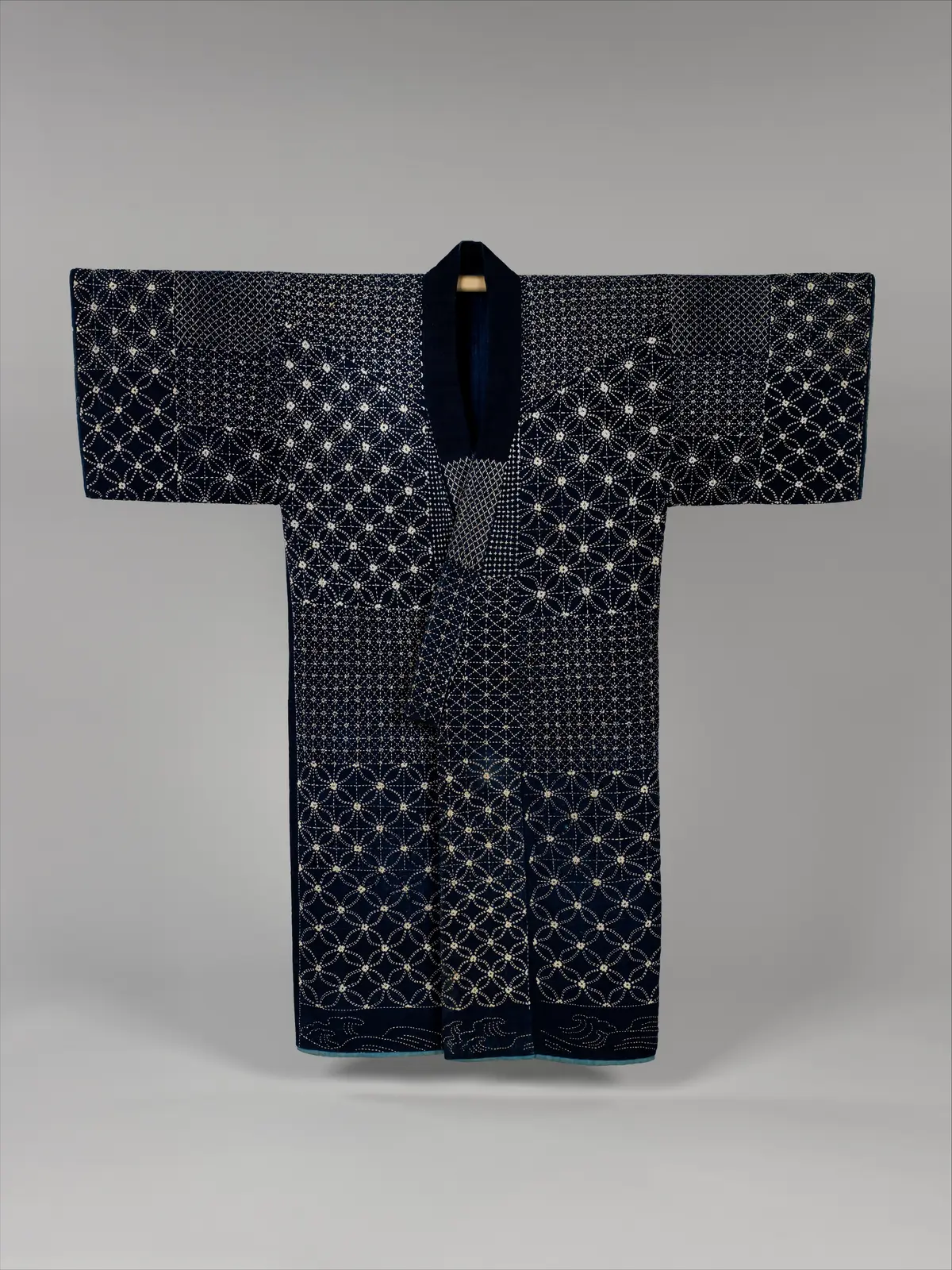
A sashiko jacket from Japan, second half of the 19th century: indigo cotton quilted and stitched in white thread with circles, lattices and waves near the hem.
"Sashiko jacket, Japan, second half of the 19th century (Metropolitan Museum of Art 67.172.1)" by Unknown author — https://commons.wikimedia.org/wiki/File:%E6%97%A5%E6%9C%AC%E3%81%A8%E7%B1%B3%E5%9B%BD%E3%81%AE%E5%9B%BD%E6%97%97%E3%82%92%E7%BA%8F%E3%81%A3%E3%81%9F%E6%97%A5%E6%9C%AC%E5%A5%B3%E6%80%A7-Sashiko_Jacket_MET_DP330768.jpg — CC0 1.0 (https://creativecommons.org/publicdomain/zero/1.0/); modified: metadata stripped (embedded staff names and camera data removed; image unchanged)
One choice per row and column
The rule fits in one line. Every grid line inside the frame gets a 1 or a 0. A line marked 1 starts with a stitch, a line marked 0 starts with a gap, and from there stitch and gap alternate to the far edge.
The figure below builds a 6-by-6 grid in three passes. Pass one stitches the five column lines and pass two the five row lines. Pass three lays both sets together. Ten choices make the whole pattern, so a grid this size has 1,024 possible patterns, two multiplied by itself ten times.
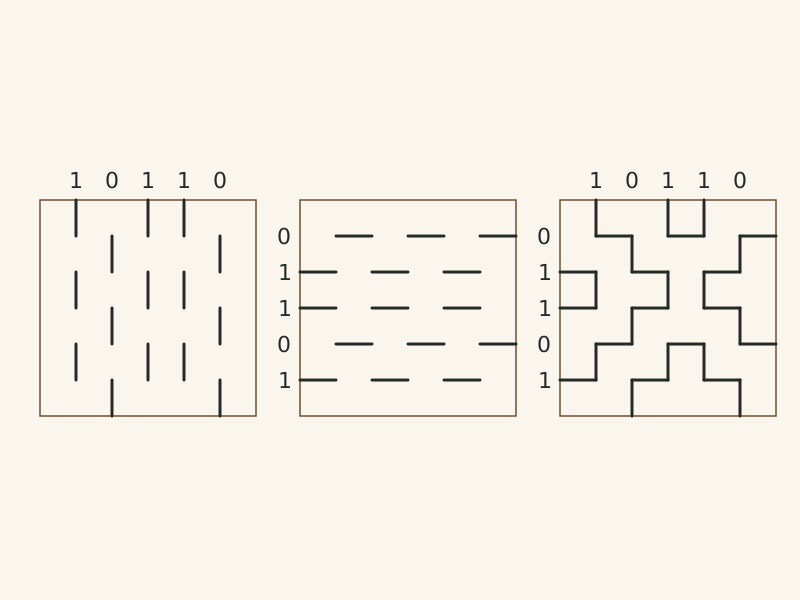
One grid built in three passes: first the column lines alone, then the row lines alone, then both together. Each number is the choice for the grid line beside it.
Check level Two-coloring computed for this grid.
"Hitomezashi rule: column lines, row lines, both" by Fold, Knot & Bind — https://foldknotbind.com/knit-and-stitch/sashiko-hitomezashi/ — licensed under CC BY 4.0: https://creativecommons.org/licenses/by/4.0/
Data: Computed by Fold, Knot & Bind (hitomezashi-grid 1.0.1), 2026-11-15
Two stitches meet at each grid point inside the frame, one from its row line and one from its column line. Each line has a stitch on exactly one side of the point, so the two stitches always meet at a corner and never form a cross. The back of the cloth carries the other half of every line: each gap on the front is a stitch on the back. So the back shows the grid in mirror image, with every 1 and 0 swapped, much as knit and purl stitches are one loop seen from two sides.
Why two colors always fill it
Count the stitches that touch any grid point inside the frame, and the answer is always 2. The figure below marks every inner point of a 4-by-4 grid with its count. A small circle drawn around one point crosses those two stitches, so it changes color twice and ends on the color it started with.
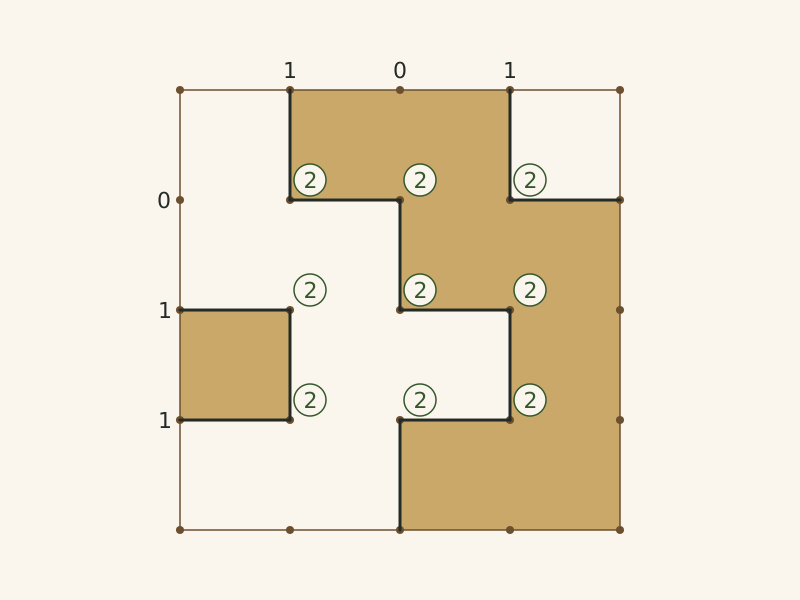
A 4-by-4 grid with its regions filled in two colors. The number beside each inner grid point counts the stitches that touch it, and every count is 2.
Check level Two-coloring computed for this grid.
"Stitch count at each grid point of a hitomezashi grid" by Fold, Knot & Bind — https://foldknotbind.com/knit-and-stitch/sashiko-hitomezashi/ — licensed under CC BY 4.0: https://creativecommons.org/licenses/by/4.0/
Data: Computed by Fold, Knot & Bind (hitomezashi-grid 1.0.1), 2026-11-15
The even count makes a two-color fill possible. The fill starts by giving one corner square the light color. Every other square then takes its color from the number of stitches crossed on a path from that corner: an even number means light, and an odd number means dark. Because a loop around any point crosses an even number of stitches, two different paths to the same square give the same answer.
The fill is unique up to swapping the two colors. Once one square's color is set, the count fixes every other square, so the only other fill is the same picture with light and dark exchanged. Defant and Kravitz state this two-color property for hitomezashi patterns of any size, with the fill unique up to that swap.
Every grid, checked one at a time
The calculation on this page repeats the check one pattern at a time. It builds every possible set of on-or-off choices for grids 4, 6 and 8 squares on a side, 17,472 patterns in all, and looks for a two-color fill in each. Every pattern has one. Every fill is unique up to the swap.
For the 64 patterns of the 4-by-4 grid, a slower count tries all 65,536 ways to color the 16 squares and finds exactly two good fills each time. How the site checks pattern diagrams is set out on which layer was checked.
| Grid | Patterns checked | Two-color fill found | Fill unique up to swap |
|---|---|---|---|
| 4 by 4 | 64 | 64 | 64 |
| 6 by 6 | 1,024 | 1,024 | 1,024 |
| 8 by 8 | 16,384 | 16,384 | 16,384 |
Download the grid check results (CSV) (what the file holds) Data: Computed by Fold, Knot & Bind (hitomezashi-grid 1.0.1), 2026-11-15
This page leaves out the third hand, the site's name for whatever keeps a part in place after it is let go. The two-color rule is about where the stitches lie on the surface, not about what holds the cloth together.
Change one starting stitch, change the pattern
Flip a single choice, and the stitches change along one line only. In the figure below, the fifth column line of the opening grid switches from 0 to 1. Every stitch on that line shifts one square along it, and no stitch anywhere else moves.
The colors respond across the whole grid. With the top-left square kept the same color, all 50 squares to the right of that line trade colors, and none to the left do. The count of regions goes from 12 to 13, and the count of closed loops, stitch paths that return to their start without touching the frame, goes from 2 to 3.
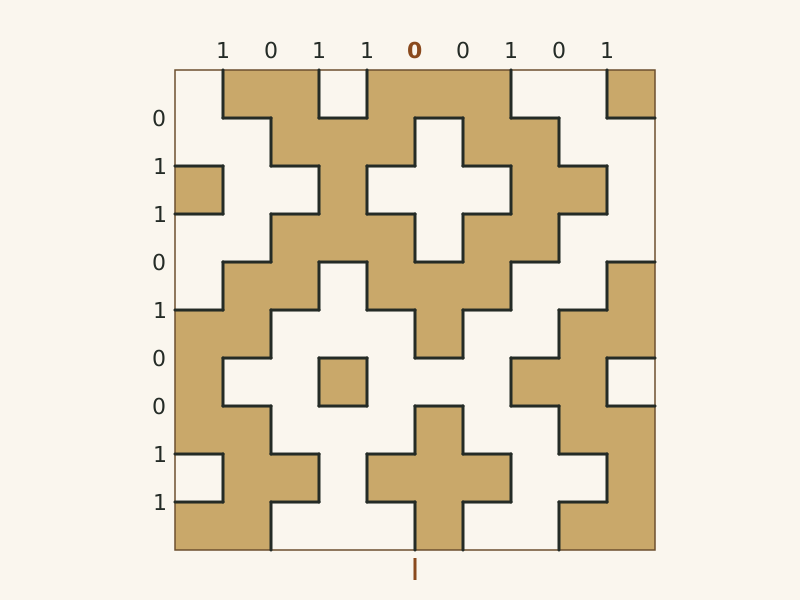
"Hitomezashi grid before one changed choice" by Fold, Knot & Bind — https://foldknotbind.com/knit-and-stitch/sashiko-hitomezashi/ — licensed under CC BY 4.0: https://creativecommons.org/licenses/by/4.0/
Data: Computed by Fold, Knot & Bind (hitomezashi-grid 1.0.1), 2026-11-15
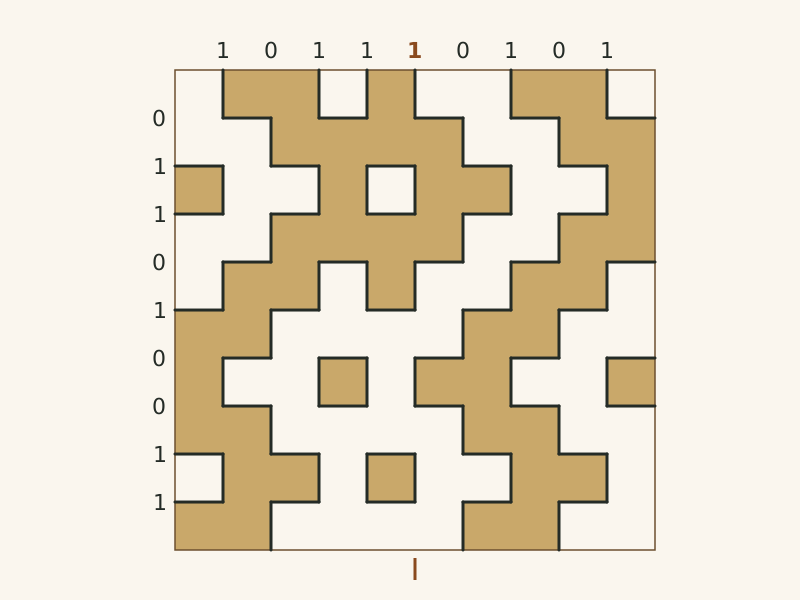
"Hitomezashi grid after one changed choice" by Fold, Knot & Bind — https://foldknotbind.com/knit-and-stitch/sashiko-hitomezashi/ — licensed under CC BY 4.0: https://creativecommons.org/licenses/by/4.0/
Data: Computed by Fold, Knot & Bind (hitomezashi-grid 1.0.1), 2026-11-15
The opening grid before and after one change: the fifth column line, marked in rust, switches from 0 to 1. Every square beyond that line trades colors.
Check level Two-coloring computed for this grid.
| Grid on this page | Column choices | Row choices | Regions | Closed loops |
|---|---|---|---|---|
| Opening grid, 10 by 10 | 101100101 | 011010011 | 12 | 2 |
| Rule figure, 6 by 6 | 10110 | 01101 | 6 | 0 |
| Grid-point figure, 4 by 4 | 101 | 011 | 4 | 0 |
| Opening grid after the change | 101110101 | 011010011 | 13 | 3 |
Download the grids on this page (CSV) (what the file holds) Data: Computed by Fold, Knot & Bind (hitomezashi-grid 1.0.1), 2026-11-15
Closed loops follow rules of their own. Defant and Kravitz prove that every hitomezashi loop is 4 stitches longer than a multiple of 8, and that the area it encloses is 1 square more than a multiple of 4. The smallest loop, four stitches around a single square, fits both rules, and so do all 38,176 closed loops in the 16,384 patterns of the 8-by-8 check above. Celtic knot patterns are another design drawn by on-or-off rules on a grid.
How it fails: one stitch out of step
The two-color rule depends on every line keeping its rhythm. With one extra stitch where the rule leaves a gap, two grid points end up touching 3 stitches each. A small circle around either point crosses 3 stitches, an odd number, so the colors cannot come back around to where they began.
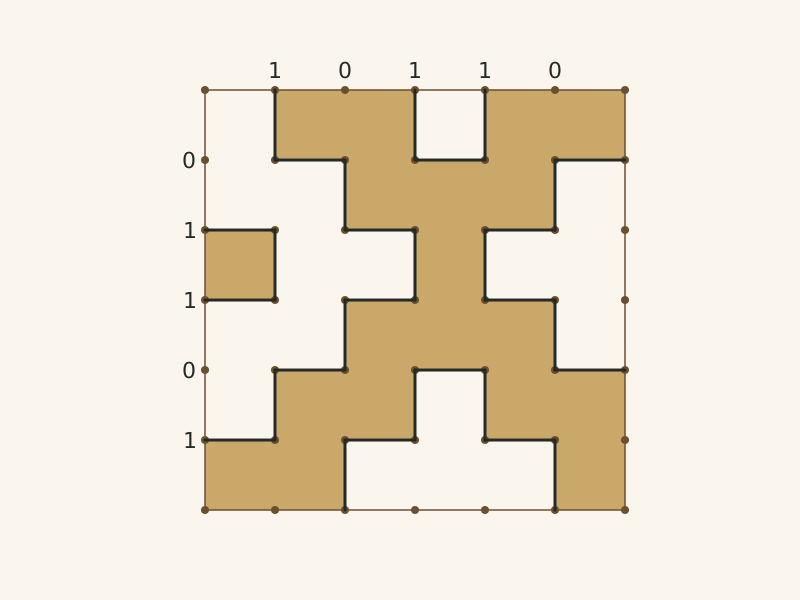
"Hitomezashi grid with every line in step" by Fold, Knot & Bind — https://foldknotbind.com/knit-and-stitch/sashiko-hitomezashi/ — licensed under CC BY 4.0: https://creativecommons.org/licenses/by/4.0/
Data: Computed by Fold, Knot & Bind (hitomezashi-grid 1.0.1), 2026-11-15
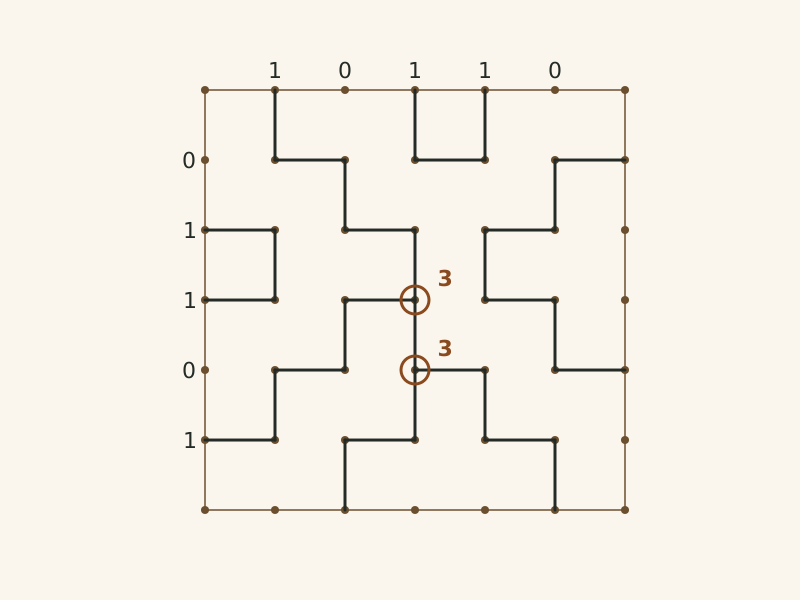
"Hitomezashi grid with one stitch out of step" by Fold, Knot & Bind — https://foldknotbind.com/knit-and-stitch/sashiko-hitomezashi/ — licensed under CC BY 4.0: https://creativecommons.org/licenses/by/4.0/
Data: Computed by Fold, Knot & Bind (hitomezashi-grid 1.0.1), 2026-11-15
The 6-by-6 grid from the rule figure, first as drawn and then with one extra stitch on the third column line. The two circled points each touch 3 stitches, and the second grid has no two-color fill.
Check level Two-coloring computed for this grid; the second grid fails at the two circled points.
The failure is not local. Counting from the corner square now gives two different answers for some squares, so no two-color fill exists for the second grid at all. The first grid, the same pattern before the extra stitch, fills cleanly.
Where sashiko comes from
According to Defant and Kravitz, sashiko took shape in Japan in the Edo period (1603–1867), as stitching that was both practical and decorative. Their paper gives that history as background and cites no source for it. This page could not read a first-hand record of where hitomezashi patterns began, so their origin is unrecorded here.
The jacket below shows sashiko on a working garment. Its image page describes it as a 19th-century Japanese firefighter's jacket, a hikeshi hanten, made of cotton with a painted design and sashiko running stitch. The museum's own record was not consulted. Close rows of running stitch cover the cloth, which also shows painted clouds, a dragon and waves.
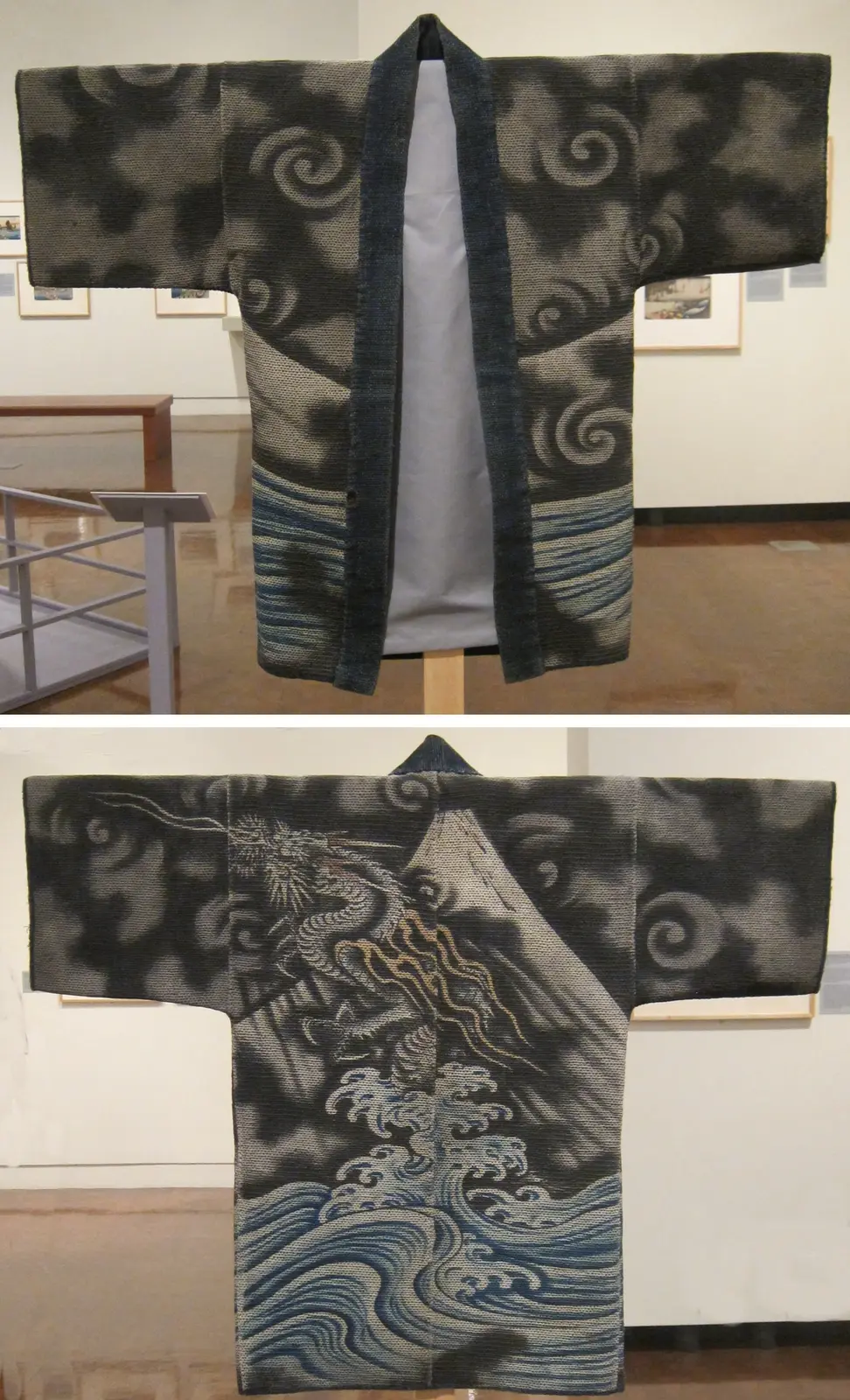
A Japanese firefighter's jacket (hikeshi hanten), 19th century, front and back, in the Honolulu Museum of Art: close rows of running stitch cover the painted cotton.
"Hikeshi hanten (firefighter's jacket), Japan, 19th century, Honolulu Museum of Art" by Unknown author — https://commons.wikimedia.org/wiki/File:Hikeshi_hanten_(fireman%27s_jacket),_19th_century,_Honolulu_Museum_of_Art.jpg — CC0 1.0 (https://creativecommons.org/publicdomain/zero/1.0/)
Sources
- Colin Defant and Noah Kravitz, "Loops and Regions in Hitomezashi Patterns," arXiv:2201.03461, version 2 (2022). arxiv.org/abs/2201.03461Read: full text (version 2); paraphrased
Cite this page
“Sashiko: Hitomezashi Grids Always Split Into Two Colors.” Fold, Knot & Bind. Published Nov. 15, 2026. https://foldknotbind.com/knit-and-stitch/sashiko-hitomezashi/. Accessed on the date you read it.
How diagrams and claims are checked All corrections Report an error on this page (contact@foldknotbind.com)
Next on the bench:
- Crochet vs knitting: another thread structure that grows one stitch at a time.
- Kumihimo: another thread craft where counting predicts the pattern.
More in Knit, Stitch & Loop
Knit, Stitch & Loop
Knit Stitch vs Purl: One Loop, Seen From Opposite Sides
Picture credit
"Old woman knitting (Interieur paisible), pen drawing, Rijksmuseum SK-A-3621" by Alexander Hugo Bakker Korff — https://commons.wikimedia.org/wiki/File:Breiende_oude_dame_Interieur_paisible_(titel_op_object),_SK-A-3621.jpg — CC0 1.0 (https://creativecommons.org/publicdomain/zero/1.0/)
Knit, Stitch & Loop
Crochet vs Knitting: Knitting Holds a Whole Row of Loops
Picture credit
"Lydia Crocheting in the Garden at Marly (Metropolitan Museum of Art 65.184)" by Mary Cassatt — https://commons.wikimedia.org/wiki/File:Lydia_Crocheting_in_the_Garden_at_Marly_MET_DP165250.jpg — CC0 1.0 (https://creativecommons.org/publicdomain/zero/1.0/); modified: cropped (black border, color bar and copyright line removed), resized to 1600 px wide
Knit, Stitch & Loop
Kumihimo: How Symmetry Limits Kongō Gumi’s Color Patterns
Picture credit
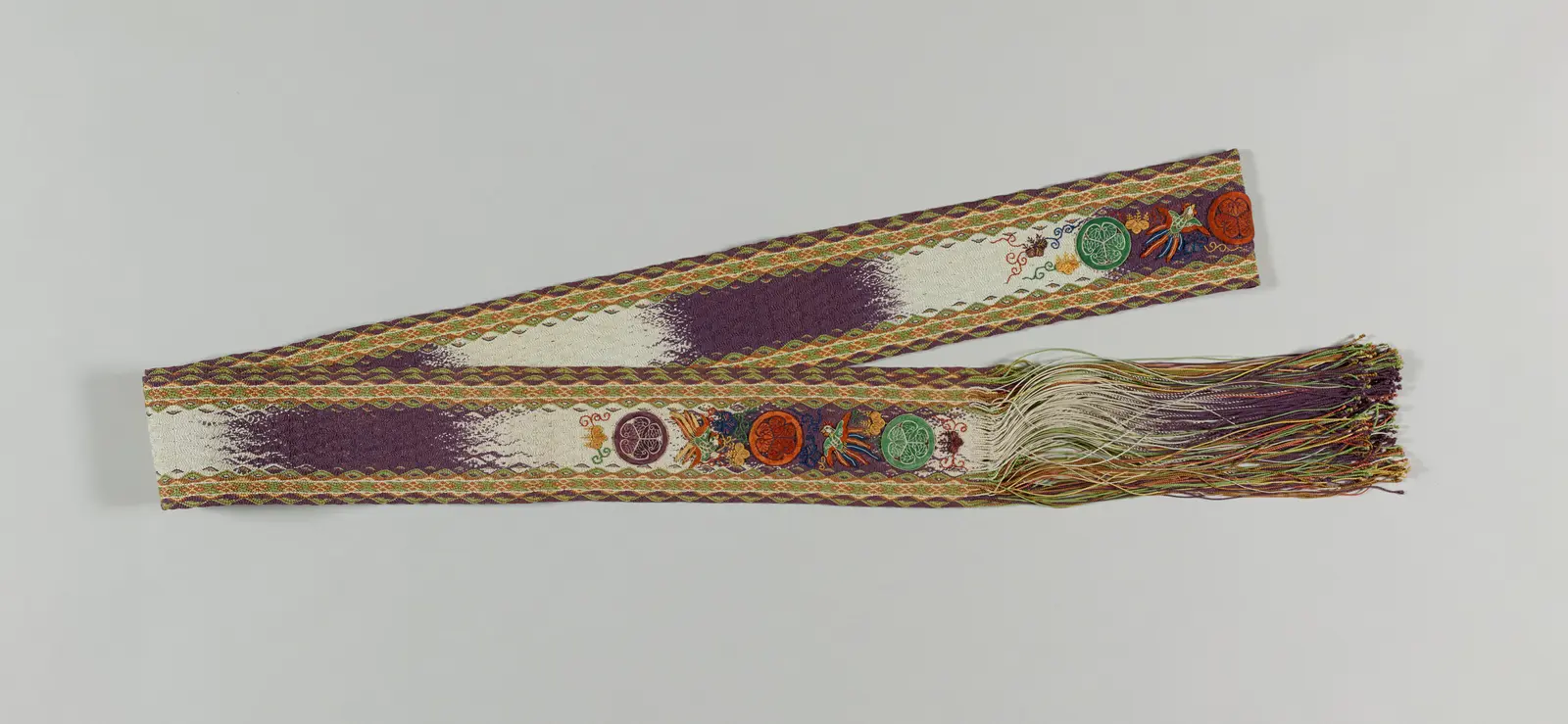
"Sageo cord for a tachi, made of kumihimo, with Tokugawa family crests (Tokyo National Museum I-1406)" by ColBase: Integrated Collections Database of the National Institutes for Cultural Heritage, Japan — https://commons.wikimedia.org/wiki/File:Sageo_cord_for_tachi_made_of_kumihimo,_%E7%B5%84%E7%B4%90%E3%81%A7%E4%BD%9C%E3%82%89%E3%82%8C%E3%81%9F%E4%B8%8B%E7%B7%92_(%E7%B6%9A%E5%B9%B3%E7%B7%92).jpg — CC BY 4.0 (https://creativecommons.org/licenses/by/4.0/); modified: metadata stripped (camera data removed; image unchanged)