Celtic Knot Patterns: Some Are One Cord, Some Are Several
Fold, Knot & Bind Published
In brief
A Celtic knot pattern can be one closed cord or several, depending on where its plait is broken. J. Romilly Allen’s 1904 book on Celtic art describes making knotwork by cutting crossings of a plain plait and rejoining the ends, and the calculation on this page counts the cords that result.
Materials: A rectangle, a grid of diagonal lines, and one plait drawn over it. No loose ends, nothing added.
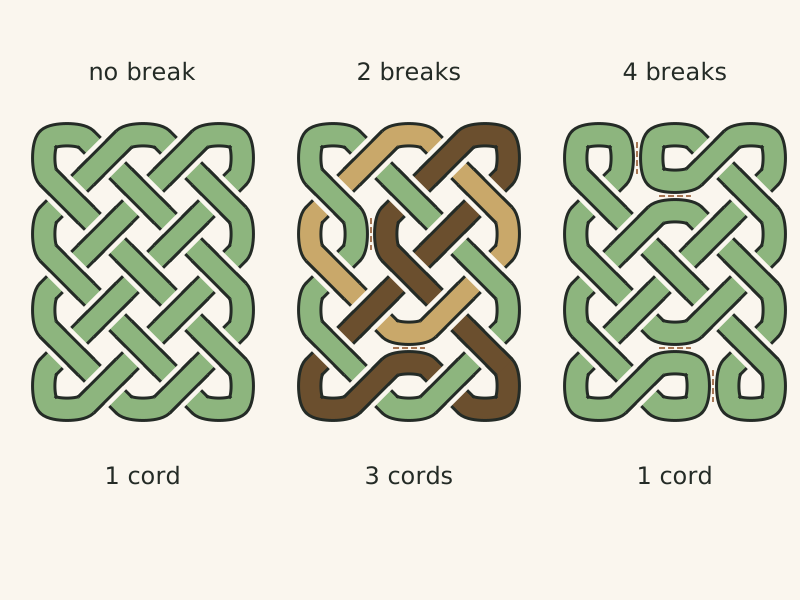
The same grid three times: a plain plait, then the plait with two breaks, then with four. The count below each panel is the number of separate closed cords, each cord in its own color, and the short dashed marks show where the plait was broken.
Check level Cord count and over-under alternation computed for this grid.
"Plait, plait with two breaks, knotwork: cord counts" by Fold, Knot & Bind — https://foldknotbind.com/knots/celtic-knot/ — licensed under CC BY 4.0: https://creativecommons.org/licenses/by/4.0/
Data: Computed by Fold, Knot & Bind (celtic-plait 1.0.1), 2026-11-15
Trace one cord through a Celtic knot with your finger and see where you come back. In the first panel above, one band runs through the whole plait before it meets its own start. In the second, the finger comes home early and leaves two more cords untouched. The grid is the same; only the breaks have moved.
What is a Celtic knot?
A Celtic knot is a band, or several bands, passing over and under each other inside a panel. The plait is the plain version: bands cross on a diagonal grid and turn back only at the edges. In Celtic Art in Pagan and Christian Times (1904), Allen sorts this interlaced work into six classes, from regular plaitwork without breaks, through broken plaitwork and three kinds of knotwork, to ringwork.
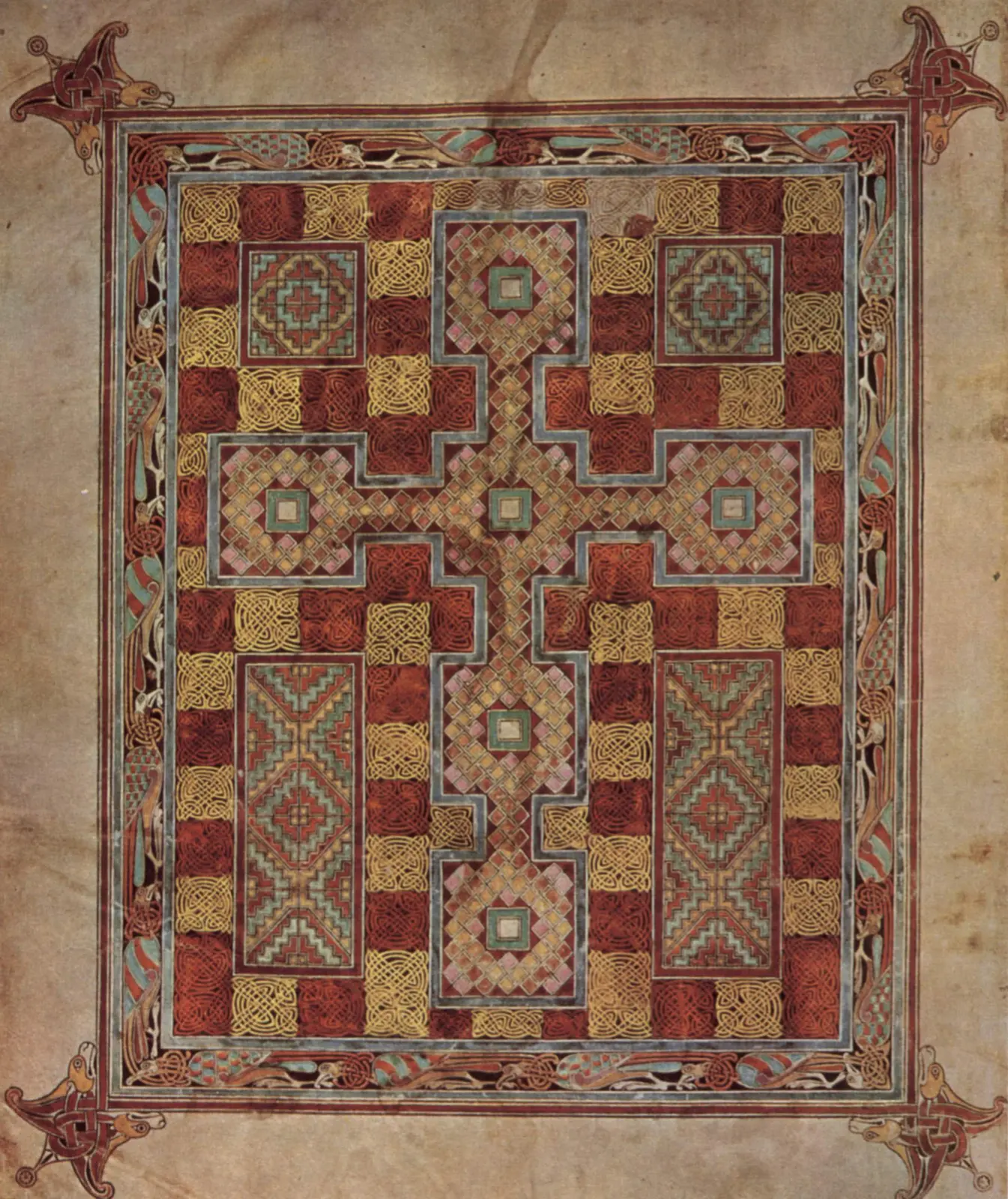
A carpet page from the Lindisfarne Gospels: a cross set on a ground of interlaced panels, inside a border of interlaced creatures.
"Carpet page, from the Lindisfarne Gospels" (late 7th or early 8th century), Unknown author — https://commons.wikimedia.org/wiki/File:Meister_des_Book_of_Lindisfarne_002.jpg — Public domain in US: medieval manuscript page, public domain; faithful photographic reproduction of a two-dimensional work (PD-Art). EU: maker died more than 1,000 years ago; faithful reproduction of a public-domain visual work (EU Directive 2019/790, Art. 14)
Interlace fills the panels around the cross on the carpet page. This page makes no count of the cords in that manuscript; the counts here come only from grids drawn and checked for this page.
How a plait becomes a knot: Allen’s breaks
Allen (1904) calls the trick a break. On his page 259, two cords are cut where they cross, which leaves four loose ends, A, B, C and D. The ends are then joined in pairs, and “This can be done in two ways only.”
- Join A to C and D to B: a vertical break, in Allen’s 1904 terms.
- Join A to D and C to B: a horizontal break, in Allen’s 1904 terms.
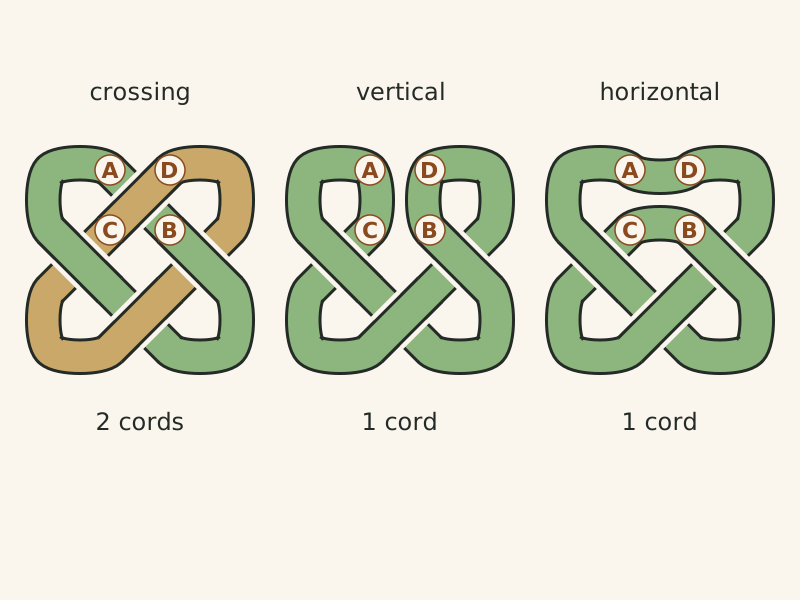
One crossing on a small plait, with its four ends lettered as in Allen’s 1904 description, then joined as a vertical break and as a horizontal break. The plain plait is 2 cords; either break makes it 1.
Check level Cord count and over-under alternation computed for this grid.
"One crossing and its two breaks" by Fold, Knot & Bind — https://foldknotbind.com/knots/celtic-knot/ — licensed under CC BY 4.0: https://creativecommons.org/licenses/by/4.0/
Data: Computed by Fold, Knot & Bind (celtic-plait 1.0.1), 2026-11-15
A break runs two of the open spaces between the cords into one, which Allen says entirely changes how the plait looks. Repeat it, he writes on page 260 of the 1904 book, and “all the knots most commonly used in Celtic decorative art may be derived from a simple plait.”
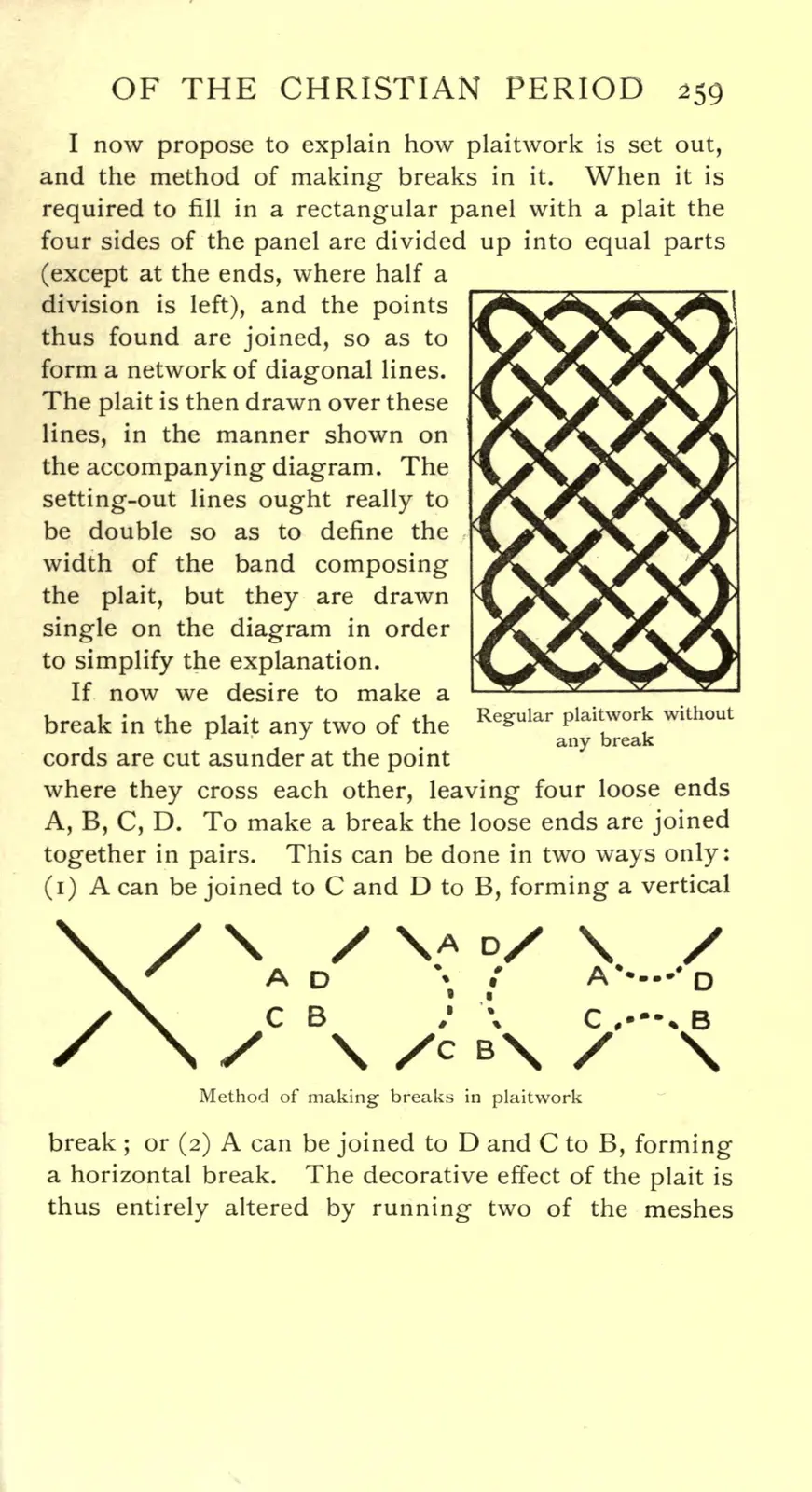
Page 259 of Allen’s Celtic Art in Pagan and Christian Times (1904): a regular plait without any break, and his diagram of the method of making breaks.
"Plaitwork and the method of making breaks, from Celtic Art in Pagan and Christian Times" (1904), J. Romilly Allen — https://archive.org/details/celticartpagan00alleiala/page/n346 — Public domain in US: first published 1904 (London: Methuen); EU: author J. Romilly Allen d. 1907
How do you draw one?
Allen’s setting-out comes before any break, and it is the same for every plait. His steps, from page 259 of the 1904 book:
- Divide the four sides of the rectangle into equal parts, but leave half a part at each end.
- Join the points to make a network of diagonal lines.
- Draw the plait over these lines.
- Choose crossings to break, and join each set of four ends in one of the two ways.
Allen (1904) notes that the setting-out lines should really be double, to mark the width of each band. He draws them single to keep the diagram simple, and the figure below does the same.
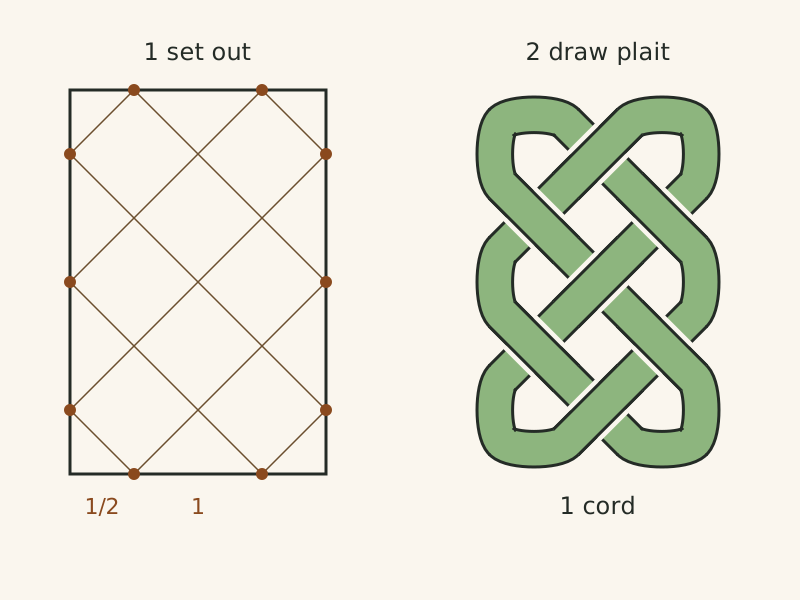
Allen’s 1904 setting-out on a small rectangle: points along the sides, a half part at each end, joined by diagonal lines. The plait drawn over the same lines makes 1 cord.
Check level Cord count and over-under alternation computed for this grid.
"Setting out a plait on a diagonal grid" by Fold, Knot & Bind — https://foldknotbind.com/knots/celtic-knot/ — licensed under CC BY 4.0: https://creativecommons.org/licenses/by/4.0/
Data: Computed by Fold, Knot & Bind (celtic-plait 1.0.1), 2026-11-15
Allen adds a rule of taste in a note on page 260 of the 1904 book: plaits of an odd number of cords are seldom used, he writes, because they give lopsided patterns.
One cord or several?
A break does one of two things to the cord count. If the two strands at a crossing belong to different cords, either break joins them into one. If both strands belong to the same cord, one way of joining splits it in two, and the other leaves it as one. The program on this page checked this rule at all 105 unbroken crossings in the panels drawn here, and it held at every one.
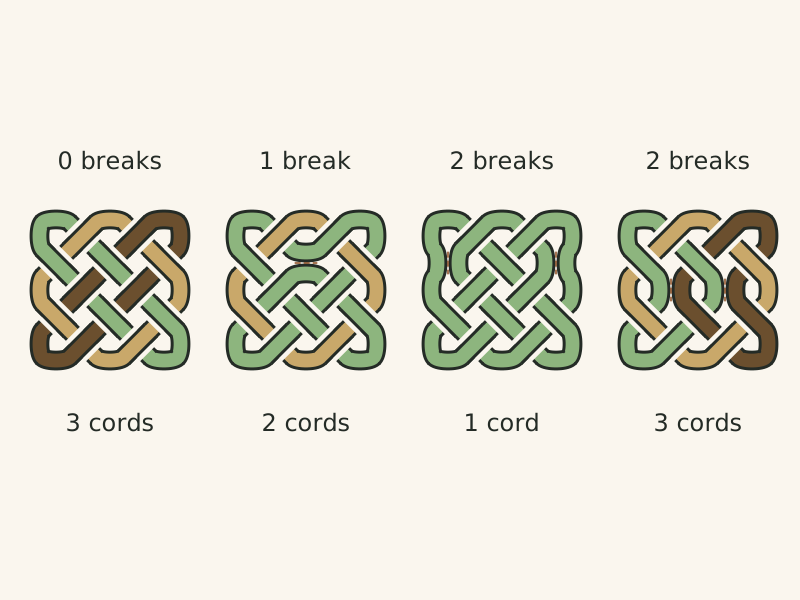
The same 3-by-3 grid broken four ways. Two breaks near the sides join everything into 1 cord; two breaks near the center leave 3.
Check level Cord count and over-under alternation computed for this grid.
"Cord counts for one grid broken four ways" by Fold, Knot & Bind — https://foldknotbind.com/knots/celtic-knot/ — licensed under CC BY 4.0: https://creativecommons.org/licenses/by/4.0/
Data: Computed by Fold, Knot & Bind (celtic-plait 1.0.1), 2026-11-15
| Panel | Breaks | Cords | Over-under alternates |
|---|---|---|---|
| 3-by-3, plain | 0 | 3 | yes |
| 3-by-3, one break | 1 | 2 | yes |
| 3-by-3, near the sides | 2 | 1 | yes |
| 3-by-3, near the center | 2 | 3 | yes |
Download the grids and cord counts (CSV) (what the file holds) Data: Computed by Fold, Knot & Bind (celtic-plait 1.0.1), 2026-11-15
The plain 3-by-3 plait has 12 crossings and 3 cords. Each of those crossings joins two different cords, so every one of its 24 single breaks leaves 2 cords. With two breaks, the count can land anywhere from 1 to 3: of the 264 ways, 192 leave 1 cord, 36 leave 2, and 36 leave 3, computed for this grid.
So the number of breaks does not decide the number of cords. Where the breaks sit, and which way each one joins, does.
This is why this site treats decorative knots as engineering, too. A knotwork panel has rules that can be checked, like any other structure here. A single closed cord through a whole panel is a design choice, and it has to be planned.
Over, then under, at every crossing
Follow any cord in the correctly drawn panels on this page and it goes over at one crossing and under at the next, all the way round. The plaits in Allen’s 1904 diagrams on pages 259 and 260 are drawn this way. The plain plait alternates because of its layout. The real test is whether a break spoils it.
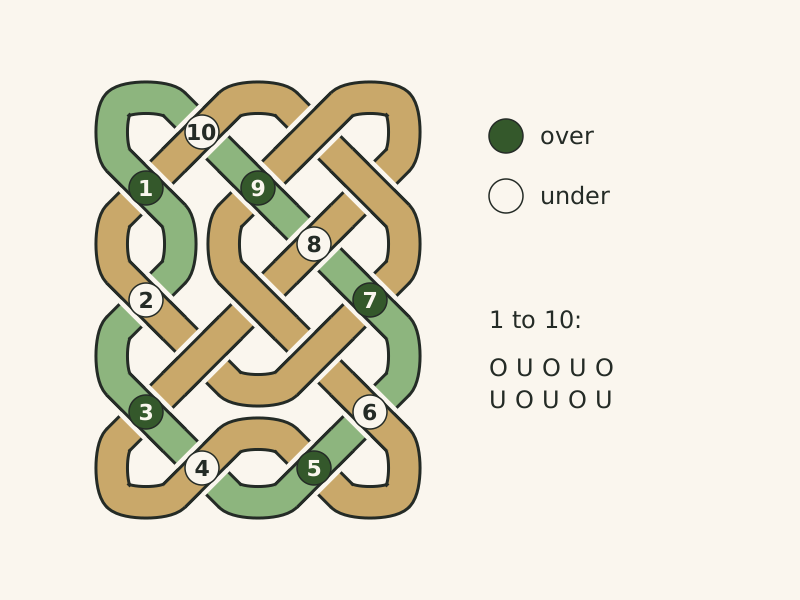
One green cord in a panel with two breaks, its 10 crossings numbered in order along the cord. Filled circles mark where it passes over and open circles where it passes under: over, under, over, under, all the way round.
Check level Cord count and over-under alternation computed for this grid.
"Over and under along one cord" by Fold, Knot & Bind — https://foldknotbind.com/knots/celtic-knot/ — licensed under CC BY 4.0: https://creativecommons.org/licenses/by/4.0/
Data: Computed by Fold, Knot & Bind (celtic-plait 1.0.1), 2026-11-15
A break does not spoil it. Each break turns a cord back, and the next crossing it meets is still the opposite of the last one. The program walked every cord in every correctly drawn panel on this page and found no two crossings in a row going the same way. It also tried all 264 two-break versions of the 3-by-3 plait, and every one still alternated.
Crossings carry the same weight in tied knots. In a square knot and a granny knot, which way the strands cross on the second throw decides which knot it is. In a kumihimo braid, the pattern comes down to counting strands as well.
How it fails: one crossing out of step
A drawn knot carries no load, so its failure is a failure of the drawing. If one crossing is drawn the wrong way round, the cord stops weaving there. On one pass it goes over three crossings in a row, and on the other pass it goes under three in a row.
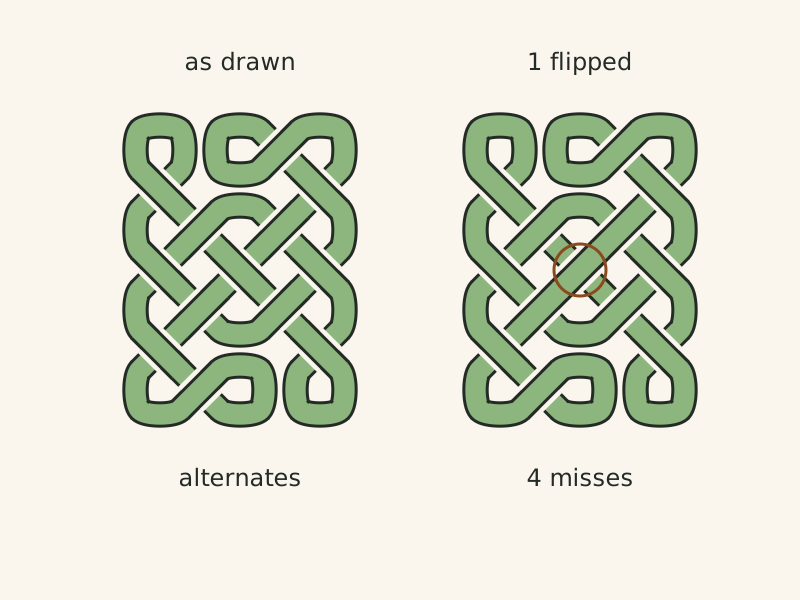
The four-break panel from the top of the page, as drawn and with over and under swapped at the circled crossing. That one swap leaves 4 places where two crossings in a row go the same way.
Check level Cord count and over-under alternation computed for this grid.
"One crossing flipped: alternation broken" by Fold, Knot & Bind — https://foldknotbind.com/knots/celtic-knot/ — licensed under CC BY 4.0: https://creativecommons.org/licenses/by/4.0/
Data: Computed by Fold, Knot & Bind (celtic-plait 1.0.1), 2026-11-15
The panel is a single cord, so it passes the circled point twice. Each pass leaves two pairs of crossings out of step, which makes 4 misses in all. The fix is to redraw that one crossing. Nothing else in the panel needs to change.
Are Celtic knots really Celtic?
In Allen’s 1904 account, the plain plait was not only Celtic. On page 257 he writes that in Egyptian, Greek and Roman decorative art the only interlaced work is the plait, with no change at all. The break was the new step. Who made that discovery, he wrote, is not known.
On page 258 of the 1904 book, Allen dates the break as nearly as he could. As far as he could tell, the Roman-period mosaic pavements of Great Britain have no break. He found none either in the plaitwork of San Clemente in Rome, which R. Cattaneo dated to AD 514 to 523.
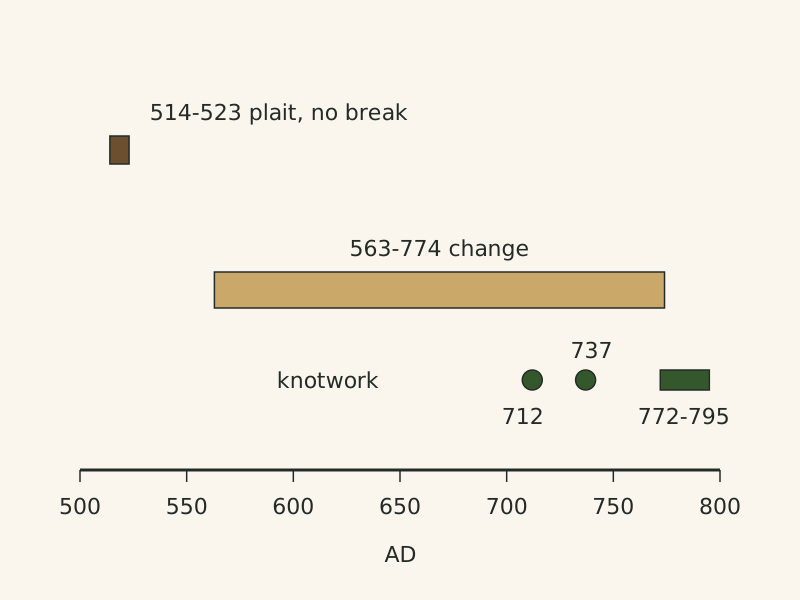
Allen’s dated examples from page 258 of the 1904 book: plaitwork without breaks at San Clemente, the window he gives for the change, and knotwork in Italian churches.
Check level Each row taken from this page’s CSV; sources and years in the table.
"Allen's 1904 dated examples of plaitwork and knotwork" by Fold, Knot & Bind — https://foldknotbind.com/knots/celtic-knot/ — licensed under CC BY 4.0: https://creativecommons.org/licenses/by/4.0/
Data: Compiled by Fold, Knot & Bind from J. Romilly Allen, Celtic Art in Pagan and Christian Times (1904), p. 258
| Allen 1904 example | Date given | What Allen reports |
|---|---|---|
| San Clemente, Rome | AD 514–523 | plaitwork, no break |
| San Giorgio, Valpolicella | AD 712 | true knotwork |
| Baptistery of Calistus, Cividale | AD 737 | true knotwork |
| Chapel of San Zeno, Rome | AD 772–795 | true knotwork |
| Change from plait to knot | AD 563–774 | “It would appear” |
Download Allen’s dated claims (CSV) (what the file holds)
Allen (1904) writes that in the eighth century, several Italian churches with well-dated examples used true knotwork. “It would appear,” he wrote, that the change from plaitwork to knotwork came between AD 563 and AD 774. He also called interlaced work the main motive of the Celtic style in its Christian period, used longer and more widely than any other. Those are Allen’s readings in 1904, and later work may date things differently.
What does a Celtic knot mean?
None of the sources read for this page gives Celtic knots a fixed meaning. The pages of Allen’s 1904 book read here, pages 257 to 260, describe how knotwork is set out, broken and dated, and say nothing about what it stands for. Meanings offered for Celtic knots today are modern claims, and this page could not read a source for any of them.
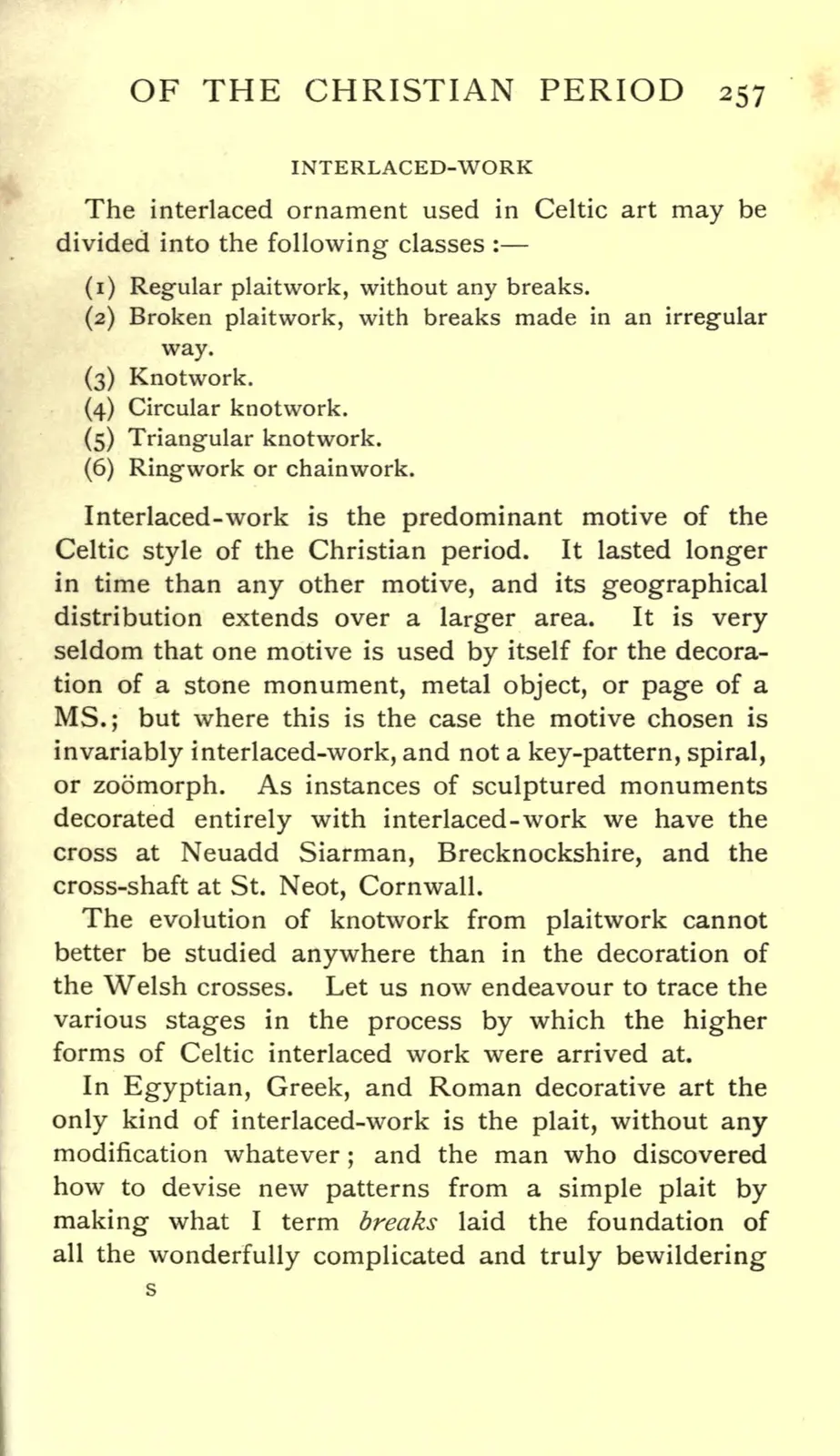
Page 257 of Allen’s Celtic Art in Pagan and Christian Times (1904), where he lists six classes of interlaced ornament.
"Interlaced-work, from Celtic Art in Pagan and Christian Times" (1904), J. Romilly Allen — https://archive.org/details/celticartpagan00alleiala/page/n342 — Public domain in US: first published 1904 (London: Methuen); EU: author J. Romilly Allen d. 1907
What the structure itself shows is easier to check. Whether a panel is one cord or several can be counted, and so can whether it weaves over and under. A khipu is another set of cords whose knots can be read by rule, and a hitomezashi grid is another pattern drawn by on-or-off choices on a grid.
Sources
- J. Romilly Allen, Celtic Art in Pagan and Christian Times (London: Methuen, 1904). archive.org/details/celticartpagan00alleialaRead: pages 257-260, checked against the page images
Cite this page
“Celtic Knot Patterns: Some Are One Cord, Some Are Several.” Fold, Knot & Bind. Published Nov. 15, 2026. https://foldknotbind.com/knots/celtic-knot/. Accessed on the date you read it.
How diagrams and claims are checked All corrections Report an error on this page (contact@foldknotbind.com)
Next on the bench:
- Macramé: one knot tied again and again, until the cords become a surface.
- Square knot vs granny knot: a real knot, where changing one throw changes the knot.
More in Knots
Knots
Square Knot vs Granny Knot: One Throw Reversed
Picture credit
"Gold armband with Herakles knot, Greek, 3rd–2nd century B.C. (Metropolitan Museum of Art 1999.209)" by Unknown author — https://commons.wikimedia.org/wiki/File:Gold_armband_with_Herakles_knot_MET_DT4404.jpg — CC0 1.0 (https://creativecommons.org/publicdomain/zero/1.0/)
Knots
Bowline Knot: The Grip Is at the Small Eye, Not the Big Loop
Picture credit
"Palstek (bowline)" (2005), Sebastian Magnusson Wigmo — https://commons.wikimedia.org/wiki/File:Palstek.jpg — Public domain in US and EU (DE/FR): released into the public domain by its author, Sebastian Magnusson Wigmo, worldwide, with a fallback grant to use it for any purpose (author's dedication on the file page)
Knots
Macramé: An 1890 Manual Says Repeated Half Knots Twist
Picture credit
"Macramé fringe (fig. 548), from Encyclopedia of Needlework" (undated English edition (before 1931)), Thérèse de Dillmont, Encyclopedia of Needlework — https://gutenberg.pglaf.org/cache/epub/20776/images/563.jpg — Public domain in US: published before 1931 (undated English edition of the Encyclopedia of Needlework; title page 'To be had of Th. de Dillmont, Dornach, Alsace'); EU (DE/FR): author Thérèse de Dillmont d. 1890; engraver not named in the book (anonymous, published more than 70 years ago)