Khipu: A Top Cord Summed the Cords Below, Locke Found
Fold, Knot & Bind Published
In brief
A khipu is a main cord hung with knotted cords, and Locke read the knots as numbers. In his 1912 paper, rows of knots stood for ones, tens and hundreds, and on one khipu from Peru a top cord carried the sum of the cords it gathered.
Materials: Cords of spun cotton or wool, doubled and twisted, then knotted. No ink, no page.
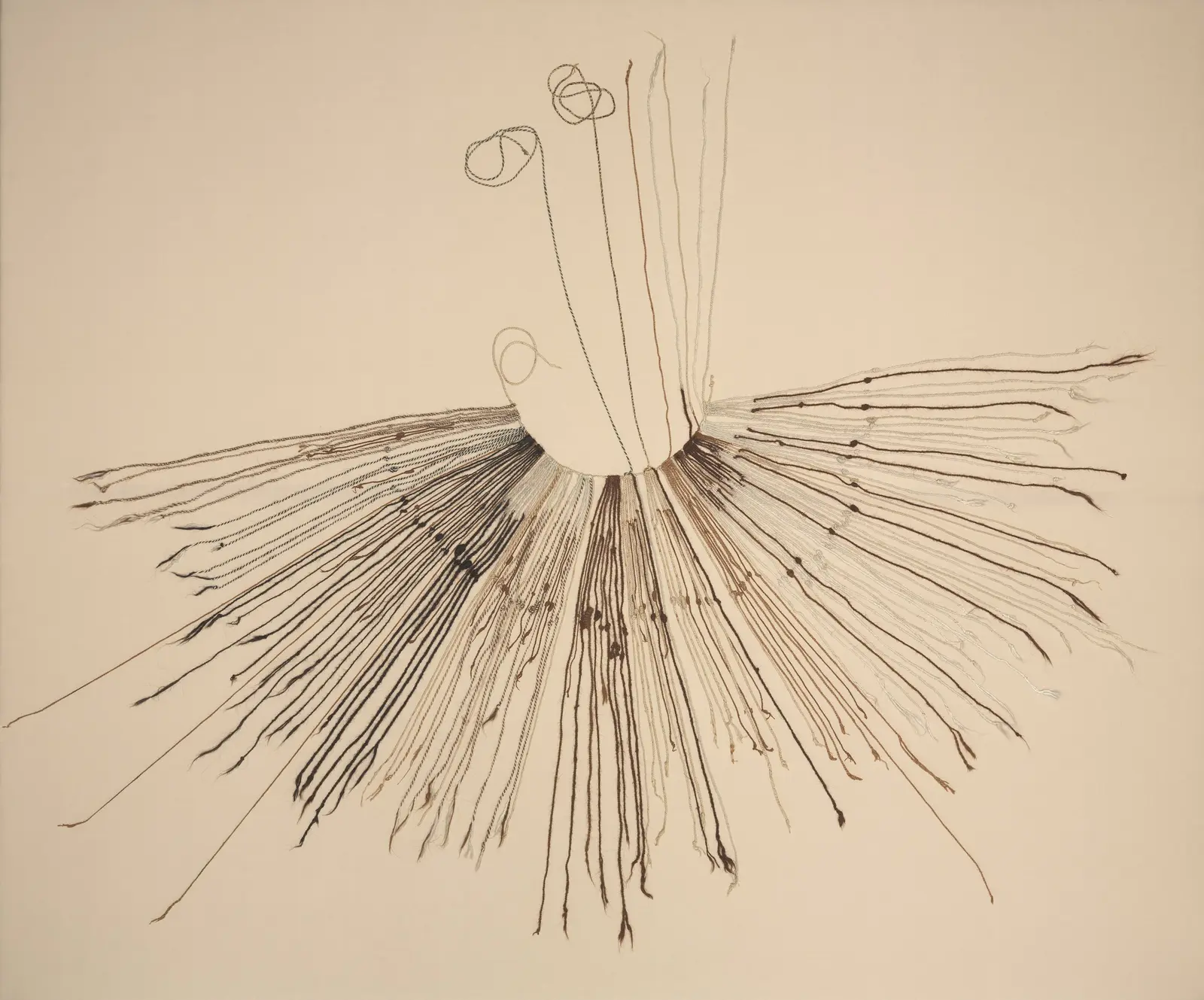
An Inka khipu in the Cleveland Museum of Art (1940.469): cotton and wool cords fan out from a curved main cord, with knots in loose rows. Its file page dates it to about 1400–1532.
"Inka Khipu (Fiber Recording Device), Peru, Inca Period, 15th–16th century (Cleveland Museum of Art 1940.469)" by Unknown author — https://commons.wikimedia.org/wiki/File:Peru,_Inca_Period,_15th-16th_Century_-_Inka_Khipu_(Fiber_Recording_Device)_-_1940.469_-_Cleveland_Museum_of_Art.tif — CC0 1.0 (https://creativecommons.org/publicdomain/zero/1.0/); modified: converted from TIFF to JPEG, scaled to 2400 px wide
Count the turns in each knot on a hanging cord, then note how far down it sits. Those two readings carry the whole number system in L. Leland Locke’s paper “The Ancient Quipu, a Peruvian Knot Record,” published in American Anthropologist in 1912. Locke spelled the word quipu and gave it as the Quichua word for “knot” (p. 326). This page uses khipu, the spelling in the museum title on the Commons file page for the cords above, which also records them as a gift of John Wise to the Cleveland Museum of Art.
How Locke read the knots
A khipu starts with a main cord, which Locke describes as “varying in length from a few centimeters to a meter or more” (p. 327). Pendant cords hang from it, “seldom exceeding 0.5 meter in length.” Knots sit along the pendant cords “roughly in rows across the quipu” (p. 328).
Then comes the rule: “The single or overhand knot (i, j), indicates 1 if it is in the row farthest from the main cord, 10 if it occurs in the next row, 100 in the next row, etc.” (p. 328). Locke found no group of more than nine single knots, “the number system being strictly decimal.” So a knot’s value depends on its row, the way a digit’s value depends on its column in a written number.
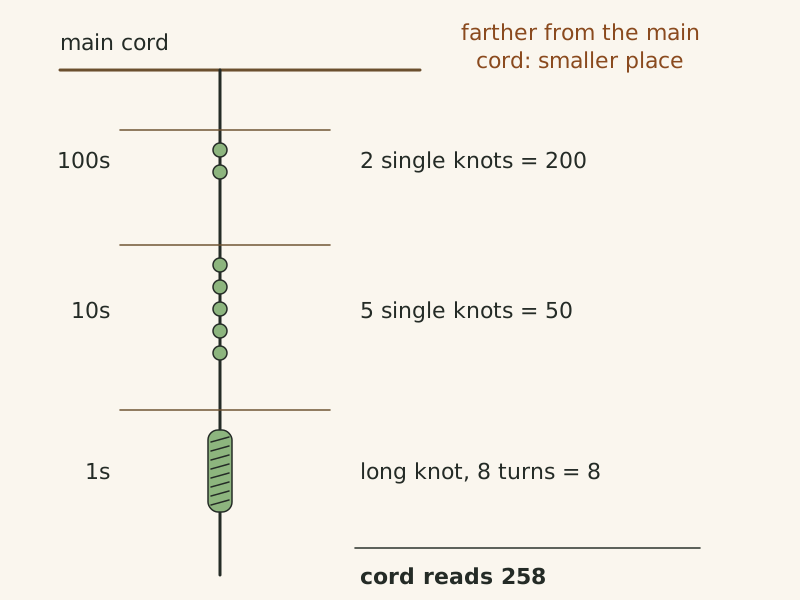
One pendant cord from Locke’s 1912 table, read by rows: 2 single knots in the hundreds row, 5 in the tens row and a long knot of 8 turns in the ones row give 258.
Check level Knot counts match cord 2 of group f in this page’s CSV; schematic, not drawn crossing by crossing.
"Reading one khipu pendant cord by rows" by Fold, Knot & Bind — https://foldknotbind.com/knots/khipu/ — licensed under CC BY 4.0: https://creativecommons.org/licenses/by/4.0/
Locke’s table also shows what an empty row means. Where a row has no knots he prints a dash, and his group totals come out right only if each dash counts as zero. That is this page’s reading of his arithmetic, not a sentence in the paper. Like the plait-and-break rule behind Celtic knot patterns, the rule is simple enough to read straight off the cord.
| Row on the pendant cord | Knot | Value, in Locke’s 1912 reading |
|---|---|---|
| Ones, farthest from the main cord | Single knot | 1 each |
| Ones | Long knot of 2 to 9 turns | 2 to 9 |
| Tens, the next row | Single knot | 10 each |
| Hundreds, the next row | Single knot | 100 each |
| Thousands, the next row | Single knot | 1,000 each |
| Any row | No knot | 0, inferred from his sums |
Download Locke’s reading rules (CSV) (what the file holds)
Single knots and long knots
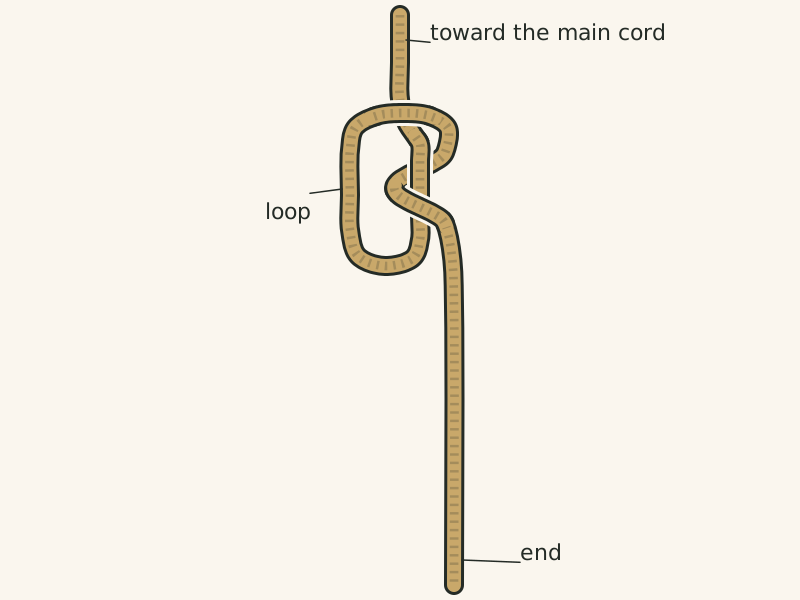
A single knot is the plain overhand knot. Richard Henry Dana’s 1847 seamanship text gives the method in one line: “Pass the end of a rope over the standing part, and through the bight” (No. 20). The standing part is the long main length of the rope, and a bight is a loop in it. In Dana’s list this knot comes two numbers before the bowline.
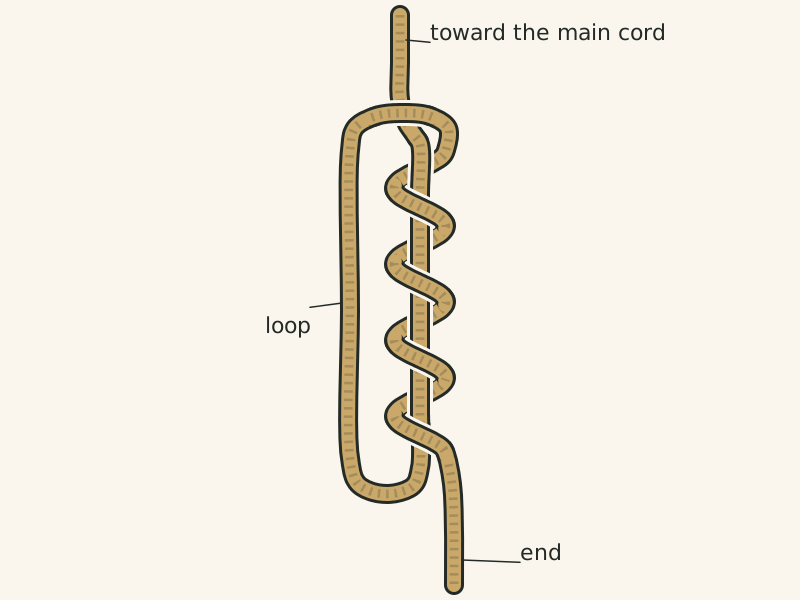
Locke’s long knot starts the same way. It is formed “by tying the overhand knot and passing the end through the loop of the knot as many times as there are units to be denoted” (p. 328). Drawing one end tight then coils the other around it. No source read here rates either knot for a load.
"Single knot on a hanging cord, drawn from its centerline" by Fold, Knot & Bind — https://foldknotbind.com/knots/khipu/ — licensed under CC BY 4.0: https://creativecommons.org/licenses/by/4.0/
"Four-turn long knot on a hanging cord, drawn from its centerline" by Fold, Knot & Bind — https://foldknotbind.com/knots/khipu/ — licensed under CC BY 4.0: https://creativecommons.org/licenses/by/4.0/
A single knot and a four-turn long knot on a hanging cord, drawn at the same scale: in the long knot the end goes through the loop four times and coils round one side of it.
Check level Crossings computed from the drawn centerline and checked against the written method.
Locke found ten knot forms in all, “two forms for the single knot and eight long knots.” The long knots “differ from each other and from the single knot only in the number of turns taken in tying” (p. 330). So in the ones row a long knot of 4 turns stands for 4 and a single knot for 1, and his Plate XXI photographs knots labeled 1 to 9, with two different knots labeled 1.
On the Huando khipus he studied, long knots appear only in the ones row, and higher rows use clusters of single knots (p. 330). One more detail from Locke matters for reading: there “seems to have been no fixed practice as to which end is drawn taut,” and the choice moves the knot up or down the cord (p. 328).
| Knot in the drawing | Passes through the loop | Crossings in the drawing |
|---|---|---|
| Single knot | 1 | 3 |
| Long knot | 4 | 9 |
Download the knot crossings (CSV) (what the file holds)
Each drawing’s turns are counted back from the drawn cord, and the CSV lists every crossing. How the knot drawings on this site are checked is set out on which layer was checked.
The top cord sums the rest
Some khipus carry a check. On the Huando specimens, the pendant cords were grouped “by passing a top cord through the top loops of the group” (p. 330). Locke’s key sentence follows: “The top cord sums the numbers on the pendent cords through which it is looped, thus giving an accurate key to the numerical character of the knots.” If the reading rule is right and a group’s cords are whole, its top cord should equal their total.
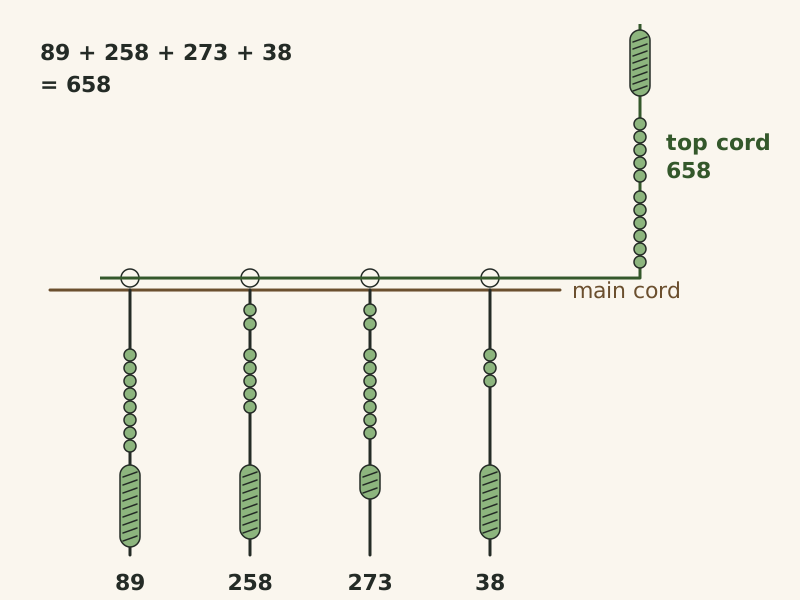
Group f of the khipu in Locke’s 1912 table: four pendant cords read 89, 258, 273 and 38, and the top cord reads 658, their sum. Schematic, not to scale.
Check level Values match group f in this page’s CSV; sum computed by this page; not drawn crossing by crossing.
"Top cord and its group, from Locke's 1912 table" by Fold, Knot & Bind — https://foldknotbind.com/knots/khipu/ — licensed under CC BY 4.0: https://creativecommons.org/licenses/by/4.0/
The khipu is No. 8713 of the Bandelier collection in the American Museum of Natural History, from Huando on the coast north of Lima (p. 330). Locke notes that the museum held a large collection from the Peruvian expedition A. F. Bandelier led in the ten years after 1892. He also lists museum specimens “exhumed from Peruvian graves” among his sources (p. 327). His table on p. 331 lists six groups of four cords, and this page re-added every group from his printed readings.
| Group | Pendant cords, as printed | Total / top cord | Result |
|---|---|---|---|
| a | 0, 10, 6, 1 | 17 / 17 | Adds up |
| b | 150, 641, 636, 90 | 1,517 / 1,417 | Top cord 100 less; Locke flags a cord |
| c | 134, 365 (366), 250, 65 (55) | 805 / 805 | Adds up on the readings in parentheses |
| d | 86 (87), 319, 168 (169), 36 (37) | 612 / 612 | Adds up on the readings in parentheses |
| e | 17, 60, fragmentary, 11 | 88 + ? / 135 | Not checkable |
| f | 89, 258, 273, 38 | 658 / 658 | Adds up |
Download the top cord check (CSV) (what the file holds)
Four of the six groups add up. Locke found the long knots hard to read “owing to the condition of the cord,” so his table gives a first reading “followed by the probable reading in parentheses” (p. 330). Groups c and d match only on those second readings, and the paper does not say whether the top cords guided them.
In group b the top cord is 100 less than the cords’ total, and Locke flags it himself: “Fragmentary subsidiary cord, attached (?); discrepancy of 100 in count” (p. 331). Group e has a fragmentary cord, so its total is unknown.
Was khipu writing?
Locke put the question plainly: “to what extent knot records took the place of writing” (p. 326). He noted that nearly all writers on Peruvian history during and since the Spanish conquest had described knotted strings keeping royal orders, orations, poems, traditions and historical data, not only numbers. His own conclusion, from the specimens he examined, went the other way: “These knots were used purely for numerical purposes” (Locke, 1912, p. 330). He also left room for doubt: “It may be that through the irony of fate no historical quipus, if they ever existed, have been preserved” (p. 332).
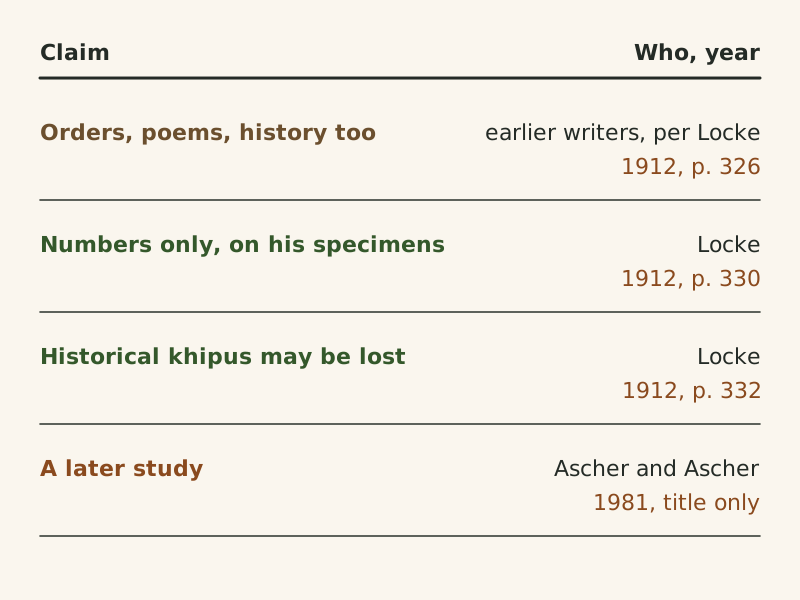
Who said what about khipus and writing, as read for this page: earlier writers as summed up by Locke, Locke’s 1912 conclusion and his caveat, and one later study listed by title only.
Check level Each row shortened from this page’s CSV, with who, year and page matched to it; sources and years in the table.
"Khipu and writing: who said what" by Fold, Knot & Bind — https://foldknotbind.com/knots/khipu/ — licensed under CC BY 4.0: https://creativecommons.org/licenses/by/4.0/
Later work exists, such as Marcia and Robert Ascher’s book Code of the Quipu (1981). This page lists it by title only and did not read it, so it reports no later verdict and takes no side.
| Claim | Who | Year | Read for this page |
|---|---|---|---|
| Knots also kept orders, poems and history | Earlier writers, as summed up by Locke | 1912 | Locke’s summary only |
| The knots he examined were for numbers only | Locke | 1912 | Yes, p. 330 |
| Historical khipus, if any, may be lost | Locke | 1912 | Yes, p. 332 |
| A later book-length study | Ascher and Ascher | 1981 | Title only |
Download the claims table (CSV) (what the file holds)
Subsidiary cords
Not every khipu is laid out like the one Locke read. Subsidiary cords are short cords attached to pendant cords. Locke wrote that nearly all old quipus have them, and that they carry “numbers that disturb the main count of the quipu” (p. 328). His Huando specimen had none, except a possible trace on cord b4, in the group whose top cord is 100 less than its total.
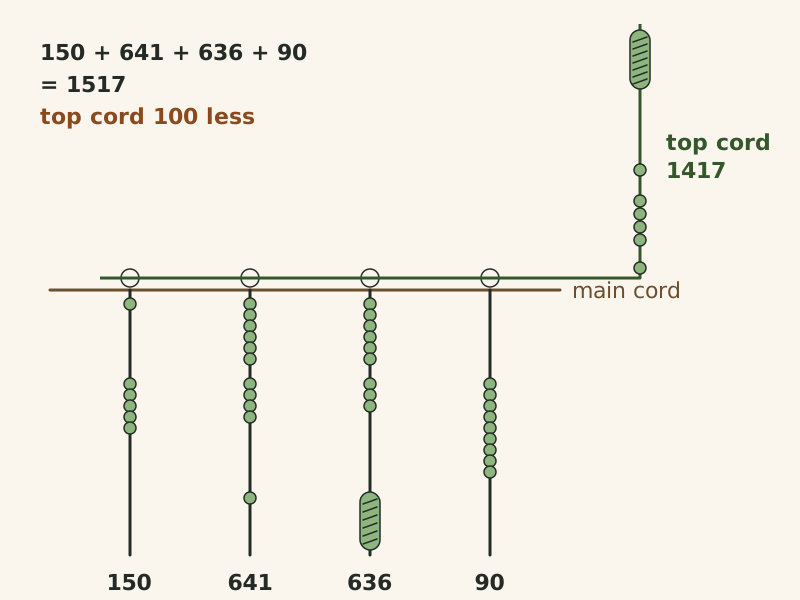
Group b of the khipu in Locke’s 1912 table: four pendant cords read 150, 641, 636 and 90, a total of 1,517, but the top cord reads 1,417, 100 less. Locke notes a possible fragmentary subsidiary cord on cord b4. Schematic, not to scale.
Check level Values match group b in this page’s CSV; sum computed by this page; not drawn crossing by crossing.
"Top cord 100 less than its group, from Locke's 1912 table" by Fold, Knot & Bind — https://foldknotbind.com/knots/khipu/ — licensed under CC BY 4.0: https://creativecommons.org/licenses/by/4.0/
This page infers from that remark that a simple top-cord sum may not be enough to check a reading on a khipu with many subsidiary cords.
Sources
- L. Leland Locke, "The Ancient Quipu, a Peruvian Knot Record," American Anthropologist, n.s., 14, no. 2 (1912): 325–332. archive.org/details/sim_american-anthropolo…Read: full article, pages 325–332; pages 326–328, 330–332 and Plates XXI and XXIII checked against the page images
- Richard Henry Dana Jr., The Seaman's Friend, 5th ed. (Boston: Thomas Groom, 1847). gutenberg.pglaf.org/cache/epub/40958/Read: full text of the knots section (Nos. 17-24) and the dictionary of sea terms entries Clove-hitch and Half-hitch
Cite this page
“Khipu: A Top Cord Summed the Cords Below, Locke Found.” Fold, Knot & Bind. Published Nov. 15, 2026. https://foldknotbind.com/knots/khipu/. Accessed on the date you read it.
How diagrams and claims are checked All corrections Report an error on this page (contact@foldknotbind.com)
Next on the bench:
More in Knots
Knots
Square Knot vs Granny Knot: One Throw Reversed
Picture credit
"Gold armband with Herakles knot, Greek, 3rd–2nd century B.C. (Metropolitan Museum of Art 1999.209)" by Unknown author — https://commons.wikimedia.org/wiki/File:Gold_armband_with_Herakles_knot_MET_DT4404.jpg — CC0 1.0 (https://creativecommons.org/publicdomain/zero/1.0/)
Knots
Bowline Knot: The Grip Is at the Small Eye, Not the Big Loop
Picture credit
"Palstek (bowline)" (2005), Sebastian Magnusson Wigmo — https://commons.wikimedia.org/wiki/File:Palstek.jpg — Public domain in US and EU (DE/FR): released into the public domain by its author, Sebastian Magnusson Wigmo, worldwide, with a fallback grant to use it for any purpose (author's dedication on the file page)
Knots
Celtic Knot Patterns: Some Are One Cord, Some Are Several
Picture credit
"Carpet page, from the Lindisfarne Gospels" (late 7th or early 8th century), Unknown author — https://commons.wikimedia.org/wiki/File:Meister_des_Book_of_Lindisfarne_002.jpg — Public domain in US: medieval manuscript page, public domain; faithful photographic reproduction of a two-dimensional work (PD-Art). EU: maker died more than 1,000 years ago; faithful reproduction of a public-domain visual work (EU Directive 2019/790, Art. 14)