Square Knot vs Granny Knot: One Throw Reversed
Fold, Knot & Bind Published
In brief
Right over left, then left over right: that two-throw rule makes a square knot. If the second throw repeats right over left, the ends are “crossed the wrong way,” and Dana's 1847 seamanship text says sailors call that a granny knot.
Materials: Two rope ends, or both ends of one rope. No tools.
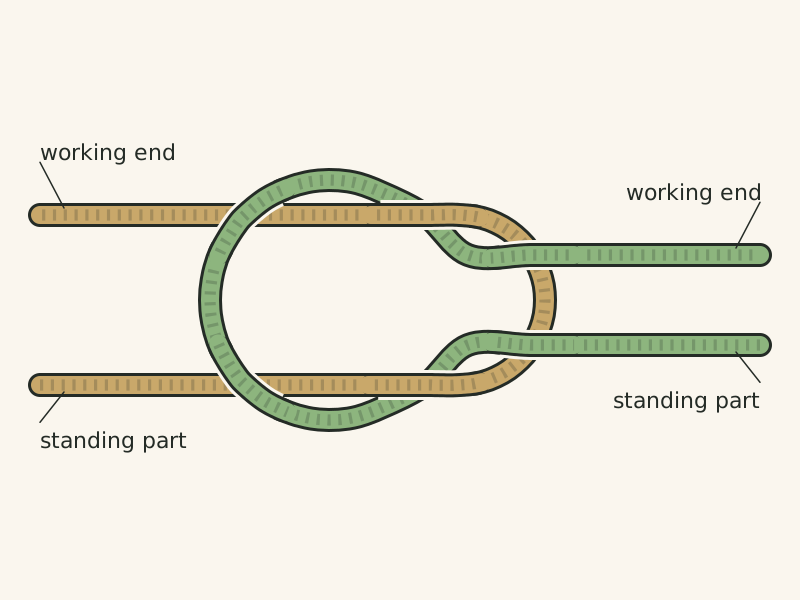
"Square knot, drawn from its centerline" by Fold, Knot & Bind — https://foldknotbind.com/knots/square-knot-vs-granny-knot/ — licensed under CC BY 4.0: https://creativecommons.org/licenses/by/4.0/
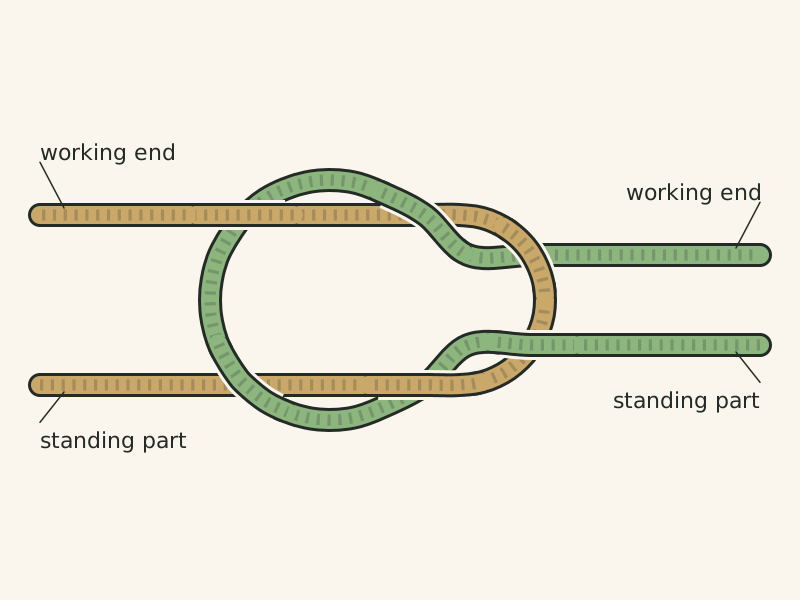
"Granny knot on the same layout, drawn from its centerline" by Fold, Knot & Bind — https://foldknotbind.com/knots/square-knot-vs-granny-knot/ — licensed under CC BY 4.0: https://creativecommons.org/licenses/by/4.0/
The square knot (first) and the granny knot (second), drawn on one layout: each rope doubles back into a bight that lies round both parts of the other rope, and three crossings change which rope lies on top.
Check level Crossings computed from the drawn centerline; closure invariants match the expected knot type; crossings checked one by one against Verrill (1912), Fig. 11 and Verrill (1912), Fig. 13.
A. Hyatt Verrill's rope manual draws the square knot as Fig. 11 and the granny as Fig. 13 (1912 printing, p. 21; the 1917 edition keeps the same figures). The same manual sets a limit on the square knot: tied between two ropes of unequal size, it will “frequently slip” and “sooner or later will pull apart” (p. 22). No source read for this page gives a strength figure or a working load for either knot in rope, so nothing here rates them for any load. For a knot that must hold a person or a weight, formal training, in-person instruction and current standards come first.
What is the difference between a square knot and a granny knot?
Both knots start with the same first throw: a half knot, in which one end wraps once round the other. The difference is the second throw. In the square knot it goes the opposite way to the first, and in the granny it goes the same way again.
Laid out on one plan, the two knots have six crossings each. At three of them, numbered 1 to 3 below, the other rope ends up on top. Crossings 4, 5 and 6 stay the same.
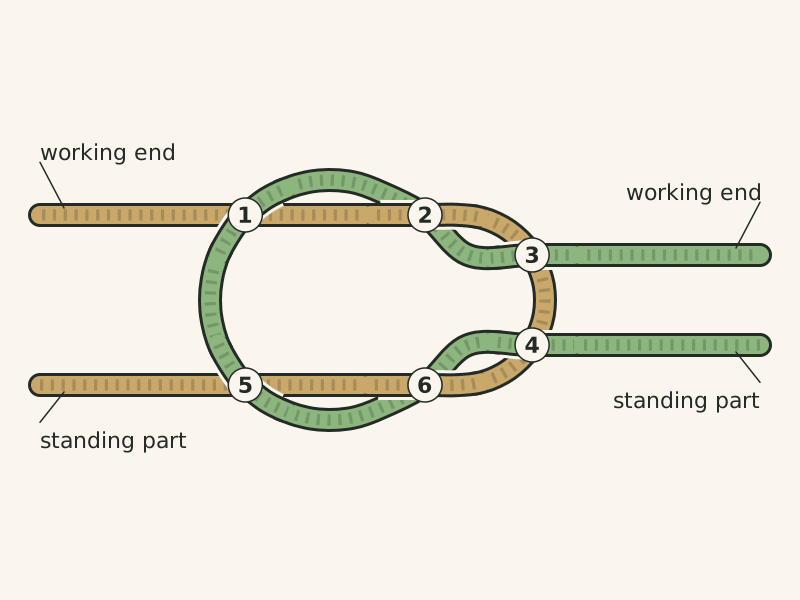
"Square knot with its six crossings numbered" by Fold, Knot & Bind — https://foldknotbind.com/knots/square-knot-vs-granny-knot/ — licensed under CC BY 4.0: https://creativecommons.org/licenses/by/4.0/
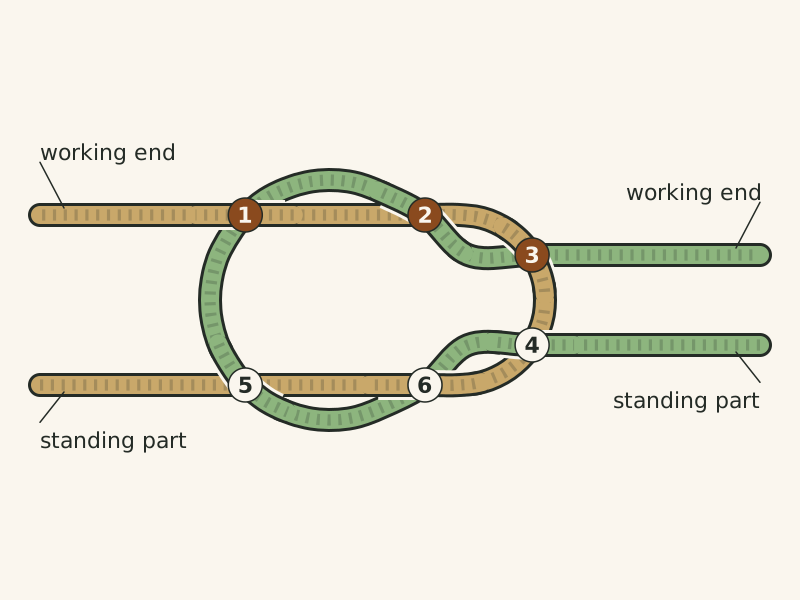
"Granny knot with the three crossings that differ from the square knot marked" by Fold, Knot & Bind — https://foldknotbind.com/knots/square-knot-vs-granny-knot/ — licensed under CC BY 4.0: https://creativecommons.org/licenses/by/4.0/
The square knot (first) and the granny knot (second) with their crossings numbered. The filled marks on the granny knot, crossings 1, 2 and 3, are where the other rope lies on top.
Check level Crossings computed from the drawn centerline; closure invariants match the expected knot type; crossings checked one by one against Verrill (1912), Fig. 11 and Verrill (1912), Fig. 13.
With their ends joined into closed loops, the two drawings compute as two different knot types, so the change is more than a matter of how the rope happens to be laid out. The crossing signs differ too: the square knot's six crossings split three positive and three negative, while all six of the granny's are negative.
| Crossing | Square knot: on top | Granny knot: on top | Changed |
|---|---|---|---|
| 1 | Bight, rope from the right | Working end, rope from the left | Yes |
| 2 | Working end, rope from the left | Working end, rope from the right | Yes |
| 3 | Working end, rope from the right | Bight, rope from the left | Yes |
| 4 | Standing part, rope from the right | Standing part, rope from the right | No |
| 5 | Bight, rope from the right | Bight, rope from the right | No |
| 6 | Standing part, rope from the left | Standing part, rope from the left | No |
Download the square and granny knot crossings (CSV) (what the file holds)
How the drawings are tested is set out on which layer was checked.
How do you tie a square knot?
Verrill's text says to “pass the left end over and under the right end, then the right over and under the left” (1912 printing, p. 21), and he sums the method up in a short formula: “Left over,” “Right over.” The drawings here start from the other side, with the end from the right crossing first. Either starting side gives a square knot, as long as the second throw goes the opposite way to the first.
- The end from the right crosses over the end from the left and wraps round it once, making a half knot with three crossings.
- The end now on the left crosses over the end now on the right and wraps round it, which brings the knot to six crossings.
- Both throws are drawn snug, and the six crossings stay the same.
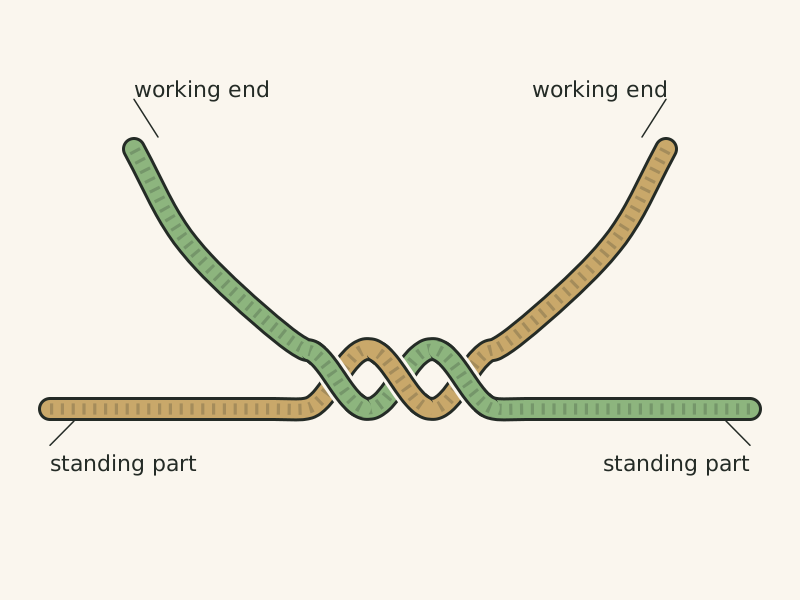
Step 1: one end crosses over the other and round it, a half knot with three crossings.
Check level Crossings computed from the drawn centerline; closure invariants match the expected knot type.
"Square knot, step 1 of 3" by Fold, Knot & Bind — https://foldknotbind.com/knots/square-knot-vs-granny-knot/ — licensed under CC BY 4.0: https://creativecommons.org/licenses/by/4.0/
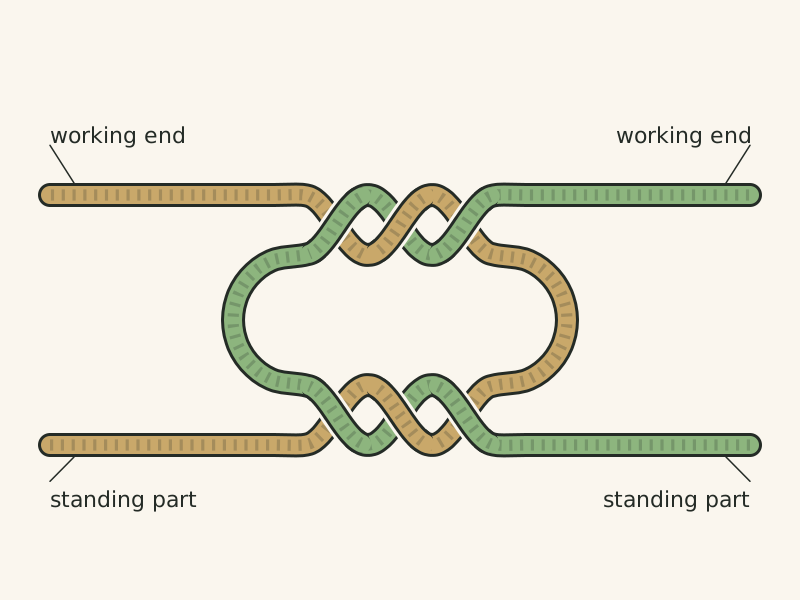
Step 2: a second throw goes the opposite way, still loose, for six crossings.
Check level Crossings computed from the drawn centerline; closure invariants match the expected knot type.
"Square knot, step 2 of 3" by Fold, Knot & Bind — https://foldknotbind.com/knots/square-knot-vs-granny-knot/ — licensed under CC BY 4.0: https://creativecommons.org/licenses/by/4.0/
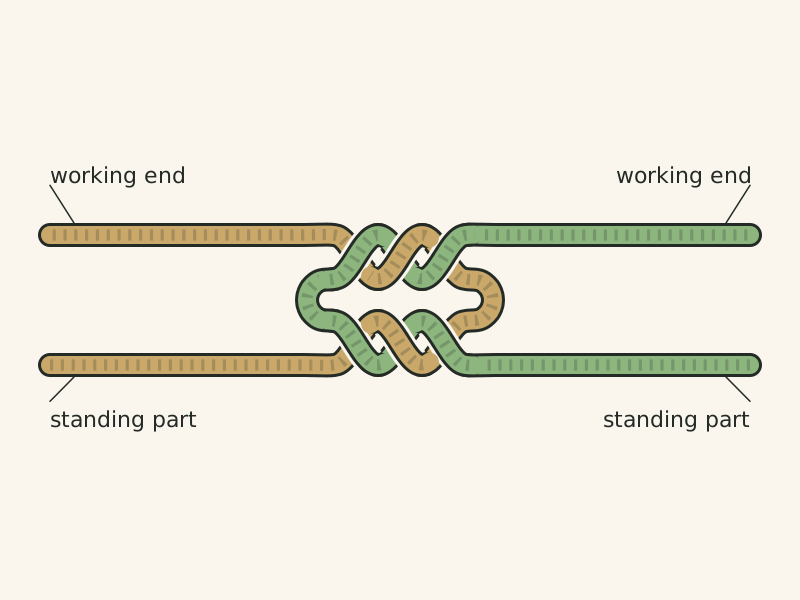
Step 3: both ends drawn snug; the same six crossings.
Check level Crossings computed from the drawn centerline; closure invariants match the expected knot type.
"Square knot, step 3 of 3" by Fold, Knot & Bind — https://foldknotbind.com/knots/square-knot-vs-granny-knot/ — licensed under CC BY 4.0: https://creativecommons.org/licenses/by/4.0/
Each step keeps the crossings of the step before it: step 2 adds three crossings to step 1, and step 3 only pulls step 2 tight. The steps map crossings and are not training for any load.
The friction contract: where the two bights grip
This site reads knots through the friction contract: each place where rope presses on rope is a clause, and a knot fails when one of its clauses gives way. In a square knot, the main clauses sit where the two bights meet. A bight is a U-shaped bend in a rope. Here each rope's bight wraps round both the standing part and the working end of the other rope.
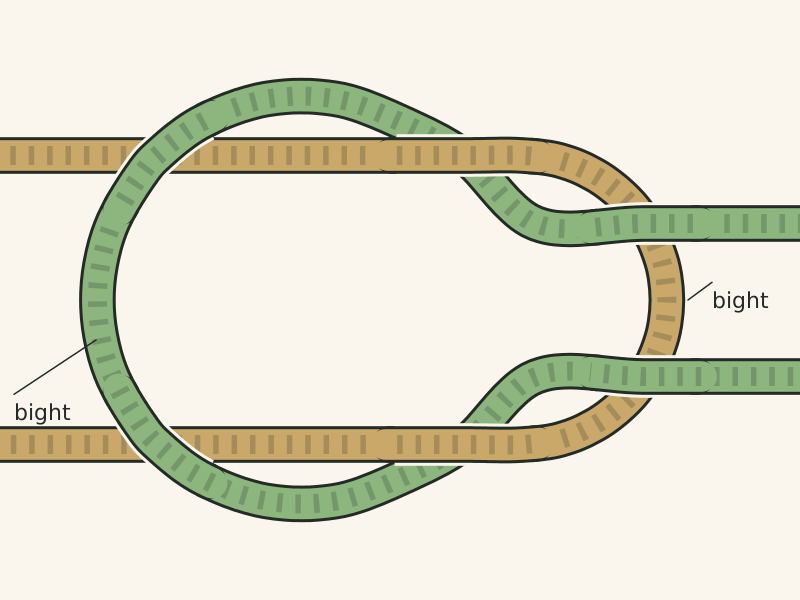
Close-up of the square knot's center: the bight of each rope wraps both the standing part and the working end of the other rope.
Check level Crossings computed from the drawn centerline; closure invariants match the expected knot type.
"Square knot close-up: where the two bights grip" by Fold, Knot & Bind — https://foldknotbind.com/knots/square-knot-vs-granny-knot/ — licensed under CC BY 4.0: https://creativecommons.org/licenses/by/4.0/
The drawings show one more rule: in the square knot, both bights lie on the same side of the other rope's two parts. The bight from the right passes over both parts (crossings 1 and 5), and the bight from the left passes under both (crossings 3 and 4). In the granny, each bight passes over one part and under the other.
Put in contract terms, the two bights sign the same clause from opposite sides. In plain terms, each bight is wrapped by the other rope, and friction where the two press together keeps them from sliding apart. A bowline puts its clauses in one small nip instead. A crochet stitch draws one loop through another and ties no knot at all.
Square knot, reef knot, Herakles knot: one name too many?
Three of the four manuals read for this page use reef knot and square knot for the same knot. Dana's 1847 text says the square knot “is sometimes called a REEF-KNOT” (No. 24), and The Bluejackets' Manual of 1917 lists “Reef, or square knot” (p. 262) and draws it round a spar (p. 263). Darcy Lever's Sheet Anchor (1843) makes its “REEF-KNOT” from an “over-hand knot” round a yard or spar, then takes one end round the other (p. 7, Figs. 51–52).
Verrill's manual is the odd one out. His “true ‘Reef Knot’ is merely the square knot with the bight of the left or right end used instead of the end itself,” which lets it be “cast off” more readily (1912 printing, pp. 21–22). His reef knot is therefore a square knot with one end doubled back into a bight, drawn with the square knots of his Fig. 12. It is not the knot his Fig. 14 captions “Slipped square knot,” which shows a square knot that has slipped.
Single overhand knots like Lever's first step also turn up in khipu, where they record numbers.
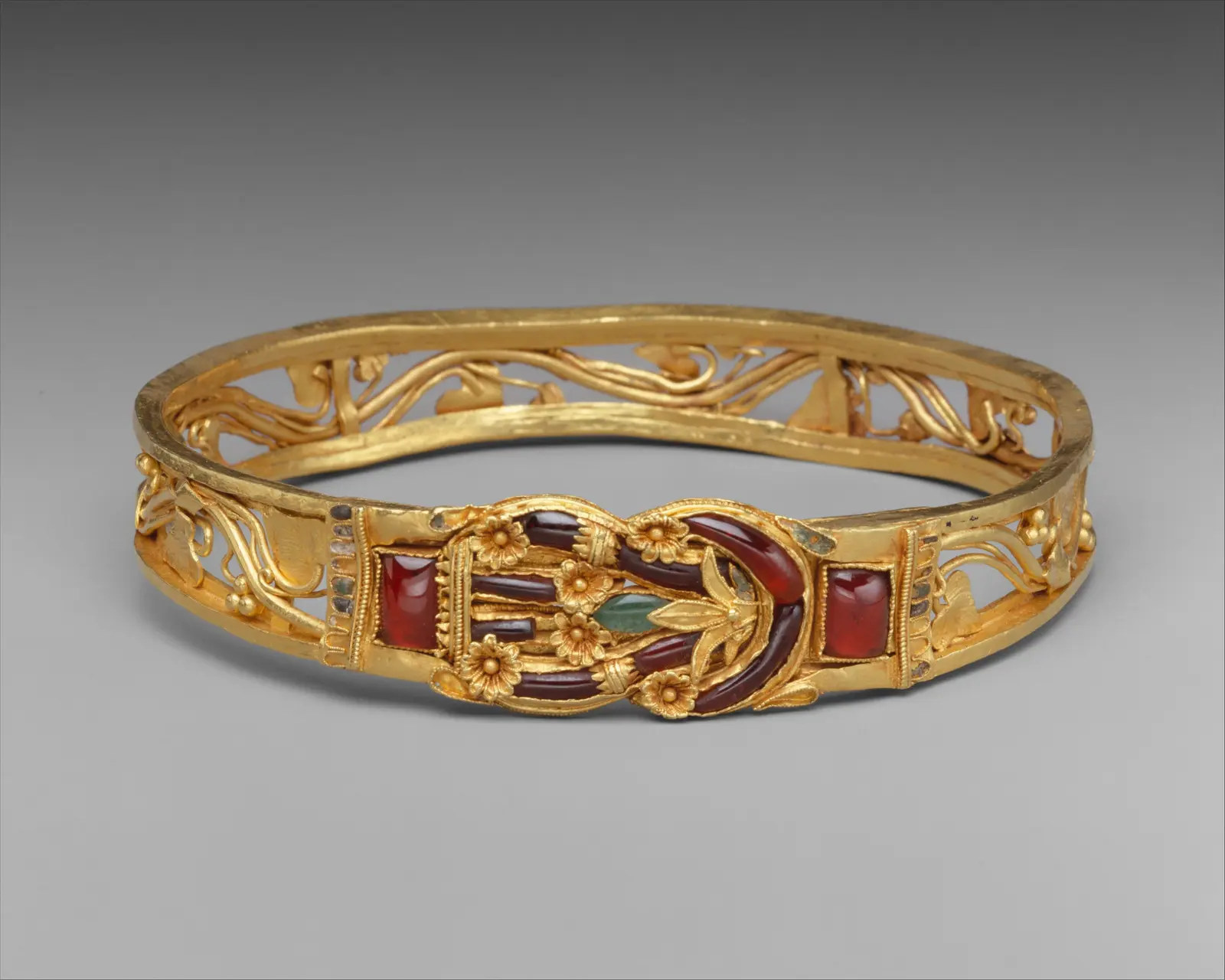
Gold armband with a Herakles knot, Greek, 3rd–2nd century B.C., gold inlaid with garnets, emeralds and enamel (Metropolitan Museum of Art, 1999.209).
"Gold armband with Herakles knot, Greek, 3rd–2nd century B.C. (Metropolitan Museum of Art 1999.209)" by Unknown author — https://commons.wikimedia.org/wiki/File:Gold_armband_with_Herakles_knot_MET_DT4404.jpg — CC0 1.0 (https://creativecommons.org/publicdomain/zero/1.0/)
A third name turns up in museum records. The Met's record, as copied to Wikimedia Commons, titles this armband “Gold armband with Herakles knot.” No source read for this page says whether a Herakles knot is the same knot as a reef or square knot, so this page keeps the names apart.
How it fails: ropes of unequal size
Verrill's manual gives one way a square knot fails. “Neither square nor reef knots, however, are reliable when tying two ropes of unequal size together,” he writes, “for under such conditions they will frequently slip and appear as in Fig. 14, and sooner or later will pull apart” (1912 printing, p. 22). He names no rope sizes, loads or tests, so this is the manual's statement, not a measured limit.
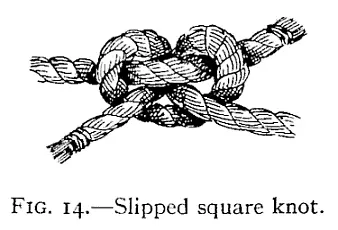
Fig. 14, “Slipped square knot,” from A. Hyatt Verrill's Knots, Splices and Rope Work (1917 edition): the shape his text says a square knot in ropes of unequal size takes before it pulls apart.
"Fig. 14, Slipped square knot, from Knots, Splices and Rope Work" (1917), A. Hyatt Verrill — https://gutenberg.pglaf.org/cache/epub/13510/pg13510-images.html — Public domain in US: first published 1912 (New York: Norman W. Henley), this edition 1917; EU (DE/FR): author A. Hyatt Verrill d. 1954, public domain from 2025; no engraver credited in the book
Why the granny does worse has been studied in a laboratory. In simulations by Patil and colleagues (2020), knotted elastic fibers 0.4 mm across were pulled with a force of 15 N; in their experiments, two Dyneema fibers 0.15 mm across were tied together and loaded with heavier and heavier masses until the knot pulled through. In both, the granny ranked less stable than the knot the study calls the reef.
The study links that ranking to the twist at each crossing: where the twists match, a knot tends to roll, and where they oppose, it tends to lock. This page's drawings show the same split in their crossing signs: three and three in the square knot, six alike in the granny. The study gives a ranking for thin fibers, not a working load for any rope.
Square knot or granny: which, and for what?
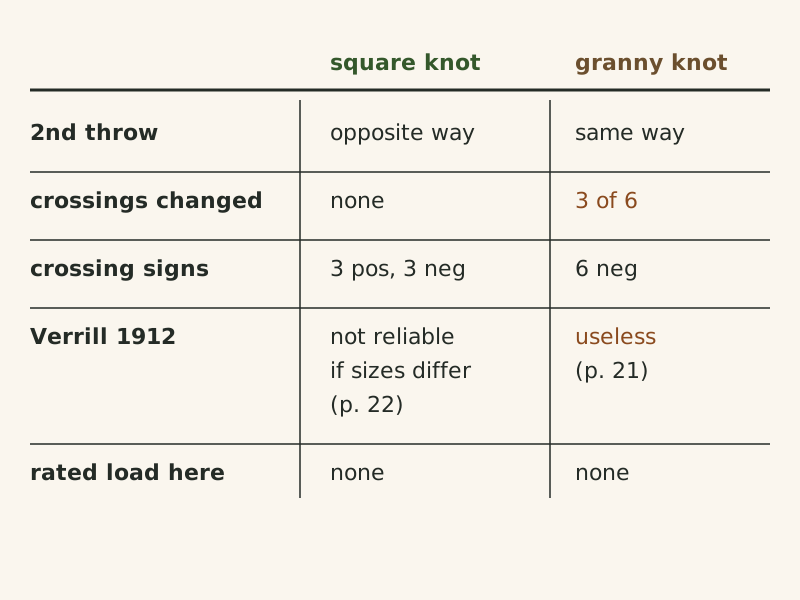
The square knot and the granny knot side by side: how the second throw goes, what this page's drawings compute, and what the sources read for this page say. Neither knot is rated here for any load.
Check level Each row taken from this page's CSV; sources and years in the table.
"Square knot or granny knot: comparison" by Fold, Knot & Bind — https://foldknotbind.com/knots/square-knot-vs-granny-knot/ — licensed under CC BY 4.0: https://creativecommons.org/licenses/by/4.0/
| Question | Square knot | Granny knot |
|---|---|---|
| Second throw | Opposite way to the first | Same way as the first |
| Crossings that change, this page's drawings | None (reference) | 3 of 6 |
| Crossing signs, this page's drawings | 3 positive, 3 negative | 6 negative |
| Verrill, 1912 printing | Not reliable with ropes of unequal size (p. 22) | “most useless, bothersome, and deceptive makeshift for any purpose” (p. 21) |
| Patil et al., 2020 | More stable in their tests | Less stable in their tests |
| Rated for a load on this page | No | No |
Download the square and granny knot sources and claims (CSV) (what the file holds)
This site's rule puts the square knot on light binding, such as tying a parcel, where a slip costs nothing and no one's weight hangs on it. Verrill finds no use for the granny at all. Neither knot is a way to join two ropes that carry a load; that choice belongs to formal training and current standards.
Sources
- Richard Henry Dana Jr., The Seaman's Friend, 5th ed. (Boston: Thomas Groom, 1847). gutenberg.pglaf.org/cache/epub/40958/Read: full text of the knots section (Nos. 17-24) and the dictionary of sea terms entries Clove-hitch and Half-hitch
- A. Hyatt Verrill, Knots, Splices and Rope Work: A Practical Treatise, 2nd rev. ed. (New York: Norman W. Henley, 1917). gutenberg.pglaf.org/cache/epub/13510/Read: full text of the 1917 edition; pages 21-22 and 45-46 checked against the page images of the 1912 printing
- Darcy Lever, The Young Sea Officer's Sheet Anchor; or, A Key to the Leading of Rigging, and to Practical Seamanship (New York: E. & G. W. Blunt, 1843). archive.org/details/youngseaofficers00leveRead: page 7 and the plate facing it (Figs. 40-46 and 51-52), checked against the page images
- The Bluejackets' Manual, United States Navy, 5th ed. (1917). archive.org/details/bluejacketsmanua0000lie…Read: pages 262 and 263, checked against the page images
- Vishal P. Patil, Joseph D. Sandt, Mathias Kolle and Jörn Dunkel, "Topological mechanics of knots and tangles," Science 367 (2020): 71–75. math.mit.edu/~dunkel/Papers/2020PaEtAl_Scien…Read: full text of the authors' copy; paraphrased only
Cite this page
“Square Knot vs Granny Knot: One Throw Reversed.” Fold, Knot & Bind. Published Nov. 15, 2026. https://foldknotbind.com/knots/square-knot-vs-granny-knot/. Accessed on the date you read it.
How diagrams and claims are checked All corrections Report an error on this page (contact@foldknotbind.com)
Next on the bench:
- Macramé: Half a square knot, tied again and again; an 1890 manual says the bar twists of itself.
- Clove hitch vs two half hitches: Another easily confused pair: the same turns, and two old manuals, Dana's and Lever's, that put the clove hitch name in different places.
More in Knots
Knots
Bowline Knot: The Grip Is at the Small Eye, Not the Big Loop
Picture credit
"Palstek (bowline)" (2005), Sebastian Magnusson Wigmo — https://commons.wikimedia.org/wiki/File:Palstek.jpg — Public domain in US and EU (DE/FR): released into the public domain by its author, Sebastian Magnusson Wigmo, worldwide, with a fallback grant to use it for any purpose (author's dedication on the file page)
Knots
Celtic Knot Patterns: Some Are One Cord, Some Are Several
Picture credit
"Carpet page, from the Lindisfarne Gospels" (late 7th or early 8th century), Unknown author — https://commons.wikimedia.org/wiki/File:Meister_des_Book_of_Lindisfarne_002.jpg — Public domain in US: medieval manuscript page, public domain; faithful photographic reproduction of a two-dimensional work (PD-Art). EU: maker died more than 1,000 years ago; faithful reproduction of a public-domain visual work (EU Directive 2019/790, Art. 14)
Knots
Macramé: An 1890 Manual Says Repeated Half Knots Twist
Picture credit
"Macramé fringe (fig. 548), from Encyclopedia of Needlework" (undated English edition (before 1931)), Thérèse de Dillmont, Encyclopedia of Needlework — https://gutenberg.pglaf.org/cache/epub/20776/images/563.jpg — Public domain in US: published before 1931 (undated English edition of the Encyclopedia of Needlework; title page 'To be had of Th. de Dillmont, Dornach, Alsace'); EU (DE/FR): author Thérèse de Dillmont d. 1890; engraver not named in the book (anonymous, published more than 70 years ago)