Clove Hitch vs Two Half Hitches: Dana and Lever Disagree
Fold, Knot & Bind Published
In brief
Per Dana's text, a clove hitch makes two half hitches round a spar, not round the rope itself. Dana's 1847 wording makes that the only difference, while Lever's 1843 manual gives the clove hitch name to two half hitches made on the rope's own standing part.
Materials: One rope and a spar or post. No second rope, no tools.
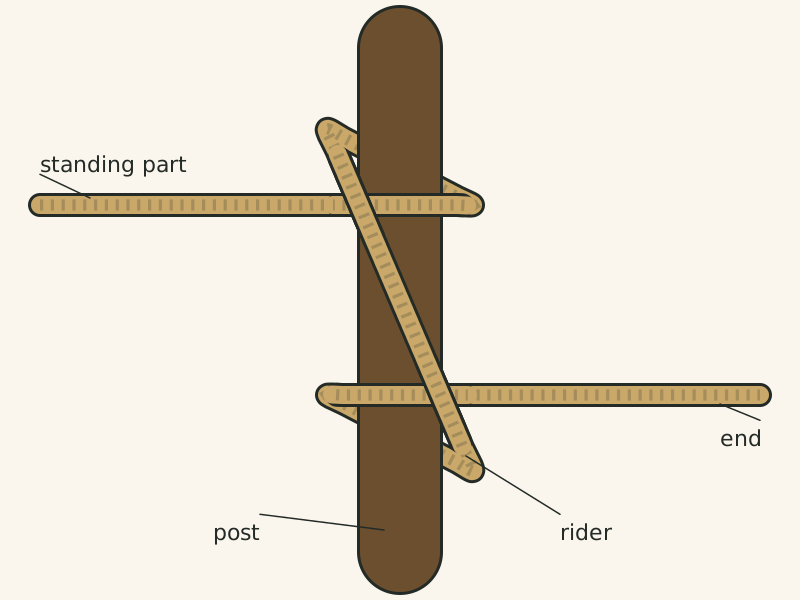
A clove hitch on an upright post: two turns, the rider laid over the first turn, and the end tucked under the rider.
Check level Crossings computed from the drawn centerline; closure invariants match the expected knot type; crossings checked one by one against Verrill (1917), Fig. 36 A.
"Clove hitch on a post, drawn from its centerline" by Fold, Knot & Bind — https://foldknotbind.com/knots/clove-hitch/ — licensed under CC BY 4.0: https://creativecommons.org/licenses/by/4.0/
Compare the drawings on this page and the two knots look alike. Each has two turns and a rider, the diagonal pass that crosses over the first turn, with the end tucked under it. The standing part is the long main length of the rope.
This page maps the structure of the clove hitch and of two half hitches only. No source read for it tests how either hitch slips or what it can hold, so nothing here rates them for any load. For climbing, rescue, lifting, towing or work at height, formal training, in-person instruction and current standards come first.
Clove hitch vs two half hitches: spar or standing part
Richard Henry Dana's The Seaman's Friend (1847) makes two half hitches by passing the end “round the standing part” and bringing it “up through the bight,” twice (No. 18). His next entry sends the end round a spar instead and calls it a clove hitch (No. 19). Then he spells it out: “the only difference between two half-hitches and a clove-hitch being that one is hitched round its own standing part, and the other is hitched round a spar or another rope.” The book's dictionary of sea terms puts it in one line: “Two half-hitches round a spar or other rope.”
"Clove hitch, first of a side-by-side pair with two half hitches" by Fold, Knot & Bind — https://foldknotbind.com/knots/clove-hitch/ — licensed under CC BY 4.0: https://creativecommons.org/licenses/by/4.0/
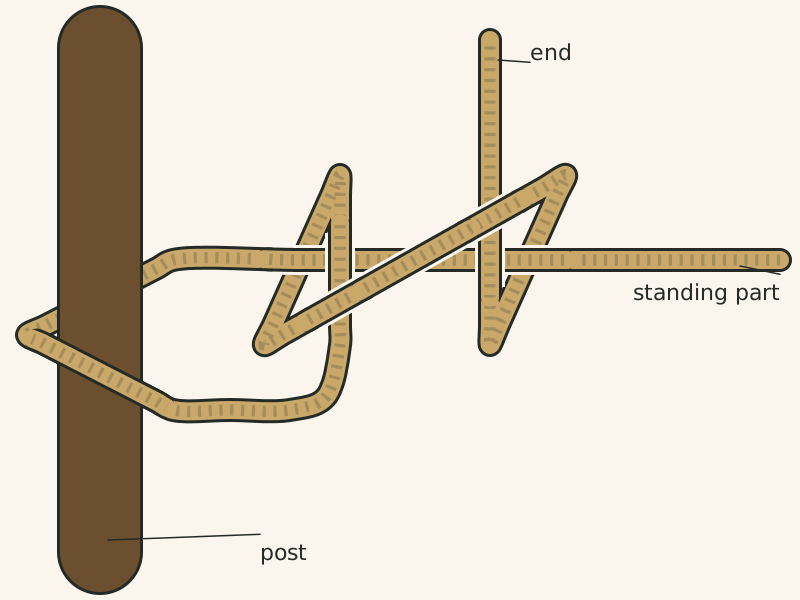
"Two half hitches round the standing part, second of a side-by-side pair" by Fold, Knot & Bind — https://foldknotbind.com/knots/clove-hitch/ — licensed under CC BY 4.0: https://creativecommons.org/licenses/by/4.0/
The same two turns, made first round a post (clove hitch) and then round the rope's own standing part after one turn round the post (two half hitches), drawn loose.
Check level Crossings computed from the drawn centerline and checked against the written method.
In the second drawing the rope goes once round the post, then makes its two turns round its own standing part. Trace the end with a finger and the pattern repeats in both: a turn, a rider across it, and the end tucked under the rider. What changes is what sits inside the turns. A bowline also takes its end round the rope's own standing part, but to close a fixed loop.
| Clove hitch | Two half hitches | |
|---|---|---|
| The two turns go round | The spar or post | The rope's own standing part |
| Crossings in the drawing | 7 | 9 |
| Rope crossing rope | 2 | 7 |
| Compared with a manual's plate | Verrill (1917), Fig. 36 A | No plate matched |
Download the two half hitches crossings (CSV) (what the file holds)
Two manuals, two definitions
Darcy Lever and Dana do not draw the line in the same place. Lever's Sheet Anchor (1843 New York edition) passes the end “round the standing part,” brings it up through the bight and calls that a half hitch; then “Two of these, one above the other, Fig. 41, is called a Clove-hitch” (p. 7). His Fig. 41 shows the two hitches on the rope itself, with no spar at all. Dana's 1847 text keeps the clove hitch name for turns round a spar or another rope, so Lever's knot is two half hitches in Dana's book.
This page sets the two definitions side by side and does not pick one. A. Hyatt Verrill's Knots, Splices and Rope Work (1917) allows two half hitches to go “either around a post or timber or around the standing part of the rope” (Figs. 34–35), and keeps the clove hitch for the spar (Fig. 36). A move that changes its name with the point of view turns up in yarn too: in knit and purl stitches, one loop seen from its two sides gets two names.
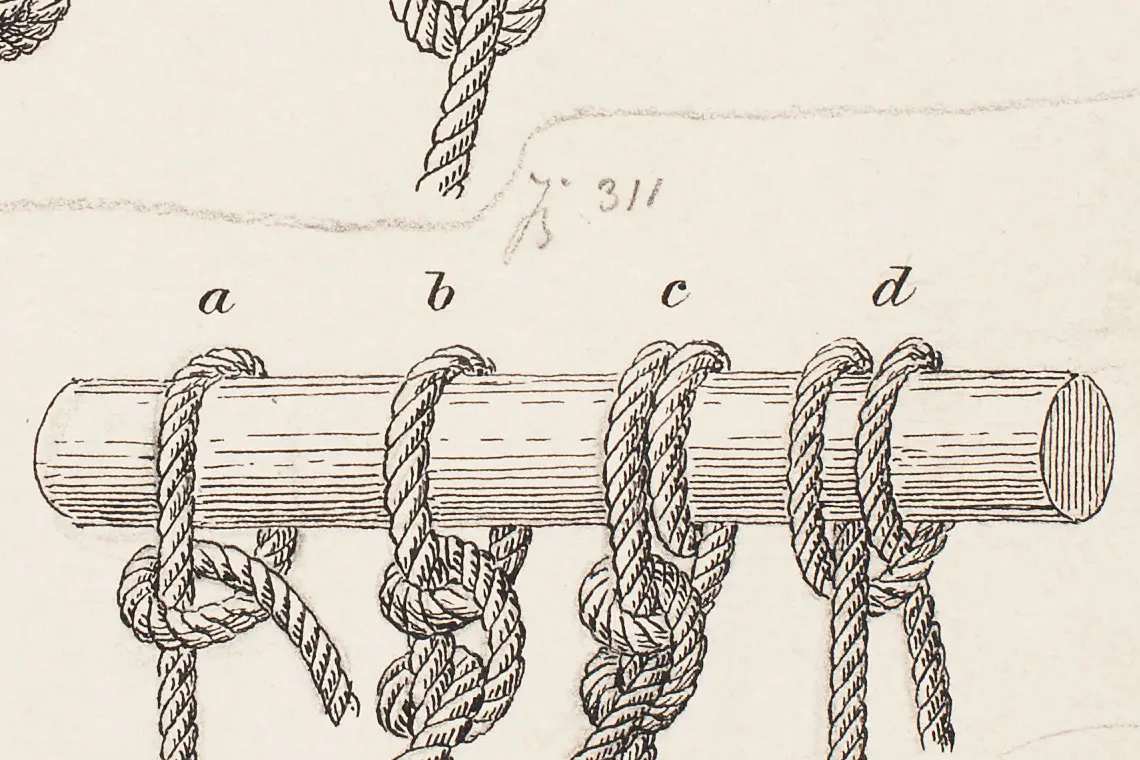
Detail of Jacob Hägg's pen drawing for an 1896 Swedish seamanship textbook: four hitches on one spar. In the second, the rope goes once round the spar and makes two half hitches round its standing part; in the last, both turns go round the spar.
“Fig. 311, hitches on a spar, from an original drawing for Lärobok i sjömanskap (Sjöhistoriska museet OB 384)”, Jacob Hägg, Sjöhistoriska museet; Public Domain Mark.
Full credit
"Fig. 311, hitches on a spar, from an original drawing for Lärobok i sjömanskap (Sjöhistoriska museet OB 384)" (1896), Jacob Hägg, Sjöhistoriska museet — https://commons.wikimedia.org/wiki/File:Teckning_-_Sj%C3%B6historiska_museet_-_OB_384.tif — Public domain in US: published 1896 as illustrations in Linder, Lärobok i sjömanskap (before 1931); EU (DE/FR): artist Jacob Hägg d. 15 April 1931 (life + 70); Public Domain Mark 1.0 on the file page; modified: cropped to Fig. 311 (four hitches on one spar); recropped 2026-11-15 (crop box 1080, 1888, 2220, 2648 in original pixels) to leave out the top of the shackle and the pencil figure number of the next figure, so the long hanging ends below the knots are cut, converted from TIFF to JPEG
Jacob Hägg drew this sheet as an original for Vilhelm Linder's Lärobok i sjömanskap (1896). The sheet lines the variants up on a single spar and makes the same comparison as the drawings above, in ink instead of numbers.
How a clove hitch goes around a spar
Verrill's 1917 manual gives the clove hitch in one sentence: “pass the end of rope around the spar or timber, then over itself; over and around the spar, and pass the end under itself and between rope and spar.” He notes that it is sometimes known as the builders' hitch. The two drawings below split that sentence into two parts. They are a map of crossings, not a tying lesson.
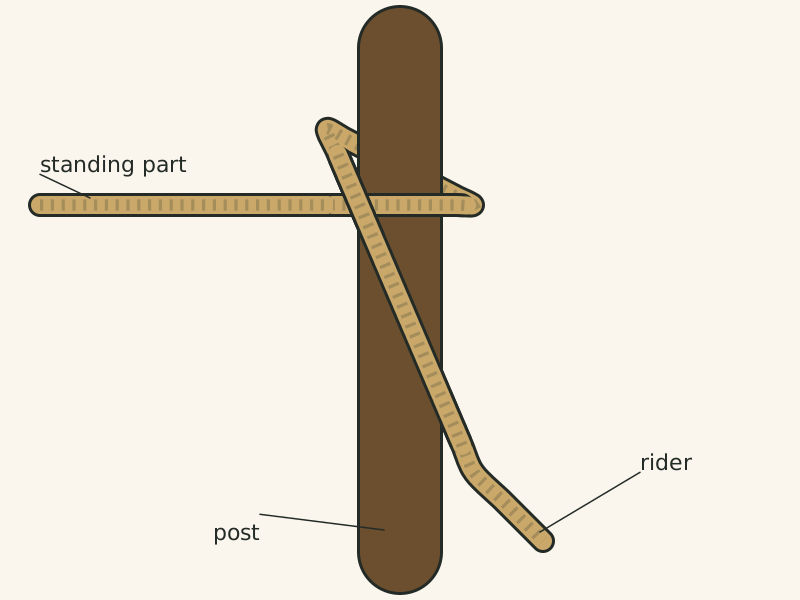
"Clove hitch, step 1 of 2" by Fold, Knot & Bind — https://foldknotbind.com/knots/clove-hitch/ — licensed under CC BY 4.0: https://creativecommons.org/licenses/by/4.0/
"Clove hitch, step 2 of 2" by Fold, Knot & Bind — https://foldknotbind.com/knots/clove-hitch/ — licensed under CC BY 4.0: https://creativecommons.org/licenses/by/4.0/
Two steps: one turn round the spar with the rider crossing over it, then a second turn with the end brought up under the rider.
Check level Crossings computed from the drawn centerline; closure invariants match the expected knot type.
The first step has 4 crossings and the second has 7. Every crossing of the first step is still there in the second, in the same order, so the second step only adds to the first. How the drawings are tested is set out on which layer was checked.
Take away the spar
Number the crossings of the finished hitch and only two of the seven are rope crossing rope: 2 and 6, both with the rider on top. The other five are places where the rope passes in front of the post or behind it.
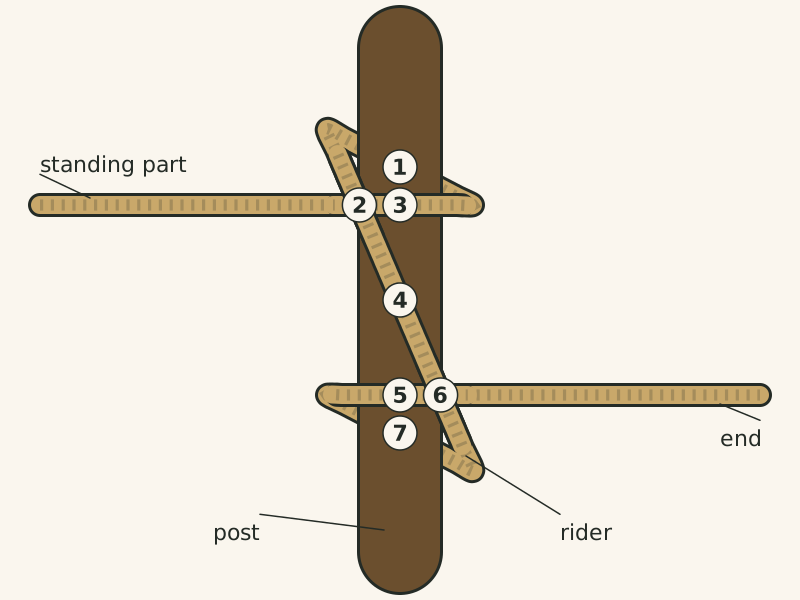
The clove hitch's seven crossings, numbered. Only 2 and 6 are rope on rope, both with the rider on top; at the other five the rope passes in front of the post or behind it.
Check level Crossings computed from the drawn centerline; closure invariants match the expected knot type; crossings checked one by one against Verrill (1917), Fig. 36 A.
"Clove hitch with its seven crossings numbered" by Fold, Knot & Bind — https://foldknotbind.com/knots/clove-hitch/ — licensed under CC BY 4.0: https://creativecommons.org/licenses/by/4.0/
| Crossing | On top | Underneath |
|---|---|---|
| 1 | Post | First turn |
| 2 | Rider | First turn |
| 3 | First turn | Post |
| 4 | Rider | Post |
| 5 | End | Post |
| 6 | Rider | End |
| 7 | Post | Second turn |
Download the clove hitch crossings (CSV) (what the file holds)
With the post lifted out and the rope's ends joined into a closed loop, the drawing computes as an unknot: the rope on its own holds no knot at all. Two earlier versions of this drawing looked right and matched the written method. Yet they computed as a trefoil knot, so they were dropped.
How it fails: what the manuals claim
The manuals read for this page praise these hitches but report no tests of them. Verrill's 1917 manual says two half hitches “will hold forever without loosening,” then calls the clove hitch “a more secure knot for this same purpose.” The same 1917 text adds that “even on a slimy and slippery spile it will seldom slip,” naming a surface but no rope, load or test. The Bluejackets' Manual of 1917 lists the clove hitch with one use: “ratlines are hitched to shrouds in this way” (p. 262).
No source read for this page tests how a clove hitch grips or slips, so no failure figure is given here. On this page's reading of the drawing, the hitch depends on the spar staying inside its turns, since the rope alone is not knotted. Which hitch to trust with a load is a matter for formal training and current standards, not for a crossing map.
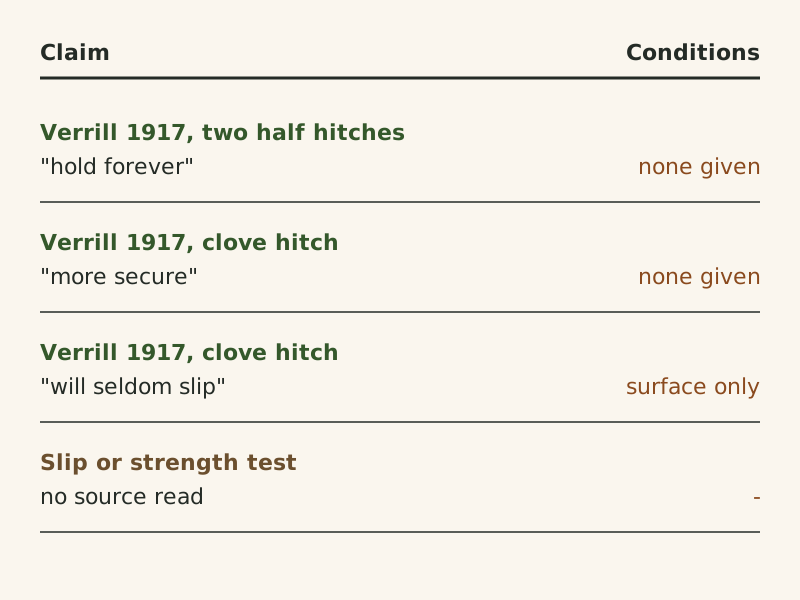
What the sources read for this page say about holding and slipping. All three claims come from Verrill's 1917 manual without a rope, a load or a test; no source gives test data.
Check level Each row taken from this page's CSV; sources and years in the table.
"Clove hitch and two half hitches: what the sources say about slipping" by Fold, Knot & Bind — https://foldknotbind.com/knots/clove-hitch/ — licensed under CC BY 4.0: https://creativecommons.org/licenses/by/4.0/
| Claim | Source | Conditions |
|---|---|---|
| Two half hitches “will hold forever without loosening” | Verrill, 1917, Figs. 34–35 | None given |
| The clove hitch is “a more secure knot” | Verrill, 1917, Fig. 36 | None given |
| “will seldom slip” on “a slimy and slippery spile” | Verrill, 1917, Fig. 36 | Surface only |
| Slip or strength test | No source read | — |
Download the clove hitch sources and claims (CSV) (what the file holds)
Sources
- Richard Henry Dana Jr., The Seaman's Friend, 5th ed. (Boston: Thomas Groom, 1847). gutenberg.pglaf.org/cache/epub/40958/Read: full text of the knots section (Nos. 17-24) and the dictionary of sea terms entries Clove-hitch and Half-hitch
- Darcy Lever, The Young Sea Officer's Sheet Anchor; or, A Key to the Leading of Rigging, and to Practical Seamanship (New York: E. & G. W. Blunt, 1843). archive.org/details/youngseaofficers00leveRead: page 7 and the plate facing it (Figs. 40-46 and 51-52), checked against the page images
- A. Hyatt Verrill, Knots, Splices and Rope Work: A Practical Treatise, 2nd rev. ed. (New York: Norman W. Henley, 1917). gutenberg.pglaf.org/cache/epub/13510/Read: full text of the 1917 edition; pages 21-22 and 45-46 checked against the page images of the 1912 printing
- The Bluejackets' Manual, United States Navy, 5th ed. (1917). archive.org/details/bluejacketsmanua0000lie…Read: pages 262 and 263, checked against the page images
Cite this page
“Clove Hitch vs Two Half Hitches: Dana and Lever Disagree.” Fold, Knot & Bind. Published Nov. 15, 2026. https://foldknotbind.com/knots/clove-hitch/. Accessed on the date you read it.
How diagrams and claims are checked All corrections Report an error on this page (contact@foldknotbind.com)
Next on the bench:
- Square knot vs granny knot: Another pair of knots that sit one step apart.
- Macramé: A half knot, not a half hitch, repeated round two core cords; an 1890 manual says the bar twists of itself.
More in Knots
Knots
Square Knot vs Granny Knot: One Throw Reversed
Picture credit
"Gold armband with Herakles knot, Greek, 3rd–2nd century B.C. (Metropolitan Museum of Art 1999.209)" by Unknown author — https://commons.wikimedia.org/wiki/File:Gold_armband_with_Herakles_knot_MET_DT4404.jpg — CC0 1.0 (https://creativecommons.org/publicdomain/zero/1.0/)
Knots
Bowline Knot: The Grip Is at the Small Eye, Not the Big Loop
Picture credit
"Palstek (bowline)" (2005), Sebastian Magnusson Wigmo — https://commons.wikimedia.org/wiki/File:Palstek.jpg — Public domain in US and EU (DE/FR): released into the public domain by its author, Sebastian Magnusson Wigmo, worldwide, with a fallback grant to use it for any purpose (author's dedication on the file page)
Knots
Celtic Knot Patterns: Some Are One Cord, Some Are Several
Picture credit
"Carpet page, from the Lindisfarne Gospels" (late 7th or early 8th century), Unknown author — https://commons.wikimedia.org/wiki/File:Meister_des_Book_of_Lindisfarne_002.jpg — Public domain in US: medieval manuscript page, public domain; faithful photographic reproduction of a two-dimensional work (PD-Art). EU: maker died more than 1,000 years ago; faithful reproduction of a public-domain visual work (EU Directive 2019/790, Art. 14)