Knit Stitch vs Purl: One Loop, Seen From Opposite Sides
Fold, Knot & Bind Published
In brief
A purl stitch is a knit stitch seen from the other side of the fabric. Thérèse de Dillmont's Encyclopedia of Needlework says it in two sentences: knit “the wrong side of plain knitting,” and “This is called purling.”
Materials: One strand of yarn and two needles. Every stitch is a loop; nothing is tied.
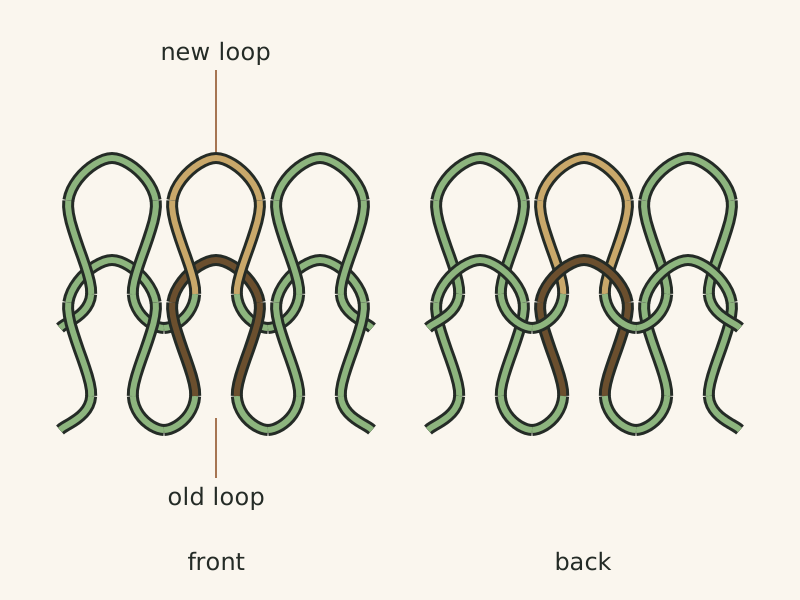
One new loop (ochre) drawn through the loop below it (brown), first seen from the front of the fabric, then from the back. From the front its legs lie on top; from the back the old loop's head lies on top.
Check level Schematic of loop structure, after de Dillmont's description; over and under set by a rule taken from her description, then crossings found and checked so each loop passes through the one below; not to scale.
"One knit loop through the loop below, front and back" by Fold, Knot & Bind — https://foldknotbind.com/knit-and-stitch/knit-vs-purl/ — licensed under CC BY 4.0: https://creativecommons.org/licenses/by/4.0/
Turn a scarf of plain knitting over and the smooth Vs become rows of bumps. Nothing about the yarn has changed. Only the side being looked at has, and that is the whole difference between the two stitches.
What is a knit stitch?
De Dillmont calls the knit stitch plain stitch and names it “the easiest stitch and the first which a knitter has to learn” (fig. 349). In her instructions, the right-hand needle goes into the first loop on the left-hand needle, from below, under the front of the loop. The yarn is laid under that needle and drawn through as a new loop, and then the old loop drops off the left-hand needle.
So a knit stitch is a new loop pulled through an old one. Nothing is tied, and the loop below stays in place only because the new loop passes through it. Cord can also be built from strands without any loops or knots, by crossing them over and under one another, as kumihimo braids are.
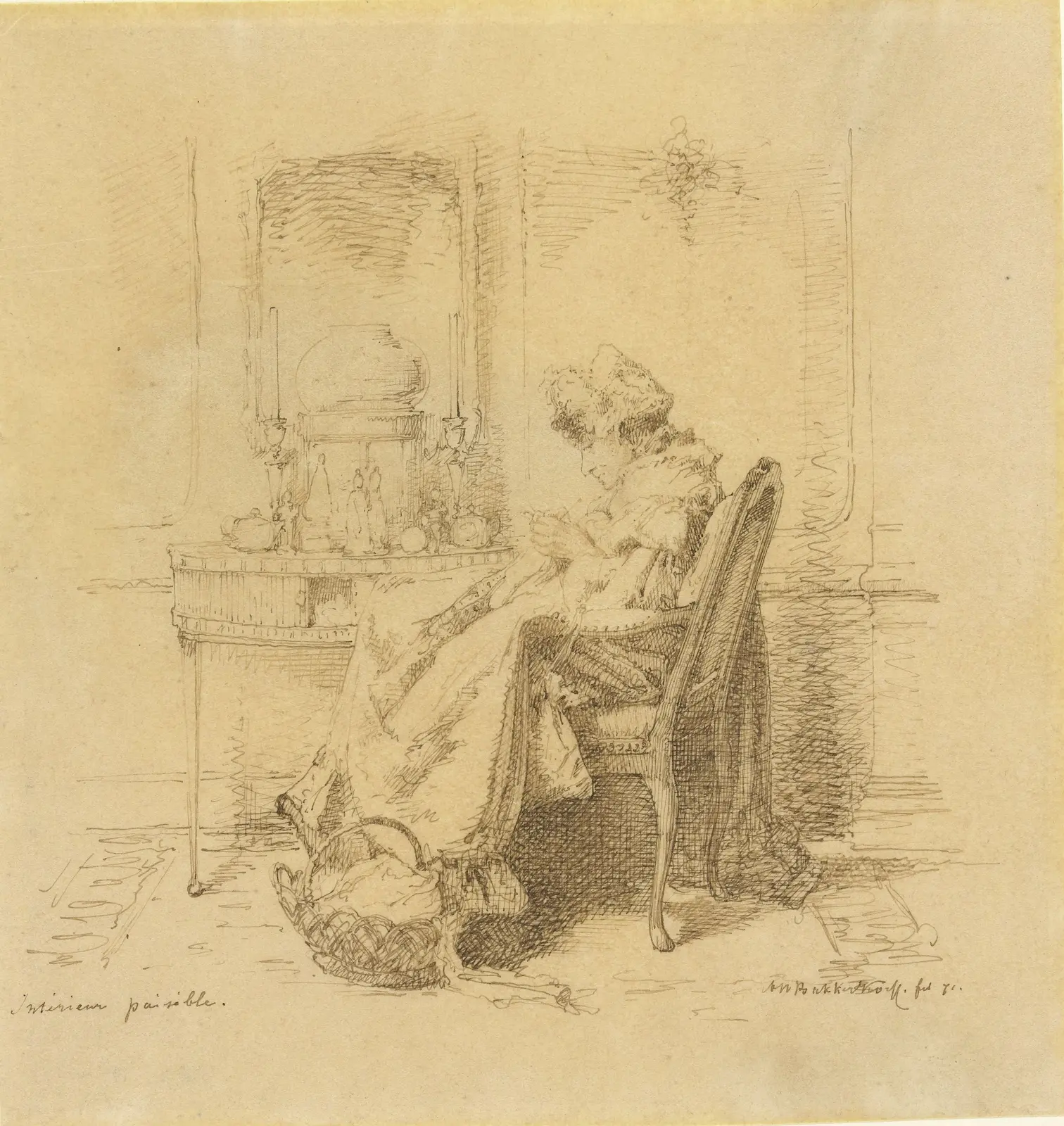
Interieur paisible, a pen drawing by Alexander Hugo Bakker Korff, 1871: a woman seated by a table, knitting, with a basket on the floor.
"Old woman knitting (Interieur paisible), pen drawing, Rijksmuseum SK-A-3621" by Alexander Hugo Bakker Korff — https://commons.wikimedia.org/wiki/File:Breiende_oude_dame_Interieur_paisible_(titel_op_object),_SK-A-3621.jpg — CC0 1.0 (https://creativecommons.org/publicdomain/zero/1.0/)
Which side is the right side? De Dillmont says plain knitting is used “wherever a perfectly smooth, even surface is required.” She adds that it “looks quite differently on the wrong side” from the right side, where it shows “vertical rows of plaiting.” This page reads those vertical rows of plaiting as the columns of Vs, so the side covered in Vs is the right side.
Purl: the same loop from the back
“You may intentionally knit the wrong side of plain knitting,” de Dillmont writes. “This is called purling.” She also calls the purl the back stitch or seam-stitch (fig. 350). It is not a new kind of loop but the knit loop itself, made so that its back faces the knitter.
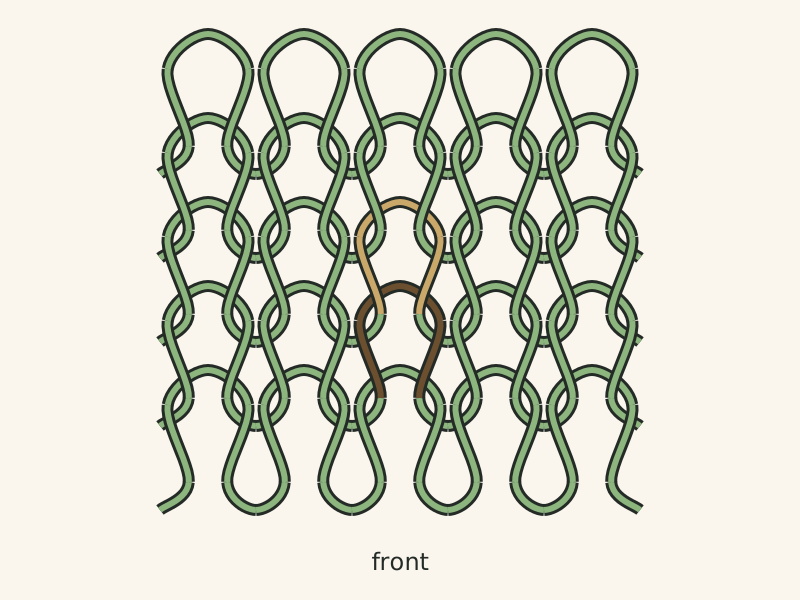
"Knitted loops seen from the front" by Fold, Knot & Bind — https://foldknotbind.com/knit-and-stitch/knit-vs-purl/ — licensed under CC BY 4.0: https://creativecommons.org/licenses/by/4.0/
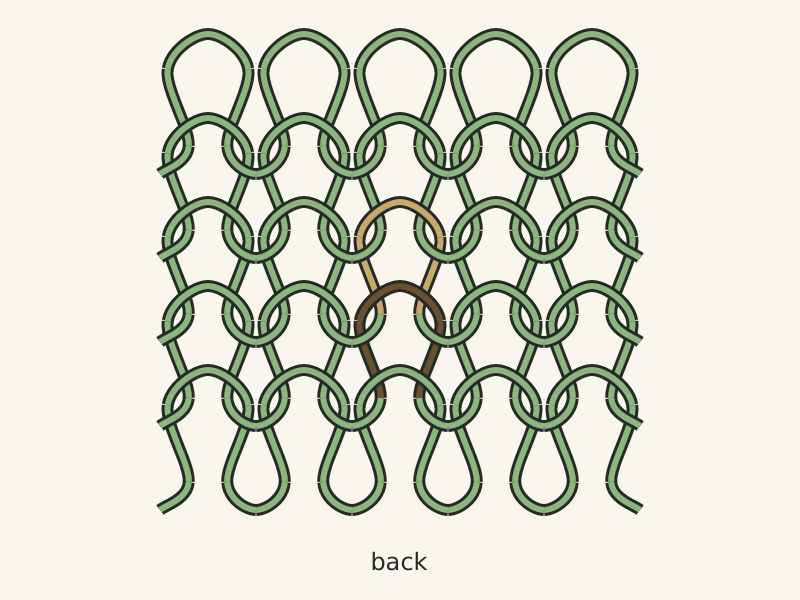
"The same knitted loops seen from the back" by Fold, Knot & Bind — https://foldknotbind.com/knit-and-stitch/knit-vs-purl/ — licensed under CC BY 4.0: https://creativecommons.org/licenses/by/4.0/
The same patch of 25 loops, first from the front, then from the back. The ochre loop and the brown loop below it are the same pair in both views.
Check level Schematic of loop structure, after de Dillmont's description; over and under set by a rule taken from her description; the back view reverses every crossing of the front view; not to scale.
Look at where the strands cross. From the front, each loop's two legs lie over the head of the loop below and over the yarn connecting neighboring stitches, which is why the front shows legs standing as Vs. From the back, every one of those crossings is reversed, so the heads and the connecting arcs lie on top and read as horizontal bumps.
Hitomezashi sashiko is another stitch structure that only makes sense once both faces have been examined.
Which way the new loop is drawn
De Dillmont's two sets of instructions differ in where the yarn is laid and where the needle enters, and this page reads them as one motion pointed in opposite directions. In plain stitch the needle enters from below, and the new loop comes out toward the knitter. In purl the yarn is laid over the left needle first, and the needle enters from above, behind the yarn, and the new loop is then drawn out through the back.
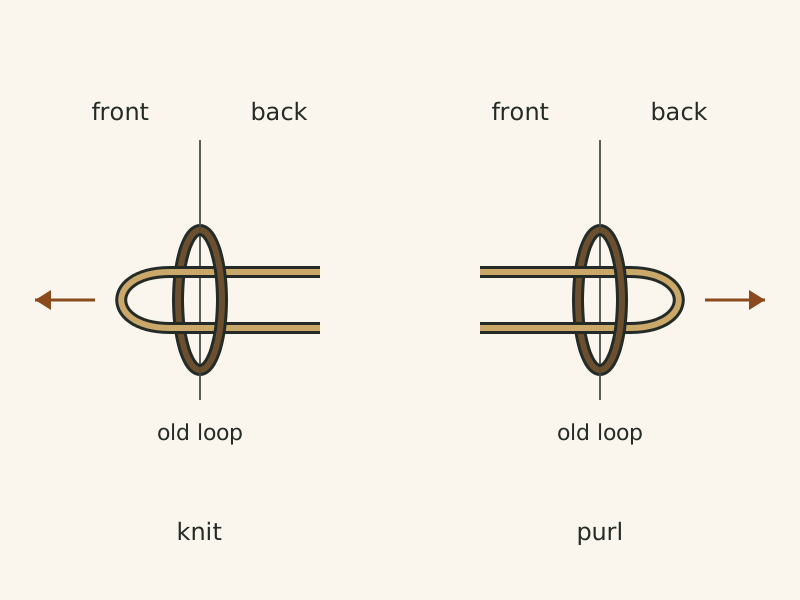
Two side views of one old loop (brown). In the first, the new loop (ochre) is drawn through it toward the front: a knit stitch. In the second, it is drawn through toward the back: a purl.
Check level Schematic of loop direction, after de Dillmont's description; no crossings computed; not to scale.
"Knit and purl: which way the new loop is drawn" by Fold, Knot & Bind — https://foldknotbind.com/knit-and-stitch/knit-vs-purl/ — licensed under CC BY 4.0: https://creativecommons.org/licenses/by/4.0/
| Knit (plain stitch) | Purl (back or seam-stitch) | |
|---|---|---|
| Needle enters the old loop | from below, under its front part | from above, behind the yarn |
| Yarn before the pull | under the needle, from right to left | laid over the left needle, then over the right |
| New loop comes out (this page's reading) | toward the knitter | away from the knitter |
| Face the knitter sees | legs, as Vs | heads, as bumps |
| De Dillmont's figure | fig. 349 | fig. 350 |
She gives the purl two jobs: it is “used in knitting patterns, and for marking horizontal lines in smooth surfaces, such as the seam of a stocking.” A line of purls on the front is a line of knit stitches turned to face the opposite direction.
How it fails: a dropped stitch runs down
Below the needle, each loop is held by one thing: the loop drawn through it from the row above. Every loop signs for the one below it, but only while a loop above passes through. If a live loop slips off the needle, nothing passes through it. Once the fabric is stretched, that loop can open, which releases the loop below, and so on down the column.
That run is this page's reading of the loop structure, not a line from de Dillmont, though her book supports it indirectly. Stitches are cast off at the end “to prevent the stitches from unravelling,” and to mend plain knitting, loops are cleared “by ravelling them out top and bottom” (fig. 368).
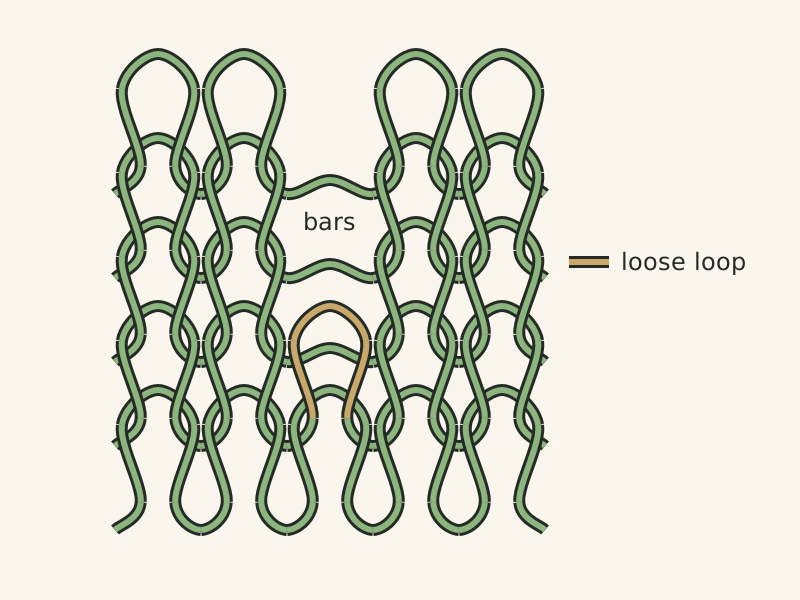
One column run down three rows. Each row's yarn now crosses the gap as a bar with no loop, and the loose loop (ochre) where the run stops has nothing passing through it.
Check level Schematic of loop structure, after de Dillmont's description; over and under set by a rule taken from her description, then crossings found and checked: no loop passes through the dropped column above the loose loop; not to scale.
"A dropped stitch run down three rows" by Fold, Knot & Bind — https://foldknotbind.com/knit-and-stitch/knit-vs-purl/ — licensed under CC BY 4.0: https://creativecommons.org/licenses/by/4.0/
Her fig. 387 even builds a decorative pattern on dropping: its “Knitting pattern with dropped stitches” drops both of its double overs and one stitch on purpose, then takes the dropped stitch up again and knits it. A column of purls could run the same way, since a purl is the identical loop. Which layer was checked explains what these schematics do and do not claim.
Sources
- Thérèse de Dillmont, Encyclopedia of Needlework, English edition (Dornach, Alsace: Th. de Dillmont, undated), Project Gutenberg eBook 20776. gutenberg.pglaf.org/cache/epub/20776/Read: full text of the Knitting chapter's opening sections (through fig. 387 and casting off), the Crochet Work chapter's opening sections and Tunisian crochet section, and the Macramé chapter's opening through fig. 531, with fig. 548 (Macramé fringe) and its caption; the eBook has no page numbers
Cite this page
“Knit Stitch vs Purl: One Loop, Seen From Opposite Sides.” Fold, Knot & Bind. Published Nov. 15, 2026. https://foldknotbind.com/knit-and-stitch/knit-vs-purl/. Accessed on the date you read it.
How diagrams and claims are checked All corrections Report an error on this page (contact@foldknotbind.com)
Next on the bench:
- Crochet vs knitting: Knitting keeps a whole row of loops live on the needle; standard crochet keeps only one.
- Macramé: One stitch repeated row after row makes a sheet of fabric; an 1890 manual says a bar of one half knot, repeated, twists of itself.
More in Knit, Stitch & Loop
Knit, Stitch & Loop
Sashiko: Hitomezashi Grids Always Split Into Two Colors
Picture credit
"Sashiko jacket, Japan, second half of the 19th century (Metropolitan Museum of Art 67.172.1)" by Unknown author — https://commons.wikimedia.org/wiki/File:%E6%97%A5%E6%9C%AC%E3%81%A8%E7%B1%B3%E5%9B%BD%E3%81%AE%E5%9B%BD%E6%97%97%E3%82%92%E7%BA%8F%E3%81%A3%E3%81%9F%E6%97%A5%E6%9C%AC%E5%A5%B3%E6%80%A7-Sashiko_Jacket_MET_DP330768.jpg — CC0 1.0 (https://creativecommons.org/publicdomain/zero/1.0/); modified: metadata stripped (embedded staff names and camera data removed; image unchanged)
Knit, Stitch & Loop
Crochet vs Knitting: Knitting Holds a Whole Row of Loops
Picture credit
"Lydia Crocheting in the Garden at Marly (Metropolitan Museum of Art 65.184)" by Mary Cassatt — https://commons.wikimedia.org/wiki/File:Lydia_Crocheting_in_the_Garden_at_Marly_MET_DP165250.jpg — CC0 1.0 (https://creativecommons.org/publicdomain/zero/1.0/); modified: cropped (black border, color bar and copyright line removed), resized to 1600 px wide
Knit, Stitch & Loop
Kumihimo: How Symmetry Limits Kongō Gumi’s Color Patterns
Picture credit
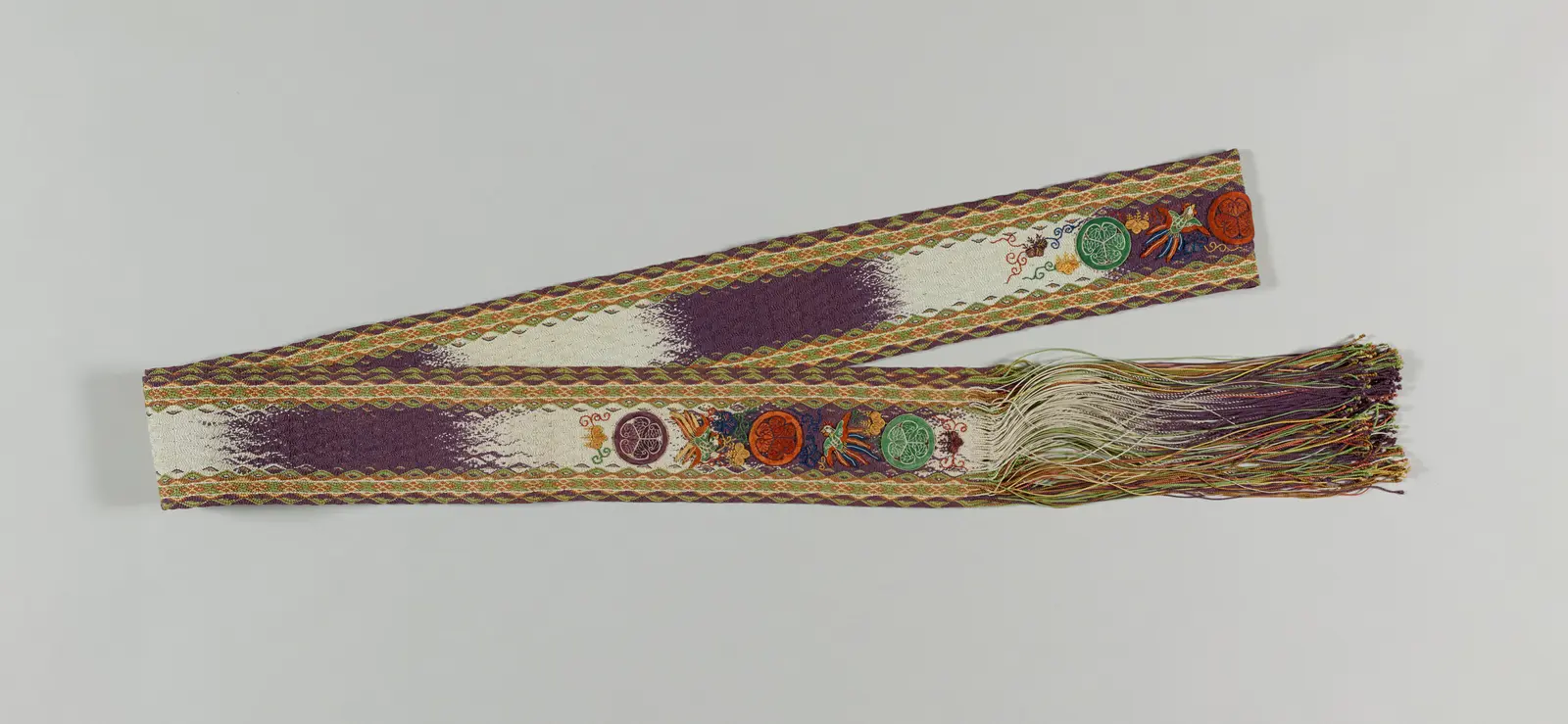
"Sageo cord for a tachi, made of kumihimo, with Tokugawa family crests (Tokyo National Museum I-1406)" by ColBase: Integrated Collections Database of the National Institutes for Cultural Heritage, Japan — https://commons.wikimedia.org/wiki/File:Sageo_cord_for_tachi_made_of_kumihimo,_%E7%B5%84%E7%B4%90%E3%81%A7%E4%BD%9C%E3%82%89%E3%82%8C%E3%81%9F%E4%B8%8B%E7%B7%92_(%E7%B6%9A%E5%B9%B3%E7%B7%92).jpg — CC BY 4.0 (https://creativecommons.org/licenses/by/4.0/); modified: metadata stripped (camera data removed; image unchanged)