Kumihimo: How Symmetry Limits Kongō Gumi’s Color Patterns
Fold, Knot & Bind Published
In brief
A two-color, 16-strand Kongō Gumi braid has 1,162 distinct patterns once symmetry is counted. That total, which includes the single-color braid and treats turned or color-swapped braids as one, matches a 2022 count by the mathematician Joshua Holden and the calculation on this page.
Materials: Sixteen strands, each one of two colors. Nothing else enters the count.
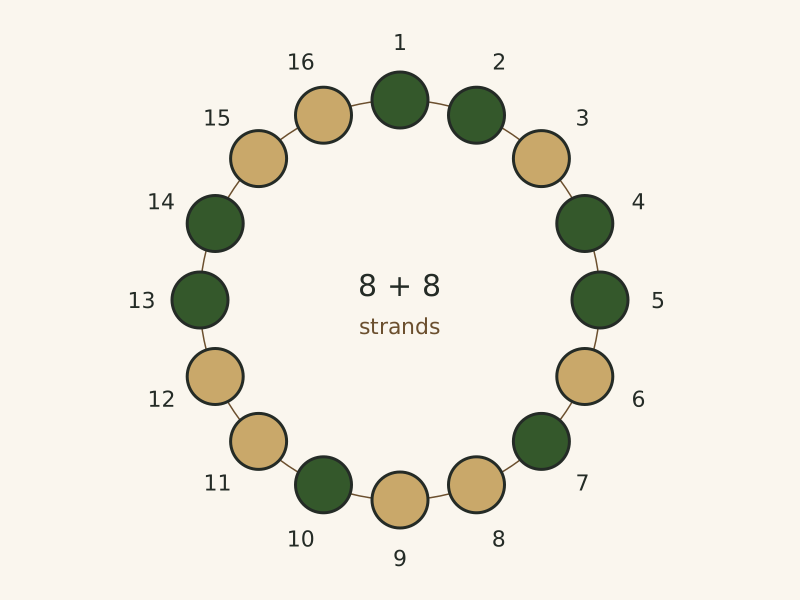
One of the 1,162 patterns: 16 color positions shown in a ring, in the order one step around the braid moves them. Eight positions are green and eight are ochre.
Check level Pattern count computed by this site with Burnside's lemma; matches Holden (2022).
"One two-color Kongō Gumi pattern on 16 positions" by Fold, Knot & Bind — https://foldknotbind.com/knit-and-stitch/kumihimo/ — licensed under CC BY 4.0: https://creativecommons.org/licenses/by/4.0/
Data: Symmetry model and published count: Joshua Holden, "Changing Spots: Using Combinatorics to Count Japanese Braiding Patterns," Bridges 2022 Conference Proceedings, pp. 327–330, https://archive.bridgesmathart.org/2022/bridges2022-327.pdf, retrieved 2026-11-14
Pick one of two colors for each of sixteen strands, and the braid's pattern is already decided. There are 65,536 ways to make those picks, two multiplied by itself 16 times. Most of them give a braid that matches another one after a turn or a color swap. Only 1,162 are different patterns.
What is kumihimo?
Kumihimo (組紐) is a Japanese style of braiding. In his 2022 paper, Holden explains the word as kumi, coming together, and himo, string, cord or rope, citing the American Kumihimo Society. He notes that kumihimo uses many more strands than Western braiding: usually a multiple of 4, and often 8 or more. The finished braid can be round, flat or something in between.
So many strands call for special equipment. One such tool is the marudai, a traditional stand, and the modern alternative is a foam disk with notches. The cord below is a flat kumihimo band made as a sageo, the cord for a tachi sword. This page could not read a source that dates the start of kumihimo, so its origin is unrecorded here.
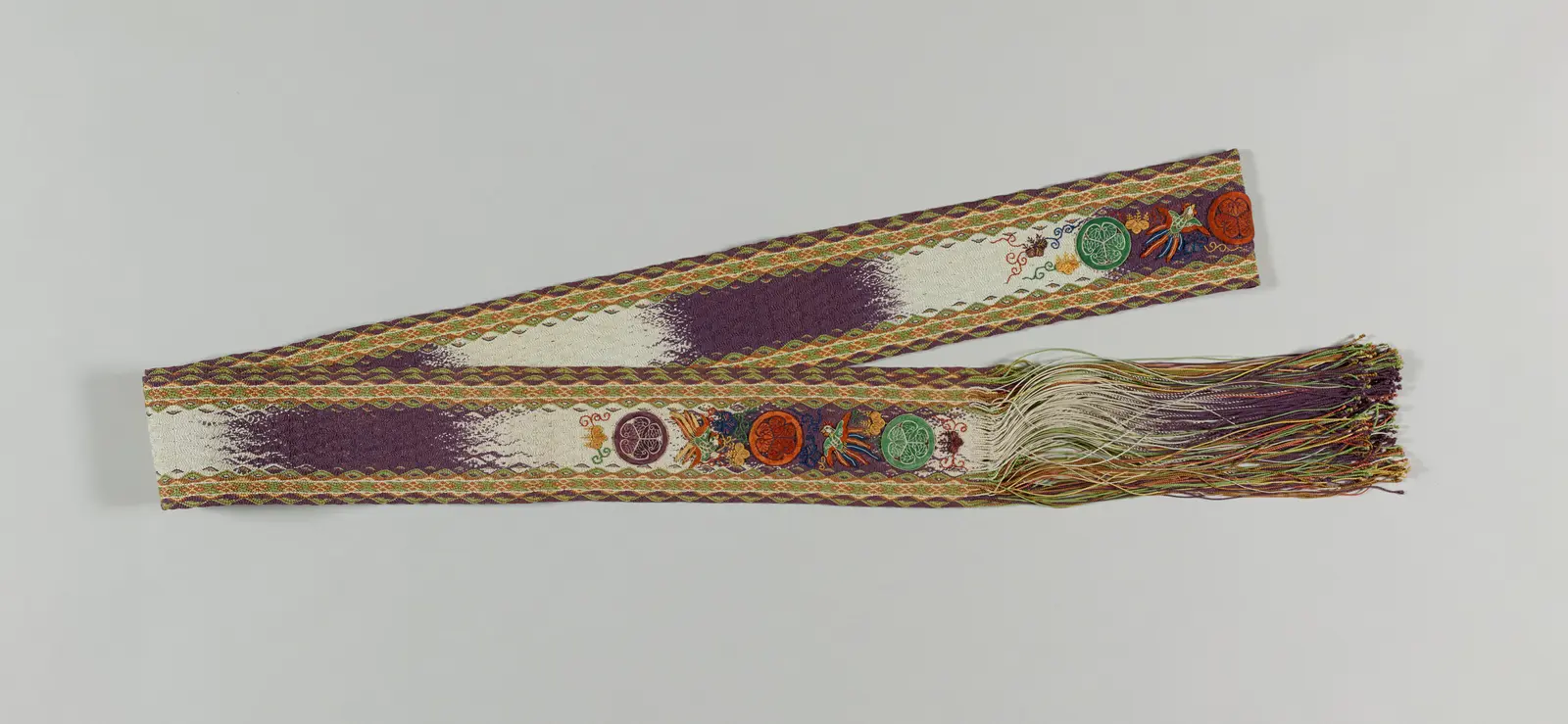
A flat kumihimo cord made as a sageo for a tachi sword, in the Tokyo National Museum. Round Tokugawa family crests, birds and flowers run along its center, and loose strands hang from one end.
"Sageo cord for a tachi, made of kumihimo, with Tokugawa family crests (Tokyo National Museum I-1406)" by ColBase: Integrated Collections Database of the National Institutes for Cultural Heritage, Japan — https://commons.wikimedia.org/wiki/File:Sageo_cord_for_tachi_made_of_kumihimo,_%E7%B5%84%E7%B4%90%E3%81%A7%E4%BD%9C%E3%82%89%E3%82%8C%E3%81%9F%E4%B8%8B%E7%B7%92_(%E7%B6%9A%E5%B9%B3%E7%B7%92).jpg — CC BY 4.0 (https://creativecommons.org/licenses/by/4.0/); modified: metadata stripped (camera data removed; image unchanged)
Kongō Gumi is a round braid, not a flat band like this one. Holden, citing the kumihimo author Rosalie Neilson, translates the name as the braid as strong as metal. This page counts that braid.
How Kongō Gumi crosses sixteen strands
A Kongō Gumi braid uses a multiple of 4 strands, and the traditional number is 16. Holden describes the strands sitting in 8 pairs, spaced evenly around the stand or disk. Each move trades strands between opposite pairs, then the work turns and the move repeats. This page leaves the hand movements there and follows the colors instead.
Each strand puts its color into a fixed set of places on the finished braid. So the 16 strands fill 16 color positions, and the colors chosen at the start fix the whole pattern. Holden notes that this way of braiding gives the finished design a lot of symmetry.
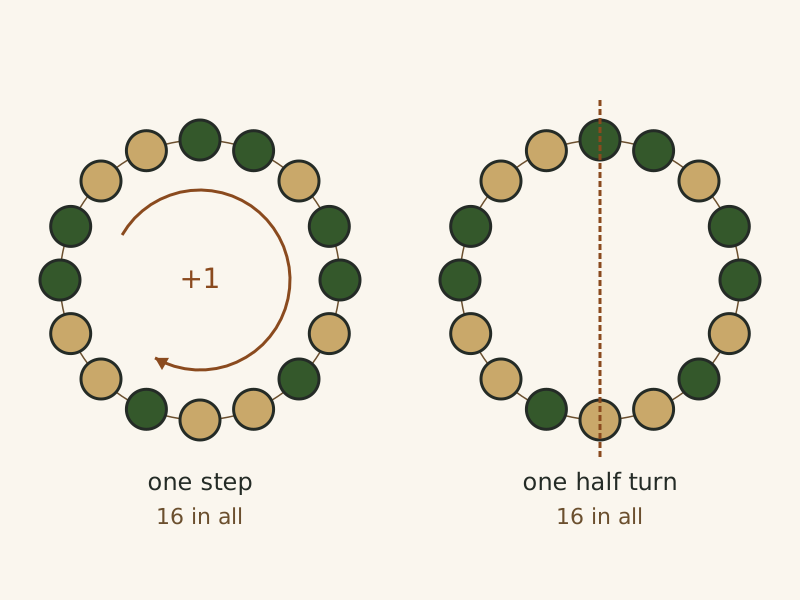
The two kinds of symmetry move. A step around the braid shifts every position to the next one, and there are 16 such steps. A half turn flips the braid end over end about a line across it, and there are 16 of those too.
Check level Symmetries as defined in Holden (2022); pattern count computed by this site with Burnside's lemma.
"The two kinds of symmetry move of a 16-strand Kongō Gumi braid" by Fold, Knot & Bind — https://foldknotbind.com/knit-and-stitch/kumihimo/ — licensed under CC BY 4.0: https://creativecommons.org/licenses/by/4.0/
Data: Symmetry model: Joshua Holden, "Changing Spots: Using Combinatorics to Count Japanese Braiding Patterns," Bridges 2022 Conference Proceedings, pp. 327–330, https://archive.bridgesmathart.org/2022/bridges2022-327.pdf, retrieved 2026-11-14
Holden sets out the symmetries of the 16-strand braid. There are 16 steps around the braid's axis, and each can be paired with a half turn about a line across it: 32 moves in all. Kongō Gumi is chiral, meaning its mirror image is a different braid, so mirrors do not count. Two braids also count as the same pattern when one is the other with the two colors traded.
Counting the patterns: why 1,162
Trace one pattern around the ring, and the same pattern shows up in many colorings. The figure below shows four different colorings of the 16 positions, and a step, a half turn or a color swap turns the first into each of the others. So all four are one pattern.
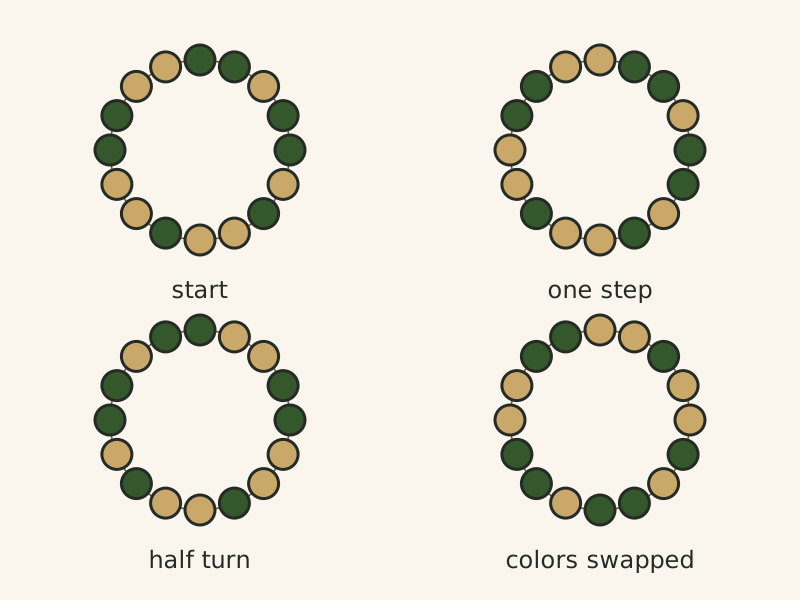
Four colorings, one pattern: the starting ring, the same ring after one step, after a half turn, and with green and ochre swapped.
Check level Pattern grouping computed by this site by listing all 65,536 colorings, with the total checked by Burnside's lemma; matches Holden (2022).
"Four colorings of one Kongō Gumi pattern" by Fold, Knot & Bind — https://foldknotbind.com/knit-and-stitch/kumihimo/ — licensed under CC BY 4.0: https://creativecommons.org/licenses/by/4.0/
Data: Symmetry model: Joshua Holden, "Changing Spots: Using Combinatorics to Count Japanese Braiding Patterns," Bridges 2022 Conference Proceedings, pp. 327–330, https://archive.bridgesmathart.org/2022/bridges2022-327.pdf, retrieved 2026-11-14
Burnside's lemma, a rule from the mathematics of symmetry, turns this into a count over 64 moves: the 32 symmetry moves, each done with or without a color swap. For every move, the calculation counts the colorings that the move leaves exactly as they were. The sum is 74,368. And 74,368 divided by 64 gives 1,162.
Some moves fix a great many colorings, others almost none. Doing nothing leaves all 65,536 unchanged. One step with the colors swapped leaves just two: the colorings that alternate green and ochre all the way around. Holden reached the same total with de Bruijn's theorem, a more general counting rule of the same family, and writes that “there are 1162 non-equivalent Kongō Gumi braid patterns, including the one which only uses one color” (p. 328).
The color swap matters. If green-for-ochre counted as a new braid, the same method would give 2,250 patterns, as the second row of the table shows.
| Two colors can swap | Moves | Unchanged colorings, summed | Patterns |
|---|---|---|---|
| Yes | 64 | 74,368 | 1,162 |
| No | 32 | 72,000 | 2,250 |
Download the pattern count (CSV) (what the file holds) Data: Symmetry model and published count: Joshua Holden, "Changing Spots: Using Combinatorics to Count Japanese Braiding Patterns," Bridges 2022 Conference Proceedings, pp. 327–330, https://archive.bridgesmathart.org/2022/bridges2022-327.pdf, retrieved 2026-11-14
A second method on this page checks the first: it sorts all 65,536 colorings into groups that the moves link together and finds 1,162 groups. In 900 of them, the pattern appears in 64 different colorings. The rest have extra symmetry and appear fewer times, down to 2 for the single-color braid and for the braid that alternates colors all the way around. So the total sits above 65,536 divided by 64, which is 1,024.
Same colors, different patterns
Holden sorts patterns by spots: the number of strands in the less-used color, which shows up as spots on a background of the other. Swapping colors turns 3 green strands into 3 ochre strands, so only 1 to 8 spots need counting. With 2 spots, only the gap between the two strands matters. It can be 1 to 8 positions, which gives the 8 patterns in the figure.
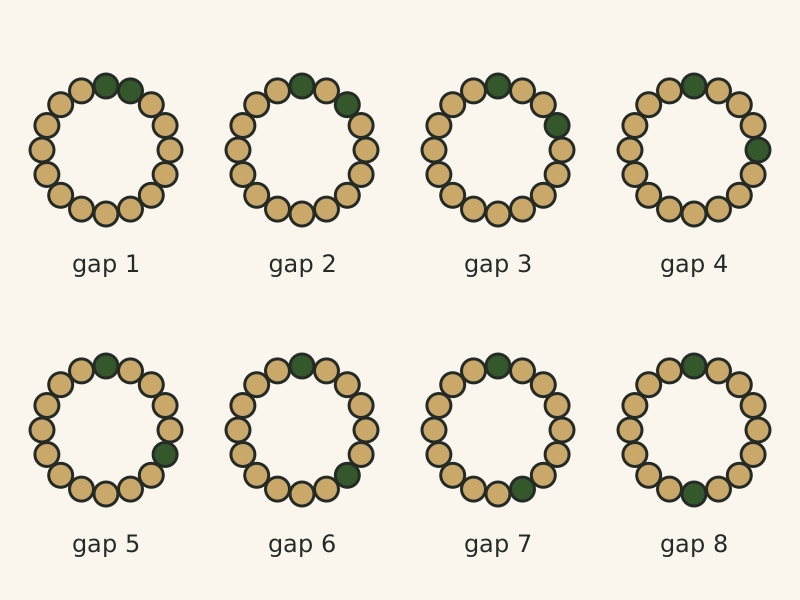
All eight two-spot patterns. Each ring has two green positions, and only the gap between them changes, from 1 position to 8.
Check level Pattern count computed by this site by listing every coloring, with the total checked by Burnside's lemma; matches Holden (2022), Table 1.
"The eight two-spot Kongō Gumi patterns" by Fold, Knot & Bind — https://foldknotbind.com/knit-and-stitch/kumihimo/ — licensed under CC BY 4.0: https://creativecommons.org/licenses/by/4.0/
Data: Symmetry model and published Table 1: Joshua Holden, "Changing Spots: Using Combinatorics to Count Japanese Braiding Patterns," Bridges 2022 Conference Proceedings, pp. 327–330, https://archive.bridgesmathart.org/2022/bridges2022-327.pdf, retrieved 2026-11-14
One spot gives just one pattern, because steps can carry a single green strand to any of the 16 positions. More spots give more patterns, up to 375 with 7 spots. Those patterns draw on 22,880 colorings, the ones with 7 green strands and the ones with 9. Eight spots, an even 8 and 8 split, draws on only 12,870 colorings and gives 257 different braids.
Neilson's 2013 catalog set out to list every 16-strand, two-color Kongō Gumi pattern, according to Holden, and it held 1,157. Holden's count predicted 1,161. The two of them then found the four missing patterns: one with 4 spots and three with 8.
| Spots | Patterns, this page | Holden (2022), Table 1 |
|---|---|---|
| 0 | 1 | in the total only |
| 1 | 1 | 1 |
| 2 | 8 | 8 |
| 3 | 21 | 21 |
| 4 | 72 | 72 |
| 5 | 147 | 147 |
| 6 | 280 | 280 |
| 7 | 375 | 375 |
| 8 | 257 | 257 |
Download the patterns by spots (CSV) (what the file holds) Data: Symmetry model and published Table 1: Joshua Holden, "Changing Spots: Using Combinatorics to Count Japanese Braiding Patterns," Bridges 2022 Conference Proceedings, pp. 327–330, https://archive.bridgesmathart.org/2022/bridges2022-327.pdf, retrieved 2026-11-14
Counting like this predicts a pattern before anyone braids it. Hitomezashi sashiko works the same way: on-or-off choices for each grid line fix the whole stitched design. Reading a Celtic knot pattern takes a count of separate cords.
How it fails: one strand out of place
Set up one strand in the wrong color, and the braid shows a different pattern. Because each strand fills its own fixed positions, the mistake changes every place that strand colors. In the figure, position 10 turns from green to ochre, and an 8 and 8 braid becomes a 7 and 9 braid.
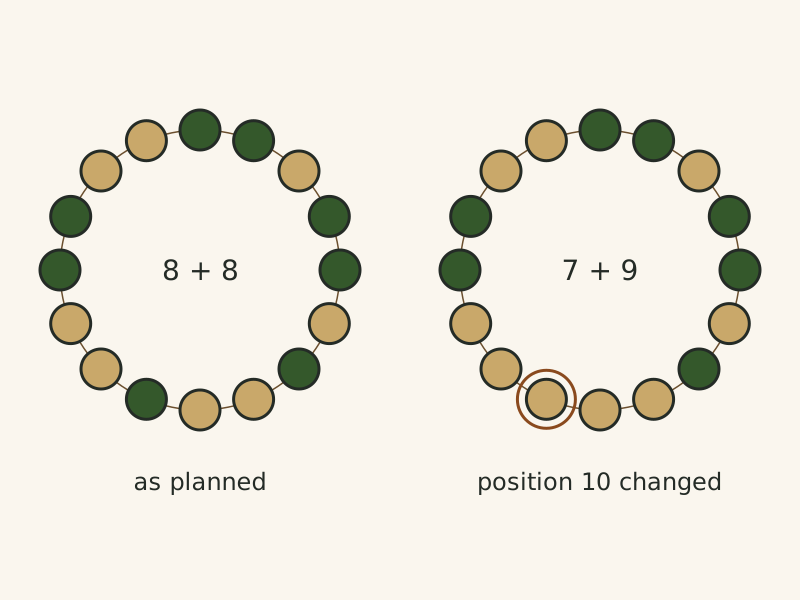
The opening pattern as planned, and the same setup with the strand at position 10 in the wrong color. The changed position is circled.
Check level Pattern grouping computed by this site by listing every coloring, with the total checked by Burnside's lemma; braid tension not modeled.
"One strand in the wrong color gives a different Kongō Gumi pattern" by Fold, Knot & Bind — https://foldknotbind.com/knit-and-stitch/kumihimo/ — licensed under CC BY 4.0: https://creativecommons.org/licenses/by/4.0/
Data: Symmetry model: Joshua Holden, "Changing Spots: Using Combinatorics to Count Japanese Braiding Patterns," Bridges 2022 Conference Proceedings, pp. 327–330, https://archive.bridgesmathart.org/2022/bridges2022-327.pdf, retrieved 2026-11-14
No turn or swap can repair that. A step or a half turn keeps the number of green strands. A swap turns 7 and 9 into 9 and 7, not back into 8 and 8. The calculation tried every single-strand change on all 65,536 colorings, 1,048,576 changes in all, and none left the pattern the same.
This failure belongs to the pattern only. This page found no readable source on how a Kongō Gumi braid behaves under strain, so it says nothing about strength or slipping. Knit and purl stitches build cloth from one strand in loops, where a kumihimo braid works many strands at once. How the site checks pattern counts is set out on which layer was checked.
Sources
- Joshua Holden, "Changing Spots: Using Combinatorics to Count Japanese Braiding Patterns," Bridges 2022 Conference Proceedings (2022): 327–330. archive.bridgesmathart.org/2022/bridges2022-327.pdfRead: full text, pages 327–330; paraphrased, with one short quotation
Cite this page
“Kumihimo: How Symmetry Limits Kongō Gumi’s Color Patterns.” Fold, Knot & Bind. Published Nov. 15, 2026. https://foldknotbind.com/knit-and-stitch/kumihimo/. Accessed on the date you read it.
How diagrams and claims are checked All corrections Report an error on this page (contact@foldknotbind.com)
Next on the bench:
More in Knit, Stitch & Loop
Knit, Stitch & Loop
Sashiko: Hitomezashi Grids Always Split Into Two Colors
Picture credit
"Sashiko jacket, Japan, second half of the 19th century (Metropolitan Museum of Art 67.172.1)" by Unknown author — https://commons.wikimedia.org/wiki/File:%E6%97%A5%E6%9C%AC%E3%81%A8%E7%B1%B3%E5%9B%BD%E3%81%AE%E5%9B%BD%E6%97%97%E3%82%92%E7%BA%8F%E3%81%A3%E3%81%9F%E6%97%A5%E6%9C%AC%E5%A5%B3%E6%80%A7-Sashiko_Jacket_MET_DP330768.jpg — CC0 1.0 (https://creativecommons.org/publicdomain/zero/1.0/); modified: metadata stripped (embedded staff names and camera data removed; image unchanged)
Knit, Stitch & Loop
Knit Stitch vs Purl: One Loop, Seen From Opposite Sides
Picture credit
"Old woman knitting (Interieur paisible), pen drawing, Rijksmuseum SK-A-3621" by Alexander Hugo Bakker Korff — https://commons.wikimedia.org/wiki/File:Breiende_oude_dame_Interieur_paisible_(titel_op_object),_SK-A-3621.jpg — CC0 1.0 (https://creativecommons.org/publicdomain/zero/1.0/)
Knit, Stitch & Loop
Crochet vs Knitting: Knitting Holds a Whole Row of Loops
Picture credit
"Lydia Crocheting in the Garden at Marly (Metropolitan Museum of Art 65.184)" by Mary Cassatt — https://commons.wikimedia.org/wiki/File:Lydia_Crocheting_in_the_Garden_at_Marly_MET_DP165250.jpg — CC0 1.0 (https://creativecommons.org/publicdomain/zero/1.0/); modified: cropped (black border, color bar and copyright line removed), resized to 1600 px wide