Macramé: An 1890 Manual Says Repeated Half Knots Twist
Fold, Knot & Bind Published
In brief
Tie the same half knot over and over and the cord starts to turn. Sylvia's Book of Macramé Lace (1890 edition) says its four-strand Twisted Bar “twists of itself,” one twist for every five repeats, while one half knot followed by its mirror image makes what the same manual calls a Double knot.
Materials: Four cords: two working cords tied around two held straight as a core. No needle, no glue.
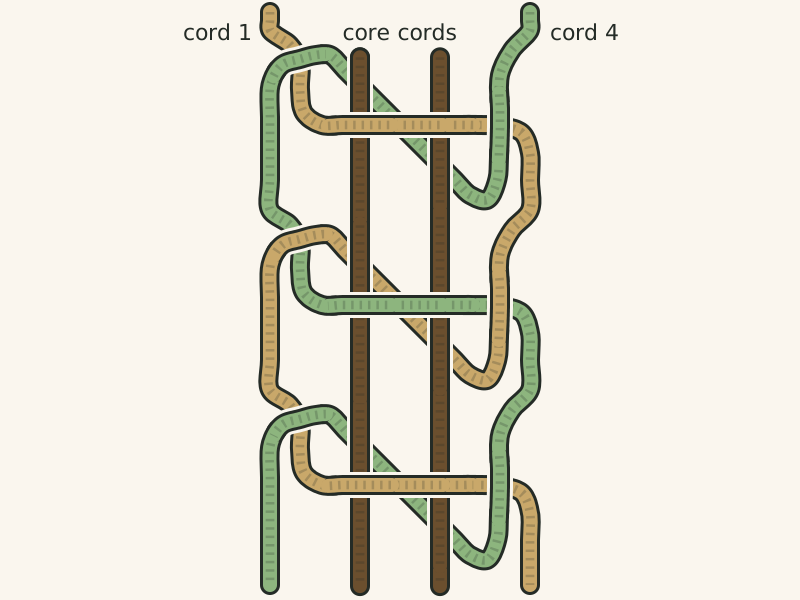
"Three half knots tied the same way over two core cords" by Fold, Knot & Bind — https://foldknotbind.com/knots/macrame/ — licensed under CC BY 4.0: https://creativecommons.org/licenses/by/4.0/
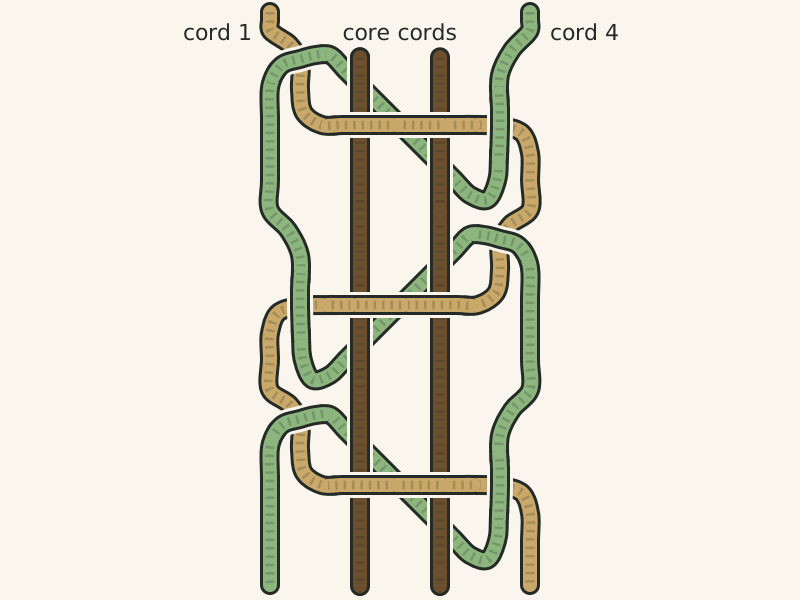
"Three half knots tied alternately over two core cords" by Fold, Knot & Bind — https://foldknotbind.com/knots/macrame/ — licensed under CC BY 4.0: https://creativecommons.org/licenses/by/4.0/
Three half knots over two core cords: in the first drawing every half is tied the same way; in the second the halves alternate. Both are drawn flat and loose.
Check level Crossings computed from the drawn centerline and checked against the written method.
Thérèse de Dillmont's Encyclopedia of Needlework describes macramé as hand-work made by “the knotting, interweaving and tying together of threads.” Both manuals build their bars from the same move. The drawings above lay the cords flat, so they show the crossings, not the twist. Neither manual gives a load figure for any bar, and the fault drawn further down is one half knot tied the wrong way.
Why repeated half knots twist
Sylvia's numbers the strands 1 to 4 and pins the middle two, 2 and 3, to a cushion as a core. Then the worker should “pass 1 over 2 and 3, and under 4, then pass 4 under 2 and 3 and up through the loop made by 1” and repeat (p. 295). That one move is a half knot, and the bar is the same half knot again and again. “It will be seen as the work proceeds, that the pattern twists of itself,” the 1890 manual says; “The number of repetitions to make one twist is five.”
De Dillmont describes a bar made the same way under another name. Her plaited knots are “formed by a continuous repetition of the first crossing of the threads for making a flat knot” (fig. 531). She words the turn differently: waved knots come from “a slight twist given to the plaited knots from left to right.” So one manual says the bar turns by itself, while the other speaks of a twist given to it.
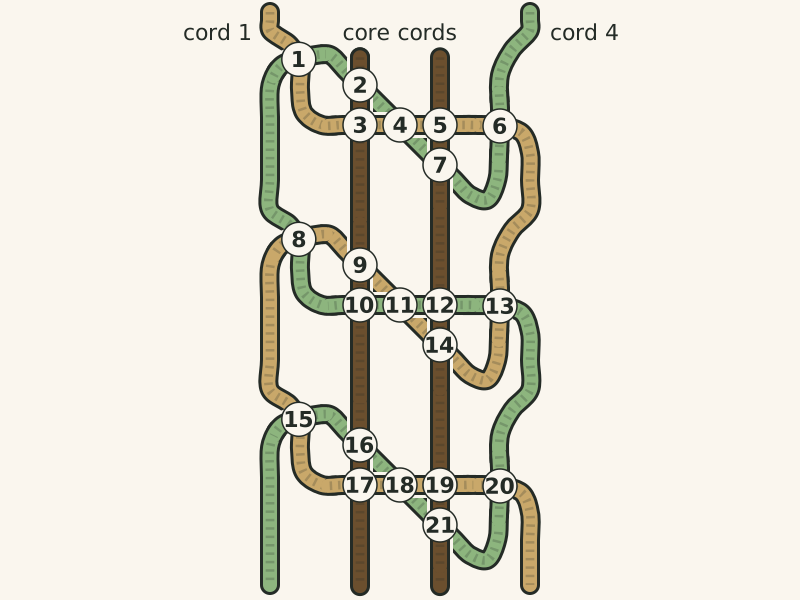
Three half knots tied the same way, crossings numbered: each half has the same seven crossings, in the same order and with the same handedness.
Check level Crossings computed from the drawn centerline and checked against the written method.
"Repeated half knots with their 21 crossings numbered" by Fold, Knot & Bind — https://foldknotbind.com/knots/macrame/ — licensed under CC BY 4.0: https://creativecommons.org/licenses/by/4.0/
Each half knot in this drawing has seven crossings. At three of them the two working cords cross each other; at the other four a working cord crosses a core cord. In all three half knots, the three cord-on-cord crossings share one sign, and the four core crossings share the other. On this page's reading, each half knot leans the bar the same way, and nothing takes the lean back.
| Half knot | Crossings | Working cords crossing each other | A working cord crossing the core |
|---|---|---|---|
| 1 | 1–7 | 3, all positive | 4, all negative |
| 2 | 8–14 | 3, all positive | 4, all negative |
| 3 | 15–21 | 3, all positive | 4, all negative |
Download the repeated half knot crossings (CSV) (what the file holds)
Read through the friction contract, each crossing is a clause, a place where cord can press on cord once the bar is pulled tight. Four of the seven involve a core cord, so the working cords cross the two pinned strands, not only each other; the loose drawing does not model tension or contact. Knitting also repeats one move and builds a sheet of fabric, as knit stitch vs purl shows; here the repeat builds a turning bar.
Alternating the two halves
The Solomon's knot in Sylvia's 1890 manual starts with the same move, then mirrors it: “pass 4 over 2 and 3 and under 1, bring 1 under 2 and 3 and up through the loop formed by 4” (p. 296). Two of these parts make what the manual calls a Double knot. De Dillmont's flat double knot starts the same way: the outer threads cross, “the right hand one under, and the left hand one over the two centre threads,” and are then brought back and tied again (fig. 516).
A. Hyatt Verrill's 1917 rope manual gives the square knot this way: “pass the left end over and under the right end, then the right over and under the left” (Figs. 11–12). On this page's reading, the flat knot is that same left-then-right pair tied around a core, and the twisting bar is half a square knot, repeated.
The square knot and its look-alike, the granny, differ by the same kind of mirror, as square knot vs granny knot shows.
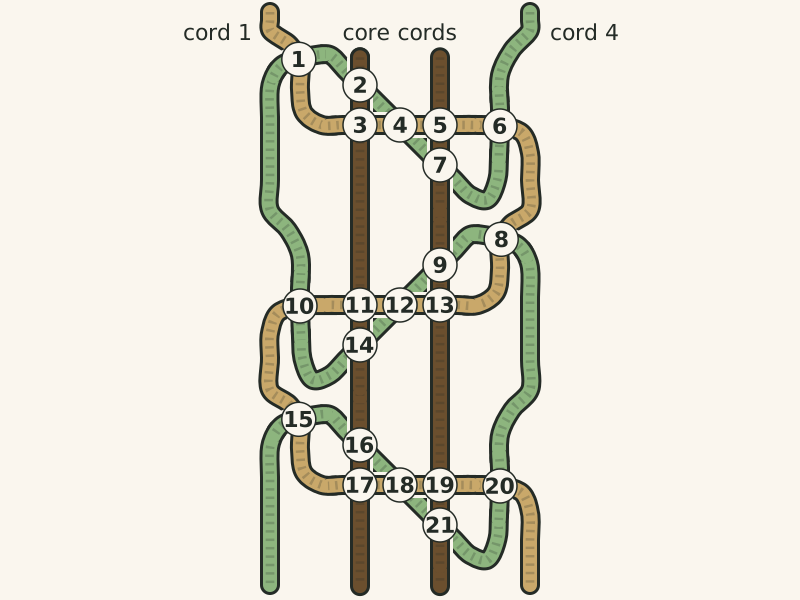
Three half knots tied alternately, crossings numbered: the second half is the mirror image of the first and third.
Check level Crossings computed from the drawn centerline and checked against the written method.
"Alternating half knots with their 21 crossings numbered" by Fold, Knot & Bind — https://foldknotbind.com/knots/macrame/ — licensed under CC BY 4.0: https://creativecommons.org/licenses/by/4.0/
In this table every sign in the middle half knot is reversed. In the alternating drawing one cord makes every front bar; in the repeated drawing the front bar changes cord each time. Neither manual says the alternating bar twists. On this page's reading, each half undoes the lean of the one before, which fits de Dillmont's word for it: flat.
| Half knot | Crossings | Working cords crossing each other | A working cord crossing the core |
|---|---|---|---|
| 1 | 1–7 | 3, all positive | 4, all negative |
| 2 | 8–14 | 3, all negative | 4, all positive |
| 3 | 15–21 | 3, all positive | 4, all negative |
Download the alternating half knot crossings (CSV) (what the file holds)
How these drawings are tested is set out on which layer was checked.
What macramé is, and where the word comes from
Two manuals give two stories for the name, and this page chooses neither. De Dillmont writes that “Macramé is an Arabic word, signifying an ornamental fringe or trimming.” Sylvia's 1890 edition calls it “nothing but the name given by the Italians round about Genoa” to “a coarse material used for towels, the fringed ends of which are knotted” (p. 289). Neither manual names a source for its account.
Sylvia's 1890 manual calls the work lace, and de Dillmont treats it as trimming, listing “not only fringe and lace, but trimmings of all kinds, in the shape of bands and stripes and headings.” Decorative knots can be read with the same care as working ones; Celtic knot patterns do it for interlace on a grid.
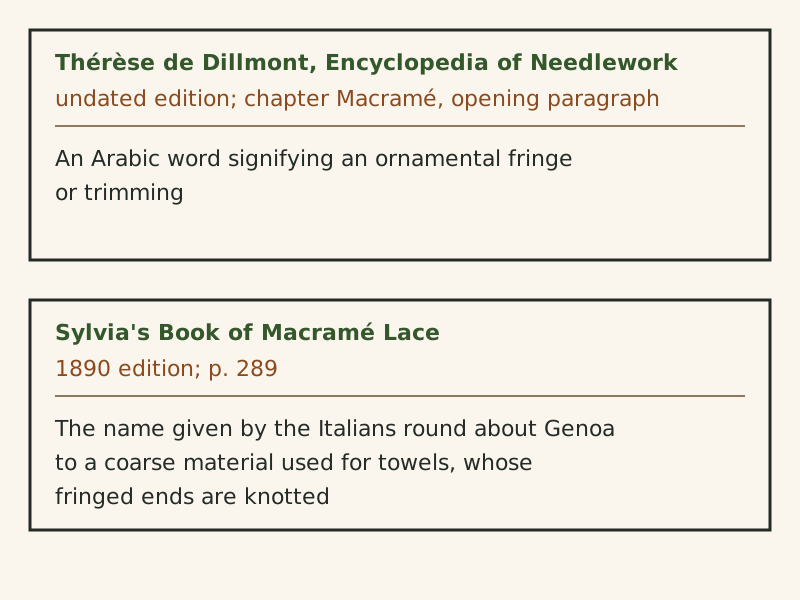
Two accounts of the word macramé, side by side, with the manual, edition and place in the book that each comes from. Neither manual gives a source for its account.
Check level Each row taken from this page's CSV; sources and years in the table.
"Two accounts of the word macramé" by Fold, Knot & Bind — https://foldknotbind.com/knots/macrame/ — licensed under CC BY 4.0: https://creativecommons.org/licenses/by/4.0/
| Account of the word | Manual | Edition | Where |
|---|---|---|---|
| An Arabic word for an ornamental fringe or trimming | de Dillmont, Encyclopedia of Needlework | Undated English edition | Chapter “Macramé” |
| A name used round Genoa for a coarse towel material with knotted fringed ends | Sylvia's Book of Macramé Lace | 1890 | p. 289 |
Download the macramé sources and claims (CSV) (what the file holds)
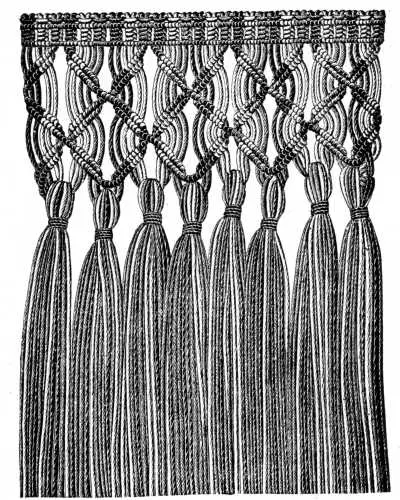
A macramé fringe from de Dillmont's Encyclopedia of Needlework (fig. 548): a knotted heading along the top, diagonal bands of knots crossing below it, and the loose ends bound into tassels.
“Macramé fringe (fig. 548), from Encyclopedia of Needlework”, Thérèse de Dillmont, Encyclopedia of Needlework; public domain.
Full credit
"Macramé fringe (fig. 548), from Encyclopedia of Needlework" (undated English edition (before 1931)), Thérèse de Dillmont, Encyclopedia of Needlework — https://gutenberg.pglaf.org/cache/epub/20776/images/563.jpg — Public domain in US: published before 1931 (undated English edition of the Encyclopedia of Needlework; title page 'To be had of Th. de Dillmont, Dornach, Alsace'); EU (DE/FR): author Thérèse de Dillmont d. 1890; engraver not named in the book (anonymous, published more than 70 years ago)
How it fails: one half knot the wrong way
The fault drawn here is a mix-up of strands, not a broken cord. Sylvia's 1890 manual says strands are “re-numbered at the beginning, not only of every row, but of every stage of a design” (p. 299), a step it mentions “to prevent any errors.” On this page's reading, a worker who counts strand 1 from the wrong side ties the next half knot as its mirror image.
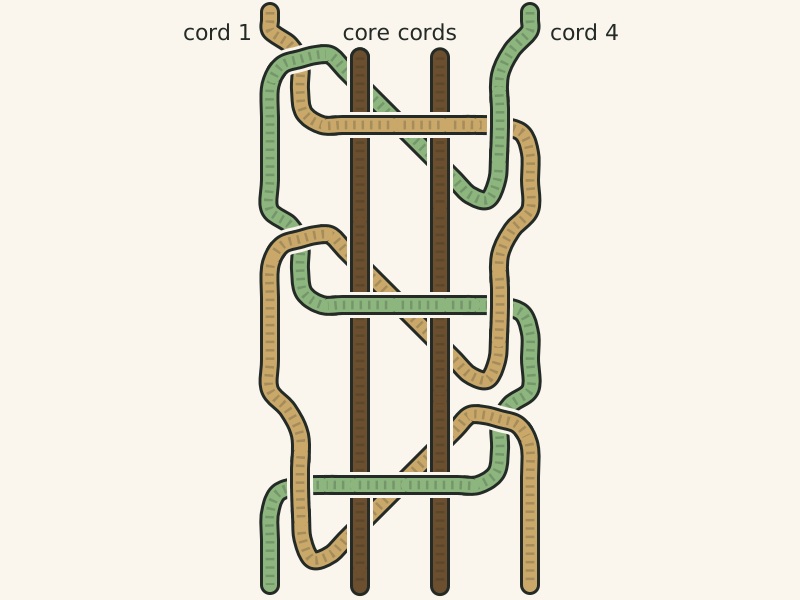
Three half knots: the first two tied the same way, the third tied the other way, so the last two together form a mirrored pair, as in the flat knot.
Check level Crossings computed from the drawn centerline and checked against the written method.
"Repeated half knots with the third tied the other way" by Fold, Knot & Bind — https://foldknotbind.com/knots/macrame/ — licensed under CC BY 4.0: https://creativecommons.org/licenses/by/4.0/
In this drawing's table, crossings 15 to 21 carry the opposite signs from the two half knots above them. On this page's reading, the wrong half undoes the lean of the one before it, so the steady turn breaks there. No manual read for this page pictures the mistake.
| Half knot | Crossings | Working cords crossing each other | A working cord crossing the core |
|---|---|---|---|
| 1 | 1–7 | 3, all positive | 4, all negative |
| 2 | 8–14 | 3, all positive | 4, all negative |
| 3 (tied the other way) | 15–21 | 3, all negative | 4, all positive |
Download the crossings with one half knot reversed (CSV) (what the file holds)
Macramé is decorative: both manuals present it as lace or trimming, and neither gives a load, a test or a strength figure for any bar. De Dillmont praises the work's “great durability and strength” as a trimming but names no test. A twisted bar is not meant to bear a load, and nothing on this page rates it for one.
Sources
- Sylvia's Book of Macramé Lace: Containing Illustrations of Many New and Original Designs, with Complete Instructions for Working (London and New York: Ward, Lock, Bowden, and Co., 1890). archive.org/details/sylviasbookofmac00londRead: pages 289, 295, 296 and 299 checked against the page images; pages 289 to 302 read for context
- Thérèse de Dillmont, Encyclopedia of Needlework, English edition (Dornach, Alsace: Th. de Dillmont, undated), Project Gutenberg eBook 20776. gutenberg.pglaf.org/cache/epub/20776/Read: full text of the Knitting chapter's opening sections (through fig. 387 and casting off), the Crochet Work chapter's opening sections and Tunisian crochet section, and the Macramé chapter's opening through fig. 531, with fig. 548 (Macramé fringe) and its caption; the eBook has no page numbers
- A. Hyatt Verrill, Knots, Splices and Rope Work: A Practical Treatise, 2nd rev. ed. (New York: Norman W. Henley, 1917). gutenberg.pglaf.org/cache/epub/13510/Read: full text of the 1917 edition; pages 21-22 and 45-46 checked against the page images of the 1912 printing
- Richard Henry Dana Jr., The Seaman's Friend, 5th ed. (Boston: Thomas Groom, 1847). gutenberg.pglaf.org/cache/epub/40958/Read: full text of the knots section (Nos. 17-24) and the dictionary of sea terms entries Clove-hitch and Half-hitch
Cite this page
“Macramé: An 1890 Manual Says Repeated Half Knots Twist.” Fold, Knot & Bind. Published Nov. 15, 2026. https://foldknotbind.com/knots/macrame/. Accessed on the date you read it.
How diagrams and claims are checked All corrections Report an error on this page (contact@foldknotbind.com)
Next on the bench:
- Square knot vs granny knot: The square knot itself: two half knots tied in opposite directions.
- Clove hitch vs two half hitches: A hitch, not a half knot: in Dana's 1847 text, two half hitches made round a spar are a clove hitch; Lever's 1843 manual draws the line elsewhere.
More in Knots
Knots
Square Knot vs Granny Knot: One Throw Reversed
Picture credit
"Gold armband with Herakles knot, Greek, 3rd–2nd century B.C. (Metropolitan Museum of Art 1999.209)" by Unknown author — https://commons.wikimedia.org/wiki/File:Gold_armband_with_Herakles_knot_MET_DT4404.jpg — CC0 1.0 (https://creativecommons.org/publicdomain/zero/1.0/)
Knots
Bowline Knot: The Grip Is at the Small Eye, Not the Big Loop
Picture credit
"Palstek (bowline)" (2005), Sebastian Magnusson Wigmo — https://commons.wikimedia.org/wiki/File:Palstek.jpg — Public domain in US and EU (DE/FR): released into the public domain by its author, Sebastian Magnusson Wigmo, worldwide, with a fallback grant to use it for any purpose (author's dedication on the file page)
Knots
Celtic Knot Patterns: Some Are One Cord, Some Are Several
Picture credit
"Carpet page, from the Lindisfarne Gospels" (late 7th or early 8th century), Unknown author — https://commons.wikimedia.org/wiki/File:Meister_des_Book_of_Lindisfarne_002.jpg — Public domain in US: medieval manuscript page, public domain; faithful photographic reproduction of a two-dimensional work (PD-Art). EU: maker died more than 1,000 years ago; faithful reproduction of a public-domain visual work (EU Directive 2019/790, Art. 14)