Japanese Stab Binding: Sewn Through, and Hard to Open Flat
Fold, Knot & Bind Published
In brief
Japanese stab binding sews a stack of leaves straight through near the spine, wrapping thread over the edge. A 1982 bookbinding dictionary calls it extremely strong but not very flexible, so the pages open only past the stitched margin.
Materials: A stack of leaves between two covers and one thread. For the four-hole form, the National Diet Library handout (2026) uses silk about three and a half times the book's height, plus two twists of paper inside. No glue in the sewing.
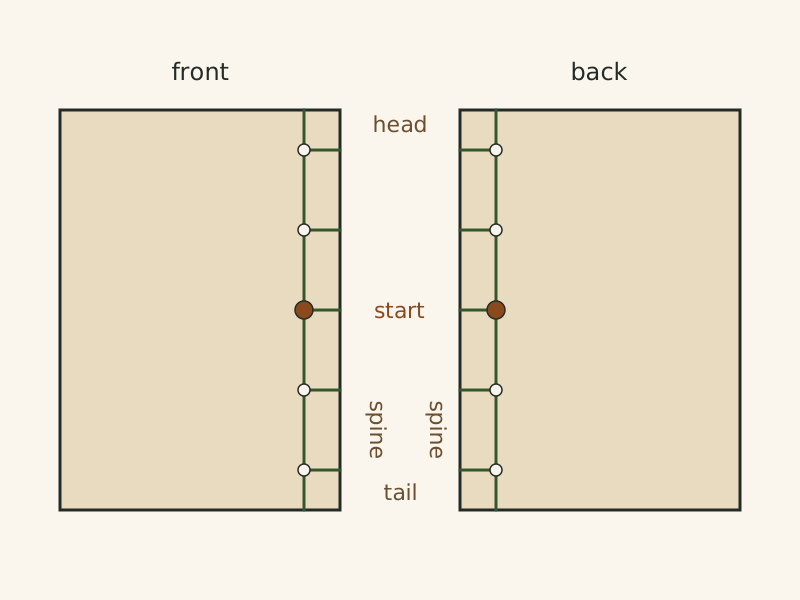
A route that starts at the center hole, shown front and back. The thread wraps the spine at every hole, and the head and tail at the end holes.
Check level Schematic, not to scale, after Roberts and Etherington (1982), with a spine wrap at each hole as in the National Diet Library handout (2026); the thread route is checked by this page's calculation.
"Center-start stab binding route with five holes" by Fold, Knot & Bind — https://foldknotbind.com/bookbinding/japanese-stab-binding/ — licensed under CC BY 4.0: https://creativecommons.org/licenses/by/4.0/
Turn a Japanese stab-bound book on its side and look at the thread along the spine edge. It crosses the edge at every hole and runs along the cover between them. The stitches go through the side of the whole stack, one of the three places where bookbinding methods can grip paper.
How does the thread go through the whole stack?
Matt Roberts and Don Etherington's 1982 dictionary of bookbinding terms, published by the Library of Congress, lists this method as “Japanese sewing.” The leaves are gathered and knocked even, and a hole is drilled through the entire thickness of the pile near the spine. More holes go on either side at equal distances.
The dictionary counts the holes as an odd number when the sewing starts at the center hole. From there the thread runs to the head, over it, down along the spine past the center to the tail, and back to the center. The two ends are tied in a flat knot on the outside. Thread, cord, string, yarn or tape can all serve.
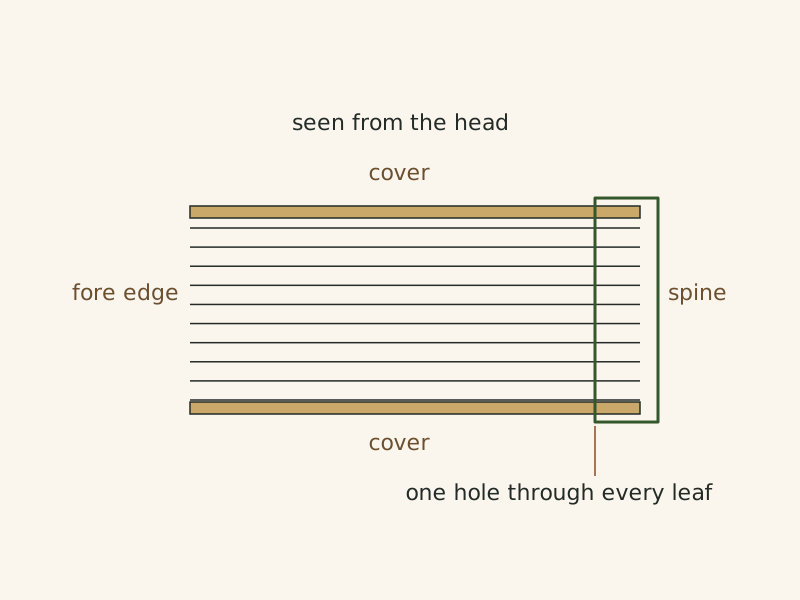
Seen from the head, one hole runs through every leaf and both covers. The thread passes through it and wraps around the spine edge.
Check level Schematic, not to scale, after Roberts and Etherington (1982); no geometric check.
"Stab binding cross-section, seen from the head" by Fold, Knot & Bind — https://foldknotbind.com/bookbinding/japanese-stab-binding/ — licensed under CC BY 4.0: https://creativecommons.org/licenses/by/4.0/
The thread runs in a straight line, much like the running stitches of hitomezashi sashiko. The difference is depth: here each stitch passes through the whole book.
Why is it called Japanese?
The name points to Japan, but the method was developed in China, according to Roberts and Etherington's 1982 dictionary. The dictionary gives no date or place beyond that, and this page could not read a source for when the method reached Japan.
The National Diet Library, Japan's national library, still teaches it. Its 2026 handout for a workshop on old Japanese books notes one difference in the thread: Japanese-bound books mostly use one thick strand, while books in classical Chinese more often use two thin strands.
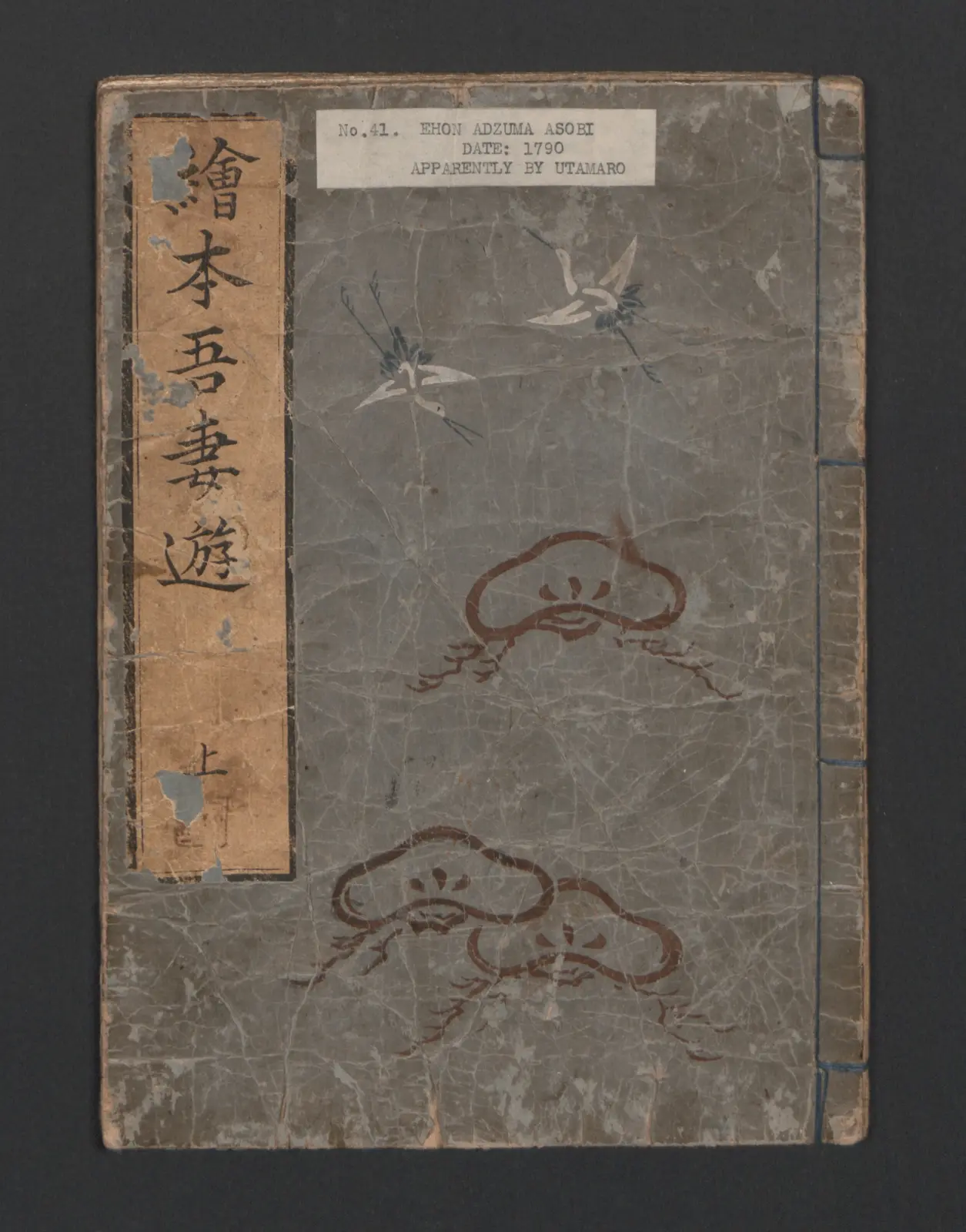
Cover of Ehon Azuma asobi, a woodblock-printed picture book of 1790 attributed to Kitagawa Utamaro. Blue thread runs along the spine edge and wraps it at four points; a museum label sits near the top.
"Ehon Azuma asobi (Picture Book of Amusements of the Eastern Capital), cover" by Kitagawa Utamaro (attributed), Metropolitan Museum of Art — https://commons.wikimedia.org/wiki/File:%E7%B5%B5%E6%9C%AC%E5%90%BE%E5%A6%BB%E9%81%8A-Ehon_Azuma_asobi-Picture_Book_of_Amusements_of_the_Eastern_Capital_(Ehon_Azuma_asobi)_MET_JIB41_001.jpg — CC0 1.0 (https://creativecommons.org/publicdomain/zero/1.0/)
Four holes: yotsume toji
The National Diet Library handout teaches yotsume toji (四つ目綴じ), “four-hole binding.” Its drawing shows four main sewing holes near the spine. Two pairs of smaller holes sit between them, and each pair holds a twist of paper that ties the leaves together before the thread goes on.
The handout starts the thread at the second hole from the tail and works toward the head, where more holes lie. The thread passes through every hole at least three times. The dictionary's center-start method needs an odd count, and its other method, begun from one end, allows an even one. The four-hole route starts at neither, so it matches neither description exactly.
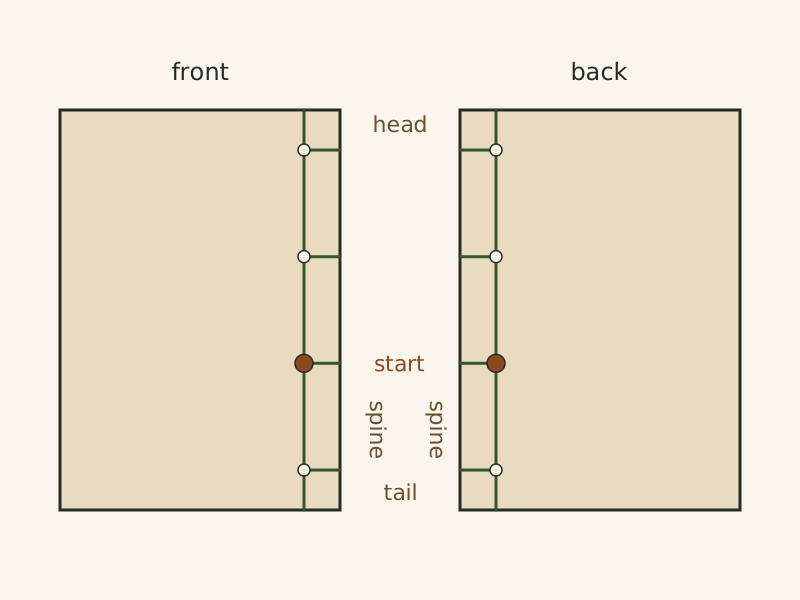
The four-hole route, front and back. The front shows one line of thread joining all four holes, with a wrap over the spine at each hole and over the head and tail.
Check level Schematic, not to scale, after the National Diet Library handout (2026); the thread route is checked by this page's calculation.
"Four-hole stab binding route (yotsume toji)" by Fold, Knot & Bind — https://foldknotbind.com/bookbinding/japanese-stab-binding/ — licensed under CC BY 4.0: https://creativecommons.org/licenses/by/4.0/
The calculation on this page models that route as 12 runs of thread. In the model every hole is passed at least 3 times, and each pair of neighboring holes is joined once on the front and once on the back. The handout's own drawing numbers 12 steps.
| Pattern | Holes | Runs of thread | Source |
|---|---|---|---|
| Japanese sewing, started at the center | Odd | Not stated | Roberts and Etherington (1982) |
| Japanese sewing, started at one end | Even or odd | Not stated | Roberts and Etherington (1982) |
| Yotsume toji | 4 | 12 numbered steps | National Diet Library (2026) |
| Yotsume toji, model on this page | 4 | 12 | This page's calculation |
| Center start with 5 holes, model on this page | 5 | 15 | This page's calculation |
Download the stab binding patterns (CSV) (what the file holds)
The 1790 cover above shows four wraps at the spine edge, which fits a four-hole sewing. The catalog data on its Commons file page does not name the pattern.
Inside a stab-bound book
Inside the same 1790 book, an open spread stops short of the gutter, the place where facing pages meet. The printed frames end well before the stitched margin. That margin stays shut, because the thread pins every leaf there.
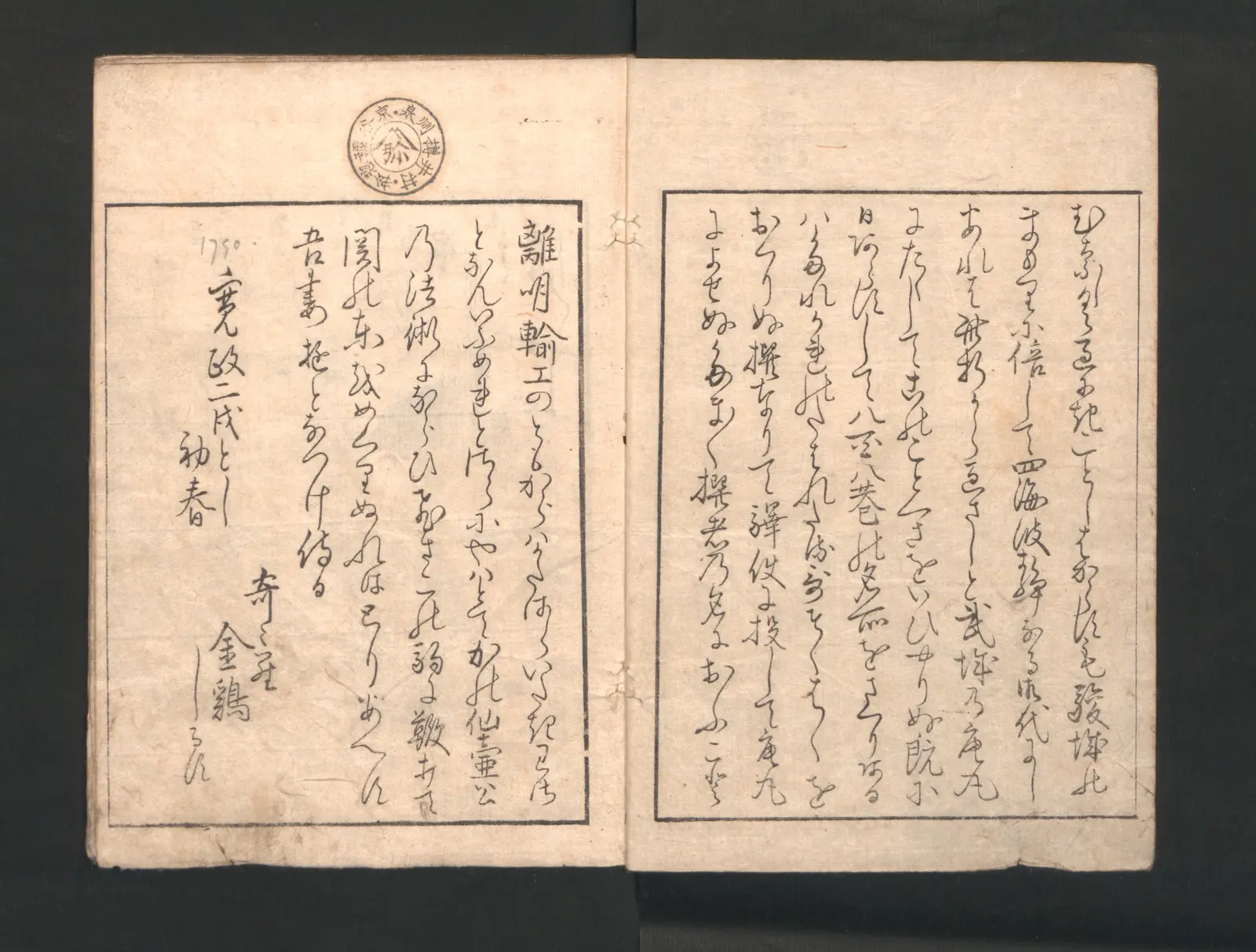
An opening of Ehon Azuma asobi (1790). Both text frames stop short of the center, and two small puckered tufts of paper show in the gutter.
"Ehon Azuma asobi (Picture Book of Amusements of the Eastern Capital), opening with preface text" by Kitagawa Utamaro (attributed), Metropolitan Museum of Art — https://commons.wikimedia.org/wiki/File:%E7%B5%B5%E6%9C%AC%E5%90%BE%E5%A6%BB%E9%81%8A-Ehon_Azuma_asobi-Picture_Book_of_Amusements_of_the_Eastern_Capital_(Ehon_Azuma_asobi)_MET_JIB41_003.jpg — CC0 1.0 (https://creativecommons.org/publicdomain/zero/1.0/)
The National Diet Library handout adds a last step for a newly bound book. Two creases are pressed into the front cover just inside the stitching, and the cover is opened along them so it bends there.
How it fails: strong, but stiff at the spine
Roberts and Etherington call Japanese sewing extremely strong, “possibly one of the strongest ever devised.” In the same entry they note that it does not allow much flexibility, especially in small books. The book opens only where the paper can bend, in the margin past the stitches.
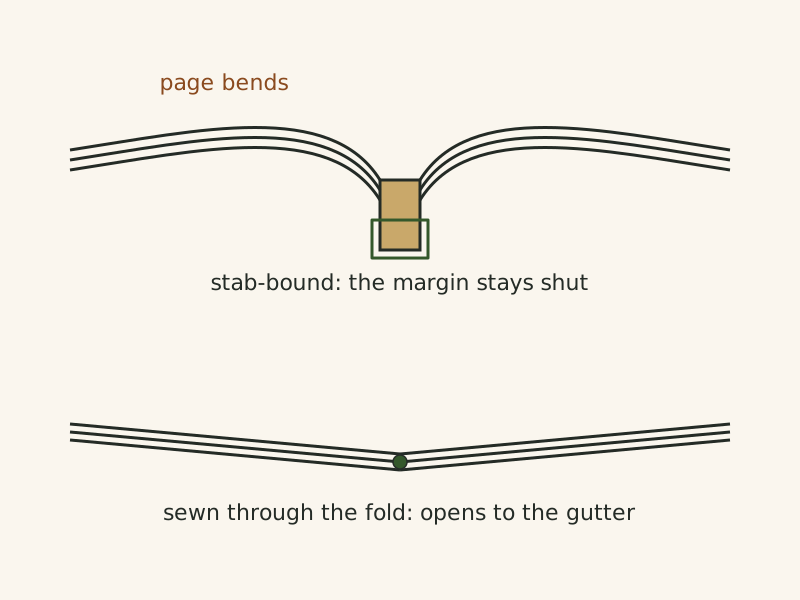
A stab-bound book keeps its stitched margin shut, and its pages bend beyond it. One section sewn through its fold opens to the gutter.
Check level Schematic, not to scale, after Roberts and Etherington (1982); no geometric check.
"Stab-bound and fold-sewn books, opened, seen from the head" by Fold, Knot & Bind — https://foldknotbind.com/bookbinding/japanese-stab-binding/ — licensed under CC BY 4.0: https://creativecommons.org/licenses/by/4.0/
Here the third hand is the thread's tension, which keeps the leaves pressed together once the sewing is done. The 2026 handout has the binder hold the thread down with a thumb while sewing, so it does not loosen. The final knot is pulled firm so no slack is left.
Thread still wears out or breaks. The handout's answer is the twists of paper inside: because they tie the leaves first, the leaves do not scatter if the sewing thread breaks. It also urges caution before re-sewing. Thread that is a little broken or loose need not be replaced if the paper tie holds and the book is usable, since re-sewing cuts the old thread and can damage the book.
Sources
- Matt T. Roberts and Don Etherington, Bookbinding and the Conservation of Books: A Dictionary of Descriptive Terminology (Washington: Library of Congress, 1982; Supt. of Docs. no. LC 1.2:B64/3; electronic edition prepared by Walter Henry, Stanford University Libraries, 1994), notes on the electronic edition cool.culturalheritage.org/don/tn/tn6.htmlRead: full page (notes on the electronic edition)
- Roberts and Etherington, Bookbinding and the Conservation of Books (1982), “Japanese sewing” cool.culturalheritage.org/don/dt/dt1913.htmlRead: full entry
- National Diet Library, Collections Department, Preservation Division, "Yotsume toji no tojikata" [How to sew four-hole binding], handout for the 24th Japanese Classical Books Workshop (Tokyo: National Diet Library, 2026), 7 pp. www.ndl.go.jp/file/preservation/cooperation/t…Read: full text (7 pages), read from the page imagesText license: Public Data License 1.0 (Japan) (terms)
- Kitagawa Utamaro (attributed), Ehon Azuma asobi (Picture Book of Amusements of the Eastern Capital), woodblock-printed book, 1790, Metropolitan Museum of Art JIB41; file pages on Wikimedia Commons. commons.wikimedia.org/wiki/Category:Ehon_Azuma_asobi_…Read: file pages for the cover and three openings; museum record not consulted
Cite this page
“Japanese Stab Binding: Sewn Through, and Hard to Open Flat.” Fold, Knot & Bind. Published Nov. 15, 2026. https://foldknotbind.com/bookbinding/japanese-stab-binding/. Accessed on the date you read it.
How diagrams and claims are checked All corrections Report an error on this page (contact@foldknotbind.com)
Next on the bench:
- Coptic binding: another binding with its thread on show, but it links each folded section to the next with chain stitches.
- Saddle stitching: the opposite grip, through the center fold only, so the book opens right to the gutter.
More in Bookbinding
Bookbinding
Bookbinding Methods: Perfect Binding Uses Glue, Not Thread
Picture credit
"Sewing press, from The Art of Bookbinding" (1890), Joseph William Zaehnsdorf — https://commons.wikimedia.org/wiki/File:Art_of_Bookbinding_p056_Sewing_Press.png — Public domain in US: published 1890 (George Bell and Sons, London, second edition; first edition 1879), before 1931; DE/FR: published 1890 in a book by Joseph William Zaehnsdorf (d. 1930), engraver not named, so both life + 70 and 70 years from publication have expired
Bookbinding
Coptic Binding: Each Section Is Chained to the Next
Picture credit
"Model Coptic binding" by Ratbasket at English Wikipedia — https://commons.wikimedia.org/wiki/File:Coptic_flat.jpg — CC BY 2.5 (https://creativecommons.org/licenses/by/2.5/); modified: lightly smoothed to reduce file size
Bookbinding
Saddle Stitching: Each Folded Sheet Adds Four Pages
Picture credit
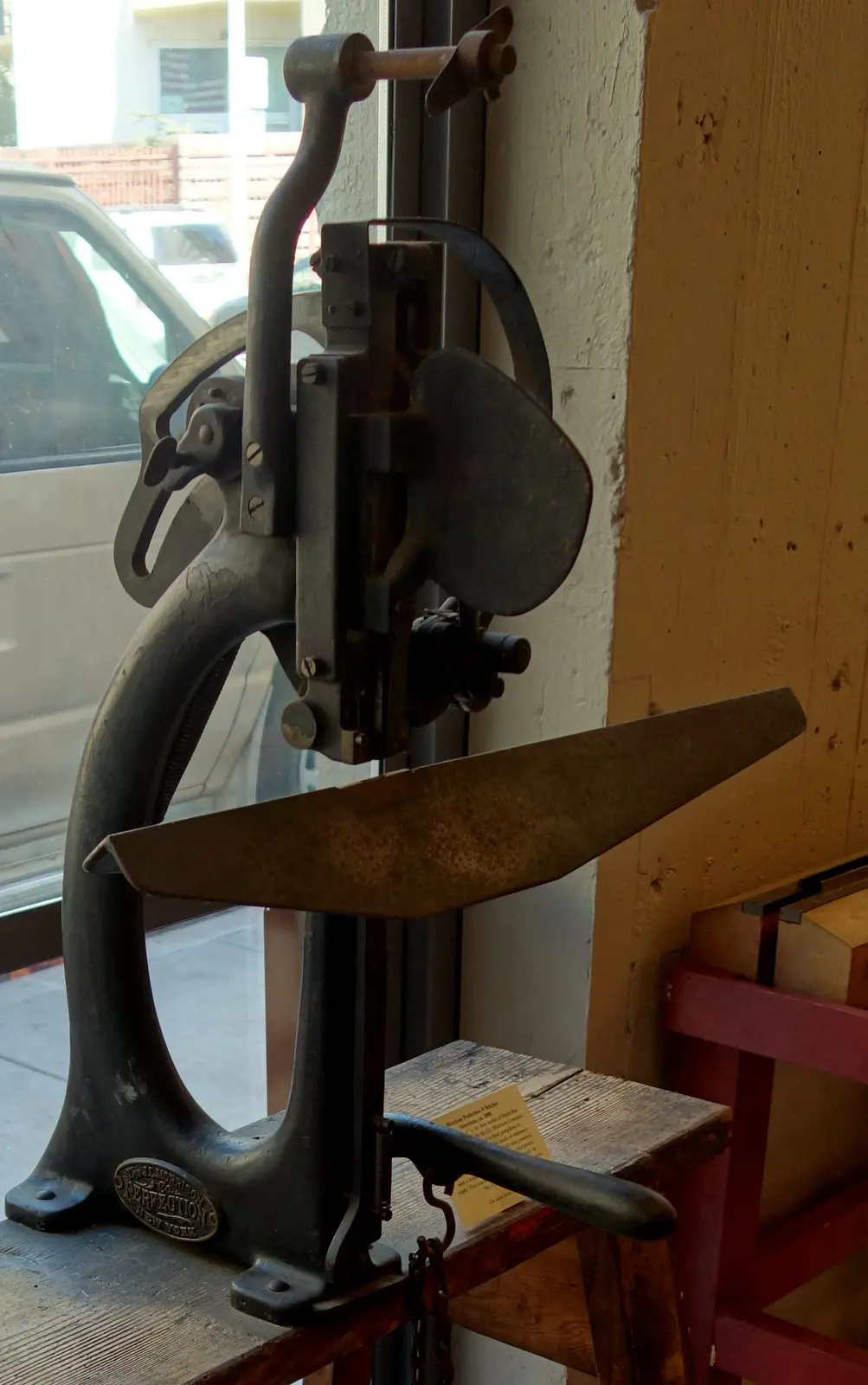
"Morrison Perfection A Stitcher (stapler), c. 1890 - American Bookbinders Museum - San Francisco, CA" by Daderot — https://commons.wikimedia.org/wiki/File:Morrison_Perfection_A_Stitcher_(stapler),_c._1890_-_American_Bookbinders_Museum_-_San_Francisco,_CA_-_DSC08204.jpg — CC0 1.0 (https://creativecommons.org/publicdomain/zero/1.0/); modified: cropped