Saddle Stitching: Each Folded Sheet Adds Four Pages
Fold, Knot & Bind Published
In brief
A saddle-stitched booklet of whole folded sheets has pages in fours: each sheet makes two leaves, four pages. Wire staples go through that shared fold, so the booklet opens all the way to the gutter, as Roberts and Etherington’s 1982 bookbinding dictionary notes, but thick stacks push the middle pages outward.
Materials: Sheets of paper, each folded once and tucked one inside the next. Two or more wire staples through the fold. No glue, no thread.
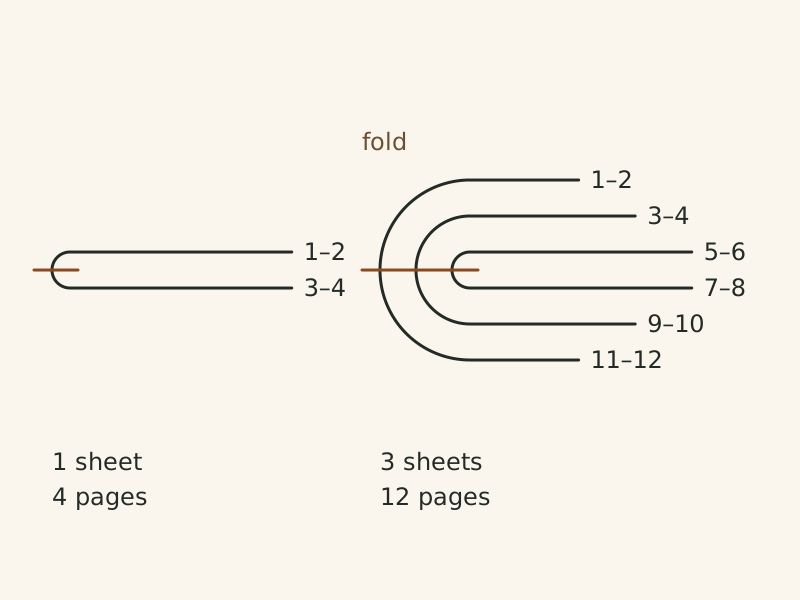
One folded sheet carries four pages, and three sheets nested one inside another carry twelve. The view is from the head of the booklet, with the gaps between sheets drawn far wider than real paper.
Check level Page order computed for nested folded sheets; paper thickness not used; drawing not to scale.
"One folded sheet is four pages; three nested sheets are twelve" by Fold, Knot & Bind — https://foldknotbind.com/bookbinding/saddle-stitching/ — licensed under CC BY 4.0: https://creativecommons.org/licenses/by/4.0/
When a stack of sheets is folded in half as one, the innermost sheet pokes out farthest. That small fact, and the fold the staples pass through, explain most of how a saddle-stitched booklet behaves. Terms on this page follow Roberts and Etherington, Bookbinding and the Conservation of Books (Library of Congress, 1982).
What is saddle stitching?
Saddle stitching holds a booklet together with wire staples driven through its center fold. Roberts and Etherington give two examples: a periodical issue and a pamphlet. The name comes from the machine, where the saddle is the part a folded section rests on as it is brought up under the stitcher head. A section is one folded unit of a book, and a saddle-stitched booklet is a single section, with all its sheets nested in one fold.
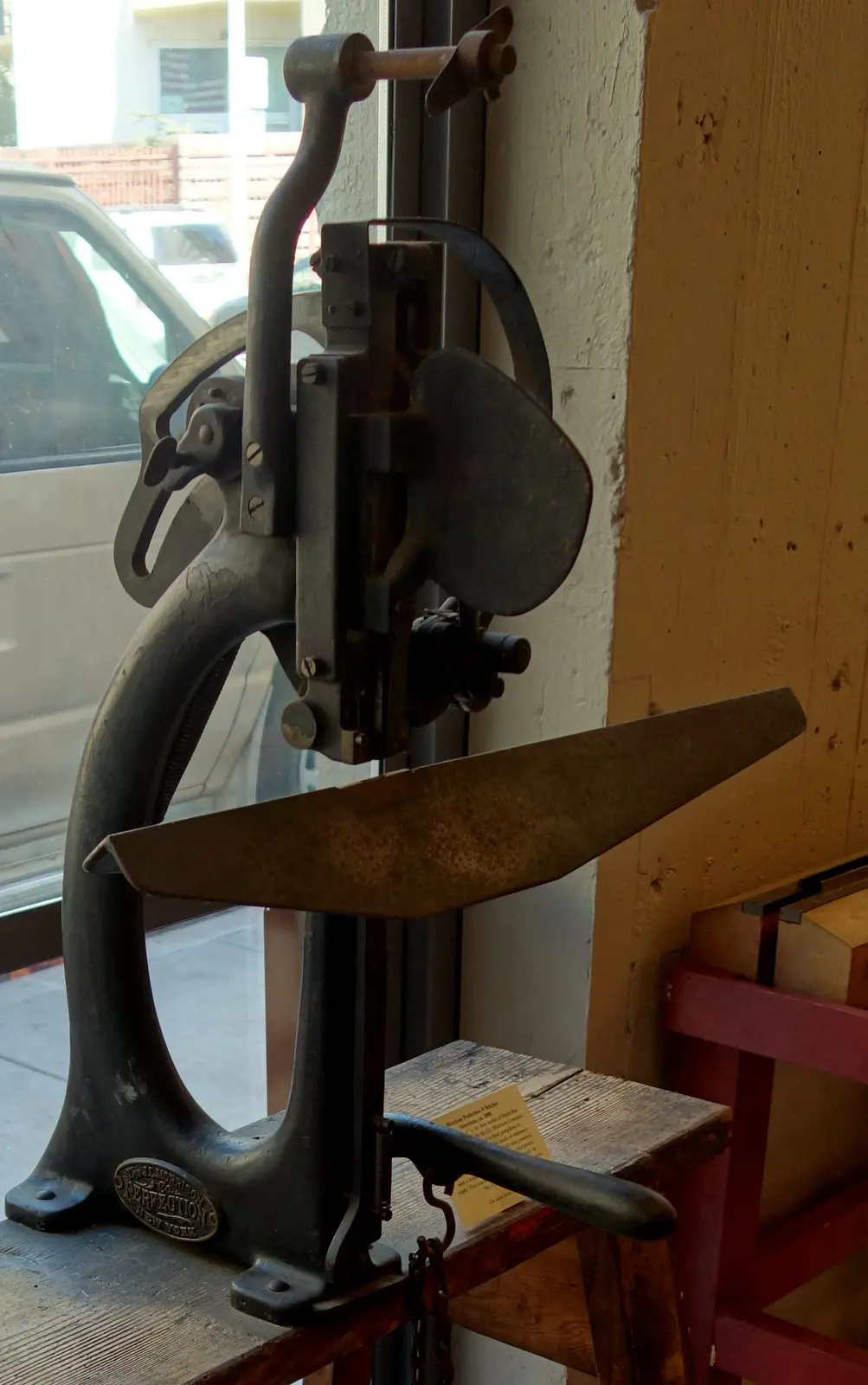
A Morrison Perfection A wire stitcher from about 1890, photographed on display at the American Bookbinders Museum in San Francisco. The long angled rest under the head appears to be its saddle.
"Morrison Perfection A Stitcher (stapler), c. 1890 - American Bookbinders Museum - San Francisco, CA" by Daderot — https://commons.wikimedia.org/wiki/File:Morrison_Perfection_A_Stitcher_(stapler),_c._1890_-_American_Bookbinders_Museum_-_San_Francisco,_CA_-_DSC08204.jpg — CC0 1.0 (https://creativecommons.org/publicdomain/zero/1.0/); modified: cropped
The dictionary sums up the machine’s work in four moves: it cuts the wire, forms the staple, drives it through the paper and bends it shut on the far side. A booklet gets two or more staples, depending on its height. The staples are usually round wire of copper, galvanized iron or aluminized iron, and the dictionary lists wire stabbing as another name for the method.
Saddle sewing does the same job with thread. The dictionary rates saddle stitching faster and so cheaper. Both give what it calls “full openability to the gutter,” the gutter being the inner margins where two facing pages meet. Of the three places a binding can grip paper in bookbinding methods, through the fold, through the side and on the cut edge, saddle stitching grips through the fold.
That openness comes from the fold. In paper logic, the rigid-sheet model this site uses for folded paper, a leaf can turn only about a crease, and here the staples sit in the crease itself.
Side stitching works the other way. Its staples are driven from front to back through the whole stack, and the dictionary says it allows almost no openability. Side sewing, the family the dictionary puts Japanese stab binding in, opens very little too. The dictionary’s exceptions include a wide inner margin and very flexible paper.
Why the page count comes in fours
One sheet folded once makes two leaves, the separate pieces a reader turns. Each leaf has two sides, and each side is a page, so every sheet adds four pages. Nest three sheets and the booklet has 12 pages; nest eight and it has 32. The dictionary’s entry on signatures, a word it treats as nearly the same as section, ties the same count to printing: “the sets of 4, 8, 16, 32, 64, or 128 printed pages,” once folded, make up a section.
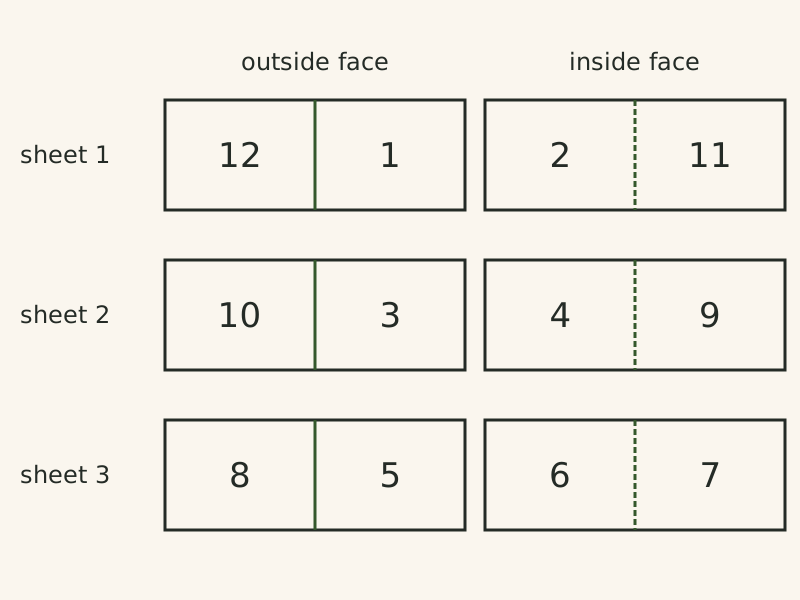
Where each page of a 12-page booklet sits on its three flat sheets. From outside, the center line is a mountain fold (solid); from inside, it is a valley fold (dashed).
Check level Page order computed for nested folded sheets; paper thickness not used; drawing not to scale.
"Page numbers on the sheets of a 12-page saddle-stitched booklet" by Fold, Knot & Bind — https://foldknotbind.com/bookbinding/saddle-stitching/ — licensed under CC BY 4.0: https://creativecommons.org/licenses/by/4.0/
The page numbers on one sheet do not run in order. The outer sheet carries pages 1, 2, 11 and 12, and the center sheet carries 5, 6, 7 and 8. On each face of a flat sheet, the two pages side by side add up to 13, one more than the page count. The dictionary calls this kind of plan imposition: pages are set on the sheet so they read in order once it is folded.
| Sheet, from outside | Pages on the sheet | Model push-out, assumed 0.1 mm paper |
|---|---|---|
| 1 (cover) | 1, 2, 11, 12 | 0.00 mm |
| 2 | 3, 4, 9, 10 | 0.16 mm |
| 3 (center) | 5, 6, 7, 8 | 0.31 mm |
Download the page and push-out table (CSV) (what the file holds)
So a booklet with 10 pages of text still takes 12 pages of paper. Two pages are left over. The dictionary notes that a section can also be one sheet plus an extra leaf, which breaks the pattern. In a booklet made only of whole folded sheets, the count stays in fours.
How it fails: push-out and too many leaves
A booklet’s weak point is its own thickness. Each sheet wraps around the ones inside it, so an outer sheet uses more of its width going around the fold. All the sheets start the same width, so the inner ones end farther out at the fore edge, the edge opposite the spine. Roberts and Etherington name the problem creep or push-out, in a stitched pamphlet made of many folded sheets of thick paper.
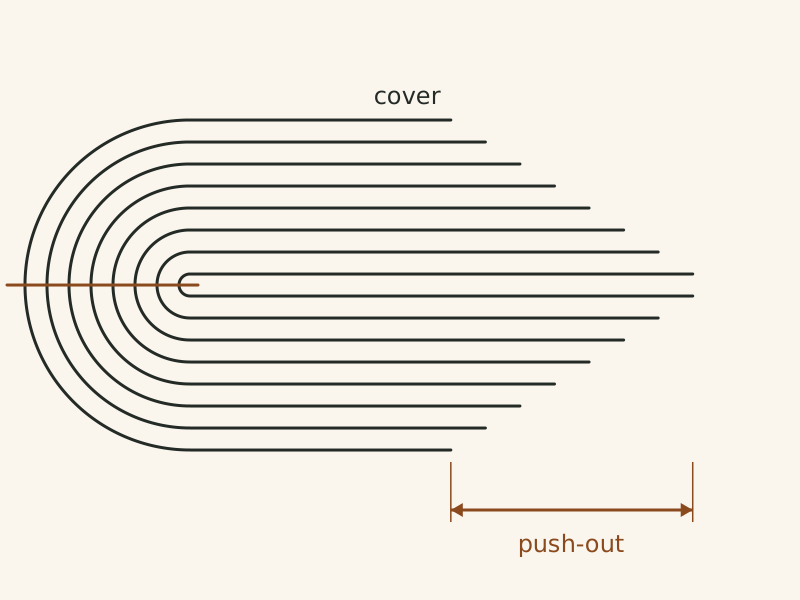
Eight nested sheets seen from the head. Each sheet bends around the ones inside it, so the center sheet reaches farthest past the cover at the fore edge. The gaps are drawn far wider than real paper. At an assumed 0.1 mm per sheet, the model puts the center sheet about 1.1 mm past the cover.
Check level Geometry of nested folded sheets; paper thickness assumed, not measured.
"Push-out of nested folded sheets at the fore edge" by Fold, Knot & Bind — https://foldknotbind.com/bookbinding/saddle-stitching/ — licensed under CC BY 4.0: https://creativecommons.org/licenses/by/4.0/
The size of the push-out here comes from a simple model. Each sheet bends in a half circle around the sheets inside it, and every sheet has the same thickness. With an assumed 0.1 mm per sheet, an 8-sheet, 32-page booklet pushes its center pages about 1.1 mm past the cover, and at 0.2 mm the push-out doubles to about 2.2 mm. These are model numbers for a stated thickness, not measurements of real paper.
Push-out is where paper logic stops matching paper. Like the rigid model behind the Miura fold, it gives paper no thickness, so in the model every sheet ends at the same edge. Real sheets do have thickness. Each one adds a little to the spread at the fore edge.
How many pages can be saddle stitched?
Roberts and Etherington’s 1982 dictionary gives no fixed number. It says the number of leaves that can be stitched well depends largely on how thick the paper is. The model on this page shows one reason thickness matters: push-out grows by the same step with every sheet added, and twice as fast for paper twice as thick.
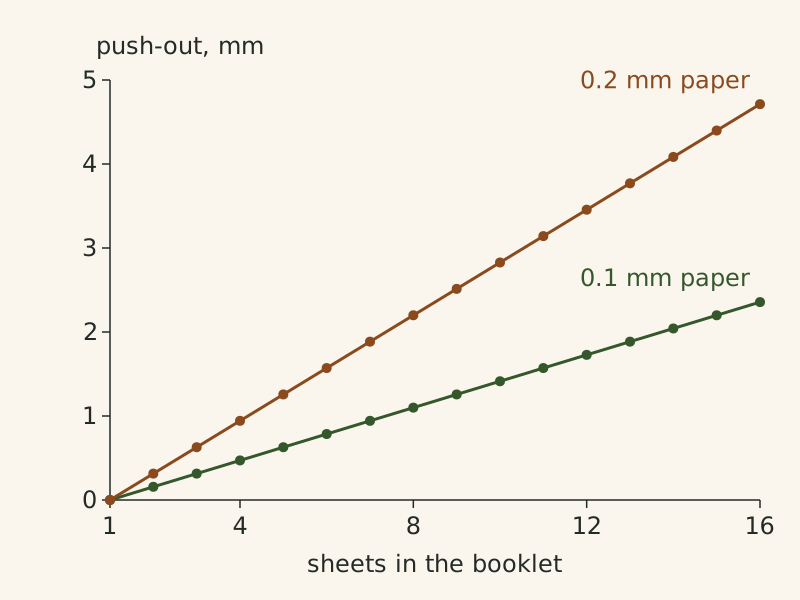
Model push-out of the center sheet past the cover, for booklets of 1 to 16 sheets, at two assumed paper thicknesses.
Check level Geometry of nested folded sheets; paper thickness assumed, not measured.
"Push-out against sheet count at two assumed paper thicknesses" by Fold, Knot & Bind — https://foldknotbind.com/bookbinding/saddle-stitching/ — licensed under CC BY 4.0: https://creativecommons.org/licenses/by/4.0/
| Sheets | Pages | Model push-out, assumed 0.1 mm paper | Model push-out, assumed 0.2 mm paper |
|---|---|---|---|
| 2 | 8 | 0.16 mm | 0.31 mm |
| 4 | 16 | 0.47 mm | 0.94 mm |
| 8 | 32 | 1.10 mm | 2.20 mm |
| 12 | 48 | 1.73 mm | 3.46 mm |
| 16 | 64 | 2.36 mm | 4.71 mm |
Download the page and push-out table (CSV) (what the file holds)
A publication that outgrows one fold is no longer one section. The dictionary notes that periodical issues made of more than one section cannot be saddle stitched, and side stitching is a common choice for them. Books of many sections need a way to tie each section to the next. The chain stitches of Coptic binding are one such way.
Shingling: trimming for the push-out
Shingling plans for push-out before the sheets are printed. Roberts and Etherington describe it as a way to counter creep or push-out: page sizes are chosen to allow for changing binding margins and outside margins, so the leaf size shrinks from the outer sheet inward. When the fore edge is cut straight, more comes off the inner leaves, because they stuck out farther. If the printed text sits in the same place on every flat sheet, the inner pages lose their outside margin.
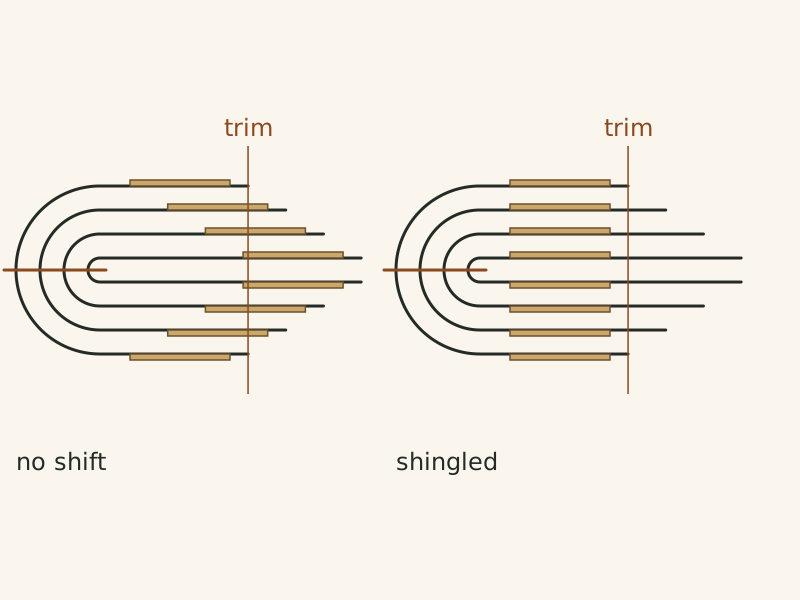
The same four nested sheets, with a straight trim line marked at the fore edge. With no shift, the printed blocks on the inner leaves run past the trim line. Shingled, each block moves toward the fold by that sheet’s push-out, and every page keeps the same outside margin. The gaps are drawn far wider than real paper.
Check level Geometry of nested folded sheets; paper thickness assumed, not measured.
"Shingling: printed blocks shifted toward the fold" by Fold, Knot & Bind — https://foldknotbind.com/bookbinding/saddle-stitching/ — licensed under CC BY 4.0: https://creativecommons.org/licenses/by/4.0/
The second drawing moves each inner page’s print toward the fold by that sheet’s push-out in the model above. Every printed block then ends the same distance from the trim line. The dictionary adds that page numbers may need adjusting so they line up after folding and trimming.
Grain and the fold
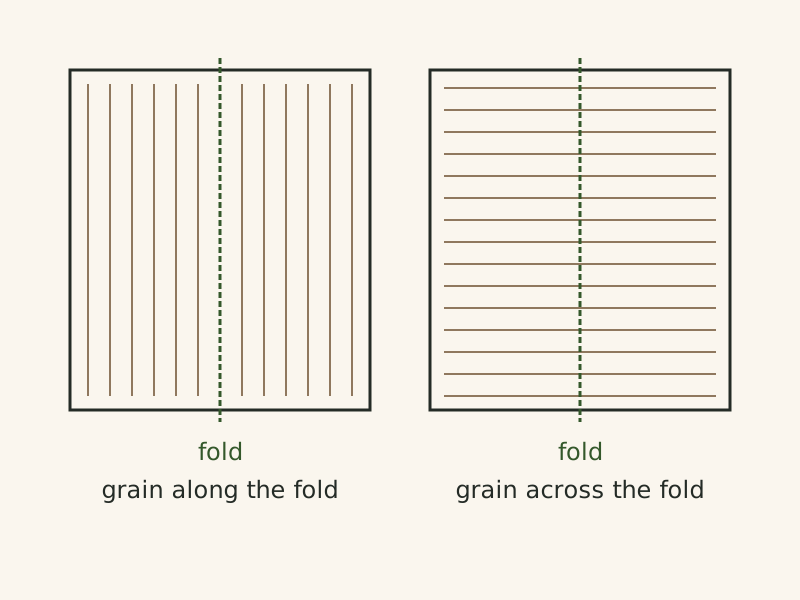
Two flat sheets, each with a fold down the middle. In the first, the grain runs along the fold, head to tail; in the second, it runs across the fold.
Check level Schematic, not to scale, after Roberts and Etherington (1982); no geometric check.
"Paper grain along and across the fold" by Fold, Knot & Bind — https://foldknotbind.com/bookbinding/saddle-stitching/ — licensed under CC BY 4.0: https://creativecommons.org/licenses/by/4.0/
Machine-made paper has a grain, the direction most of its fibers lie, and Roberts and Etherington say a well-made book runs it from head to tail so the binding fold is not against the grain. Folded with the grain, the leaves are more inclined to lie flat. The page on bookbinding methods covers grain in more depth.
Sources
- Matt T. Roberts and Don Etherington, Bookbinding and the Conservation of Books: A Dictionary of Descriptive Terminology (Washington: Library of Congress, 1982; Supt. of Docs. no. LC 1.2:B64/3; electronic edition prepared by Walter Henry, Stanford University Libraries, 1994), notes on the electronic edition cool.culturalheritage.org/don/tn/tn6.htmlRead: full page (notes on the electronic edition)
- Roberts and Etherington, Bookbinding and the Conservation of Books (1982), “saddle stitching” cool.culturalheritage.org/don/dt/dt2950.htmlRead: full entry
- Roberts and Etherington, Bookbinding and the Conservation of Books (1982), “saddle” cool.culturalheritage.org/don/dt/dt2947.htmlRead: full entry
- Roberts and Etherington, Bookbinding and the Conservation of Books (1982), “saddle sewing” cool.culturalheritage.org/don/dt/dt2948.htmlRead: full entry
- Roberts and Etherington, Bookbinding and the Conservation of Books (1982), “signature” cool.culturalheritage.org/don/dt/dt3109.htmlRead: full entry
- Roberts and Etherington, Bookbinding and the Conservation of Books (1982), “section” cool.culturalheritage.org/don/dt/dt3005.htmlRead: full entry
- Roberts and Etherington, Bookbinding and the Conservation of Books (1982), “shingling” cool.culturalheritage.org/don/dt/dt3085.htmlRead: full entry
- Roberts and Etherington, Bookbinding and the Conservation of Books (1982), “imposition” cool.culturalheritage.org/don/dt/dt1816.htmlRead: full entry
- Roberts and Etherington, Bookbinding and the Conservation of Books (1982), “side stitching” cool.culturalheritage.org/don/dt/dt3104.htmlRead: full entry
- Roberts and Etherington, Bookbinding and the Conservation of Books (1982), “side sewing” cool.culturalheritage.org/don/dt/dt3103.htmlRead: full entry
- Roberts and Etherington, Bookbinding and the Conservation of Books (1982), “Japanese sewing” cool.culturalheritage.org/don/dt/dt1913.htmlRead: full entry
- Roberts and Etherington, Bookbinding and the Conservation of Books (1982), “against the grain” cool.culturalheritage.org/don/dt/dt0053.htmlRead: full entry
- Roberts and Etherington, Bookbinding and the Conservation of Books (1982), “machine direction” cool.culturalheritage.org/don/dt/dt2135.htmlRead: full entry
- Roberts and Etherington, Bookbinding and the Conservation of Books (1982), “gutter” cool.culturalheritage.org/don/dt/dt1682.htmlRead: full entry
Cite this page
“Saddle Stitching: Each Folded Sheet Adds Four Pages.” Fold, Knot & Bind. Published Nov. 15, 2026. https://foldknotbind.com/bookbinding/saddle-stitching/. Accessed on the date you read it.
How diagrams and claims are checked All corrections Report an error on this page (contact@foldknotbind.com)
Next on the bench:
- Japanese stab binding: the opposite grip, with thread through the whole stack, and a book that is hard to open flat.
- Coptic binding: when one fold is not enough, chain stitches tie each section to the next.
More in Bookbinding
Bookbinding
Bookbinding Methods: Perfect Binding Uses Glue, Not Thread
Picture credit
"Sewing press, from The Art of Bookbinding" (1890), Joseph William Zaehnsdorf — https://commons.wikimedia.org/wiki/File:Art_of_Bookbinding_p056_Sewing_Press.png — Public domain in US: published 1890 (George Bell and Sons, London, second edition; first edition 1879), before 1931; DE/FR: published 1890 in a book by Joseph William Zaehnsdorf (d. 1930), engraver not named, so both life + 70 and 70 years from publication have expired
Bookbinding
Japanese Stab Binding: Sewn Through, and Hard to Open Flat
Picture credit
"Ehon Azuma asobi (Picture Book of Amusements of the Eastern Capital), cover" by Kitagawa Utamaro (attributed), Metropolitan Museum of Art — https://commons.wikimedia.org/wiki/File:%E7%B5%B5%E6%9C%AC%E5%90%BE%E5%A6%BB%E9%81%8A-Ehon_Azuma_asobi-Picture_Book_of_Amusements_of_the_Eastern_Capital_(Ehon_Azuma_asobi)_MET_JIB41_001.jpg — CC0 1.0 (https://creativecommons.org/publicdomain/zero/1.0/)
Bookbinding
Coptic Binding: Each Section Is Chained to the Next
Picture credit
"Model Coptic binding" by Ratbasket at English Wikipedia — https://commons.wikimedia.org/wiki/File:Coptic_flat.jpg — CC BY 2.5 (https://creativecommons.org/licenses/by/2.5/); modified: lightly smoothed to reduce file size