Miura Fold: In the Rigid Model, No Panel Bends
Fold, Knot & Bind Published
In brief
The Miura fold is a crease pattern of parallelogram panels set in zigzag rows. In the rigid model, where each panel is a stiff plate on hinges, every crease turns together and no panel bends, and a 2013 study by Schenk and Guest finds one way for the sheet to expand.
Materials: One rectangular sheet creased into parallelograms, 6 by 4 panels in the model on this page. No cuts, no glue.
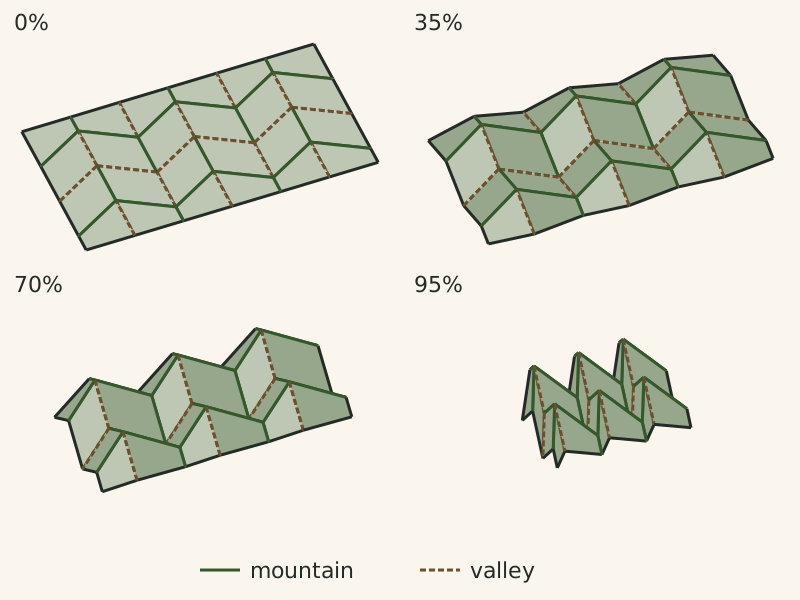
A Miura-patterned sheet at 0%, 35%, 70% and 95% of the way to fully folded. Every crease turns at the same time, and every parallelogram panel stays flat. The model is rigid panels on hinges, with no paper thickness.
Check level Rigid-panel model; Levels 1 and 2 hold at all 15 interior vertices (Maekawa and Kawasaki, with the mountain and valley folds as marked); the folding motion was sampled to 99.5% of fully folded with no collisions; layer order at full fold not computed; paper thickness not modeled.
"Miura fold at four stages of folding, rigid-panel model" by Fold, Knot & Bind — https://foldknotbind.com/paper-mechanisms/miura-fold/ — licensed under CC BY 4.0: https://creativecommons.org/licenses/by/4.0/
Squeeze a rigid Miura sheet from one side and the whole pattern closes together. The zigzag rows rise. The sheet gets narrower in both directions at once. Engineers Mark Schenk and Simon Guest (2013) describe this: with its panels treated as rigid, the sheet has a single way to expand and shrink.
This page builds that rigid model and reports which checks it passed. It gives no folding steps and does not claim the sheet can be pressed into one tight stack.
What is the Miura fold?
A Miura fold divides a sheet into parallelograms that lean one way in one row and the other way in the next. Its creases form two sets. One set runs in straight lines; the other crosses them in zigzags.
In this page's model, each panel has sides of 30 mm and 25 mm with a 60° corner, before the zigzag edges are trimmed. The percentages measure how far the panels have tilted: 0% is the open sheet, and 100% is the fully folded position. The model does not reach it.
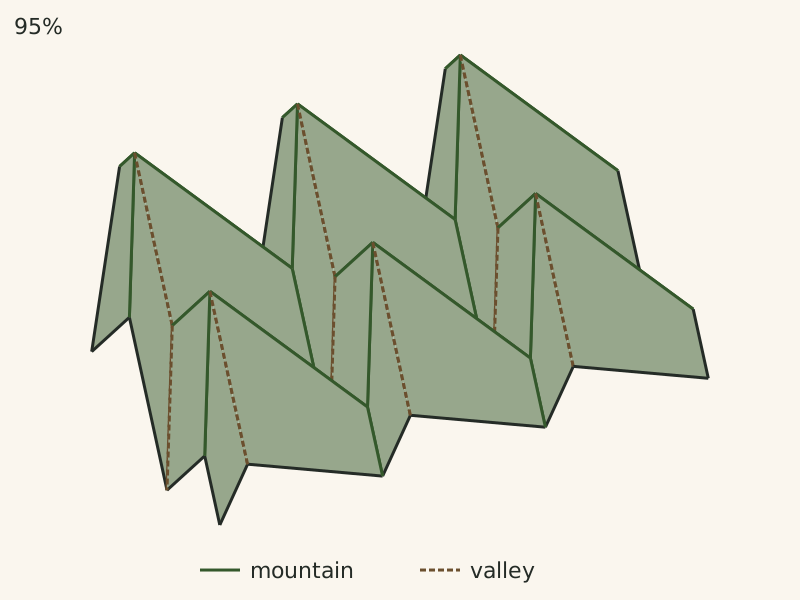
The 95% state, enlarged from the same model and the same view. The zigzag rows have closed most of the way, and every panel is still flat. Paper thickness is not modeled.
Check level Rigid-panel model; Levels 1 and 2 hold at all 15 interior vertices (Maekawa and Kawasaki, with the mountain and valley folds as marked); the folding motion was sampled to 99.5% of fully folded with no collisions; layer order at full fold not computed; paper thickness not modeled.
"Miura fold at 95 percent of fully folded, enlarged" by Fold, Knot & Bind — https://foldknotbind.com/paper-mechanisms/miura-fold/ — licensed under CC BY 4.0: https://creativecommons.org/licenses/by/4.0/
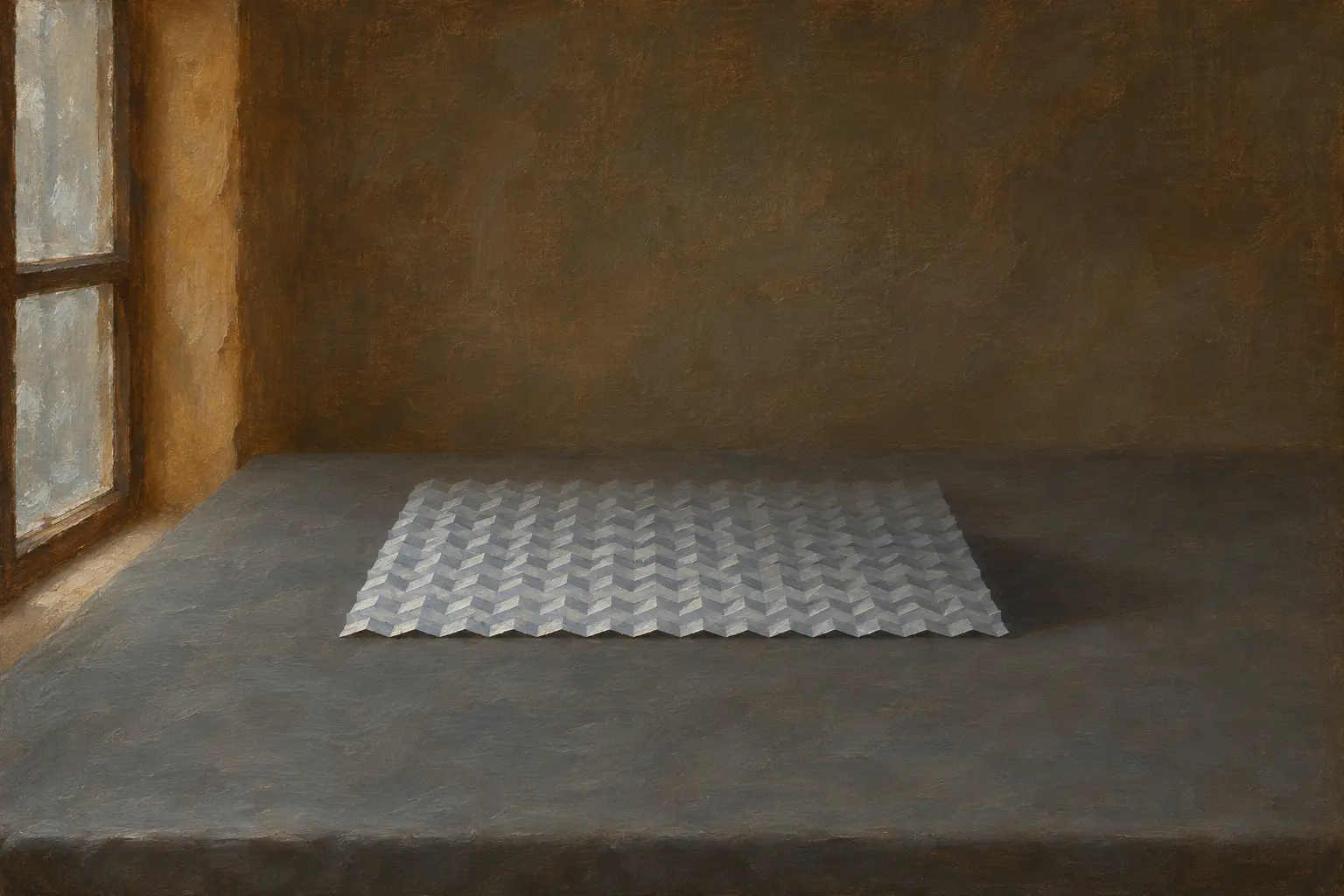
A Miura-folded sheet, every panel opened to the same angle so the whole sheet sits half folded.
Illustration: Fold, Knot & Bind. Generated schematic illustration — not a photograph or historical record. Reuse: CC BY 4.0 (https://creativecommons.org/licenses/by/4.0/), to the extent Fold, Knot & Bind holds rights in this image.
Schenk and Guest call it the classic Miura-ori pattern. It had already been considered for deployable solar panels, they note, citing a 1985 report by K. Miura, No. 618 in the Institute of Space and Astronautical Science report series. This page could not read that report, so it says nothing about who first folded the pattern or when.
The crease pattern
The pattern below has 38 creases and 15 interior vertices. A vertex is a point inside the sheet where creases meet; here, four meet at each one. A mountain fold rises toward the viewer. A valley fold sinks away.
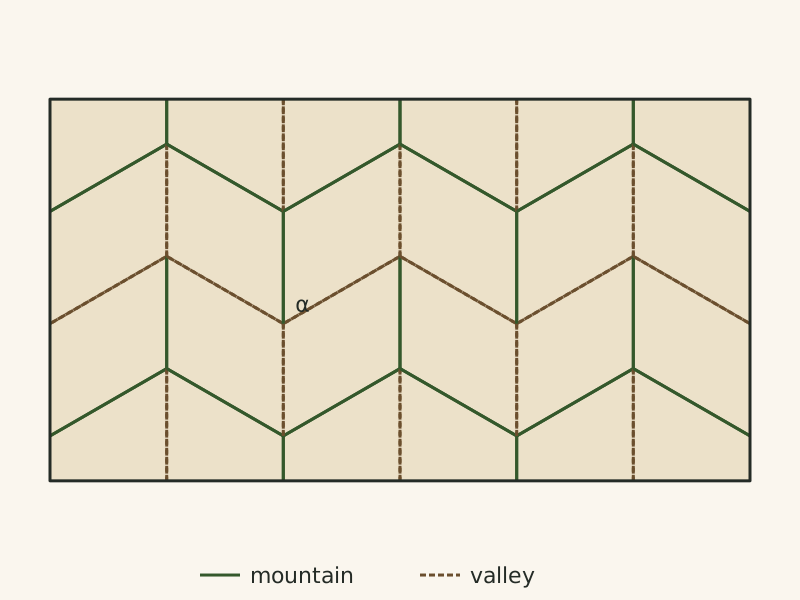
The crease pattern, trimmed to a rectangle: mountain folds solid, valley folds dashed, with α marking the 60° angle of the parallelogram panels. The pattern is drawn from its parameters (panel sides 30 and 25 mm, 6 by 4 panels), not traced from any published drawing. Paper thickness is not modeled.
Check level Levels 1 and 2 hold at all 15 interior vertices (Maekawa and Kawasaki, with the mountain and valley folds as marked); layer order at full fold not computed; paper thickness not modeled.
"Miura crease pattern, trimmed to a rectangle" by Fold, Knot & Bind — https://foldknotbind.com/paper-mechanisms/miura-fold/ — licensed under CC BY 4.0: https://creativecommons.org/licenses/by/4.0/
Two levels of checking are reported, as described on which layer was checked. Level 1 means that at all 15 vertices, the standard local rules for the paper to close up around the point hold. Level 2 means the mountain and valley folds, exactly as marked, meet those rules. The next level, the stacked layer order at full fold, was not computed.
| Creases at the vertex | Interior vertices |
|---|---|
| 3 mountain, 1 valley | 10 |
| 1 mountain, 3 valley | 5 |
| All | 15 |
Download the vertex checks (CSV) (what the file holds)
This site prefers a crease pattern to step diagrams, because it shows why the fold works, not only the order of moves. Steps would need a checked path from the open sheet to the finished fold, and here the path is checked only to 99.5%.
One way to move
Look at any one interior vertex. Four creases meet there, and the paper around the point splits into angles of 60°, 60°, 120° and 120°.
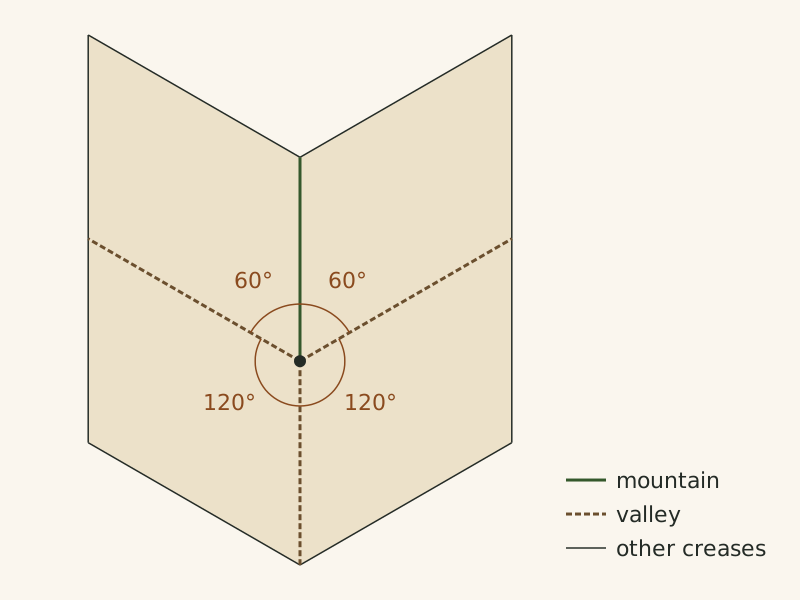
One interior vertex of the flat pattern, where four creases meet: one mountain and three valleys, with the paper around the point split into angles of 60°, 60°, 120° and 120°. Every interior vertex has these angles; at some of them the counts are reversed, three mountains and one valley. Paper thickness is not modeled.
Check level One interior vertex of the rigid-panel model; Maekawa and Kawasaki hold with the mountain and valley folds as marked; paper thickness not modeled.
"One interior vertex of the Miura crease pattern" by Fold, Knot & Bind — https://foldknotbind.com/paper-mechanisms/miura-fold/ — licensed under CC BY 4.0: https://creativecommons.org/licenses/by/4.0/
Schenk and Guest explain why that matters. At a vertex where four creases meet, one fold angle sets all the others. A whole sheet of such vertices is overconstrained: it has more conditions to satisfy than ways to move, so it folds only when the angles meet strict conditions. The Miura pattern meets them, so the rigid sheet has one way to move.
The calculation on this page works the same way. One number, the tilt of the panels, places every corner of the sheet, so moving one edge moves the far edge too. Folds also shape a tunnel book, where two concertina folds hold the cut panels apart, but there the spacing is fixed only when the book is shut or fully open.
In the rigid model, no panel bends
The model tests this claim at 100 steps, from 0% to 99.5% of fully folded. At each step it compares every panel's sides and diagonals with the open sheet and checks that each panel stays a plane.
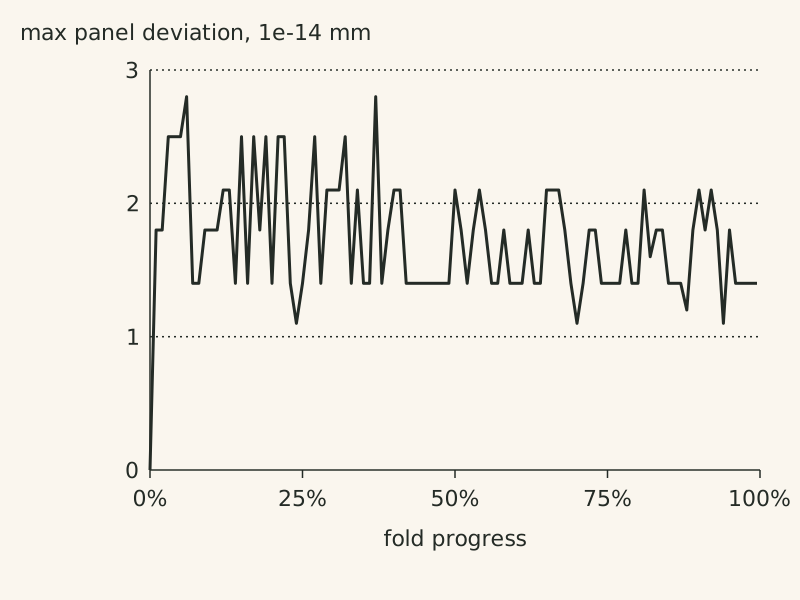
The largest distance by which any panel strays from its original flat shape, at each of the 100 sampled steps from 0% to 99.5% of fully folded. Every value is below 3e-14 mm. Data: this page's miura-fold-path.csv (paper-mech 1.0.0, computed 2026).
Check level Plotted from this page's data file (miura-fold-path.csv); rigid-panel model; paper thickness not modeled.
"Largest panel deviation along the Miura folding path" by Fold, Knot & Bind — https://foldknotbind.com/paper-mechanisms/miura-fold/ — licensed under CC BY 4.0: https://creativecommons.org/licenses/by/4.0/
The largest change anywhere is 2.8e-14 mm, less than a millionth of a millionth of a millimeter. That is arithmetic rounding, not bending. The same steps test for collisions: no two panels overlap, and no fold angle jumps between one step and the next.
| Fold progress | Largest panel change (mm) | Closest gap between panels that share no edge or corner (mm) | Panels overlapping |
|---|---|---|---|
| 0% | 0 | not measured | none |
| 25% | 1.4e-14 | 21.684 | none |
| 50% | 2.1e-14 | 21.664 | none |
| 75% | 1.4e-14 | 20.412 | none |
| 95% | 1.8e-14 | 10.456 | none |
| 99.5% | 1.4e-14 | 3.362 | none |
Download the folding path, all 100 steps (CSV) (what the file holds)
This rigid sheet is paper logic, the model this site uses for folded paper, and it leaves things out. It has no thickness, so it cannot say how thick the stack gets near the fully folded end.
Miura fold vs an ordinary map fold
The map fold below uses a sheet of the same size, divided into 6 by 4 rectangles. In its first stage only the creases parallel to the short side move, like an accordion. The cross creases stay open until that stage is done.
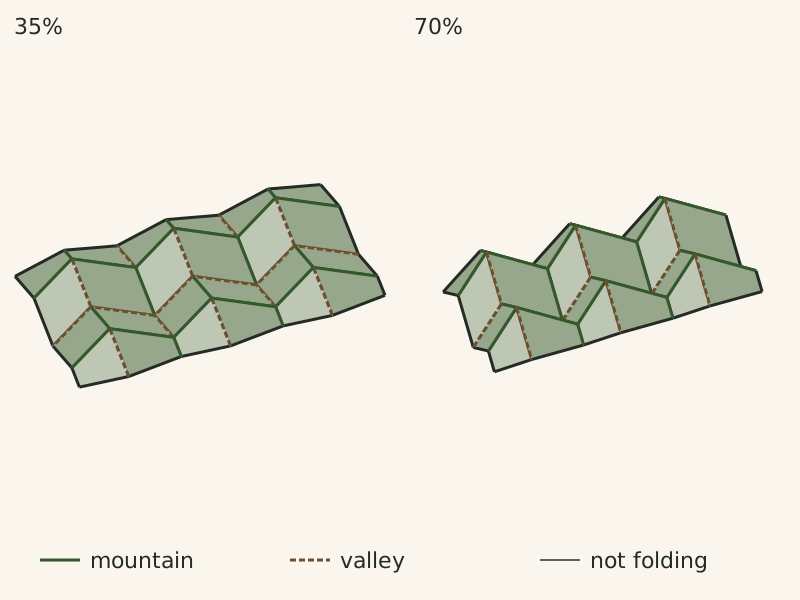
"Miura fold at 35 and 70 percent, drawn to compare with a map fold" by Fold, Knot & Bind — https://foldknotbind.com/paper-mechanisms/miura-fold/ — licensed under CC BY 4.0: https://creativecommons.org/licenses/by/4.0/
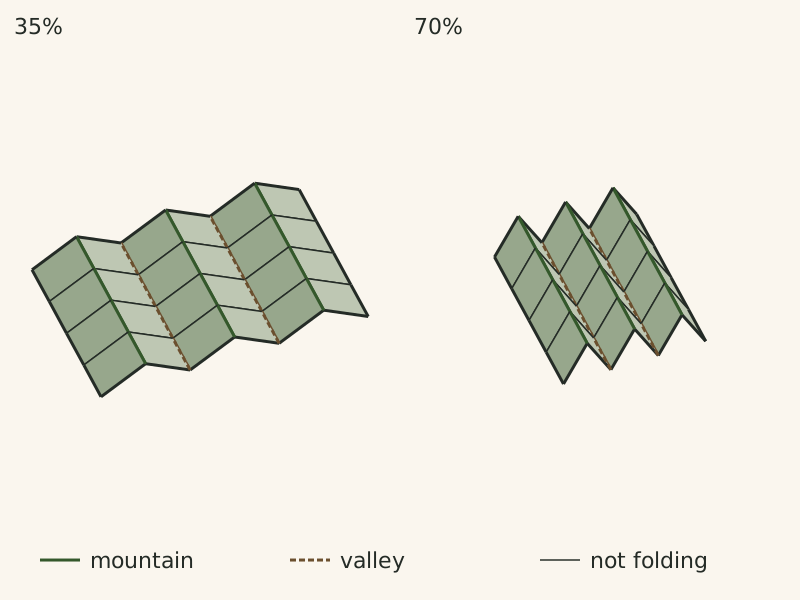
"Ordinary map fold, first stage at 35 and 70 percent" by Fold, Knot & Bind — https://foldknotbind.com/paper-mechanisms/miura-fold/ — licensed under CC BY 4.0: https://creativecommons.org/licenses/by/4.0/
First, the Miura sheet at 35% and 70% of its folding motion. Second, a map fold of the same size, 6 by 4 rectangles, at 35% and 70% of its first stage, at the same scale and view. The map's cross creases (thin lines) stay open, and its second stage is not modeled. Paper thickness is not modeled.
Check level Rigid-panel models; the Miura fold and the first stage of the map fold, each checked for rigidity and for collisions (panel overlap and fold-angle jumps), sampled to 99.5% of that motion; the map fold's second stage not modeled; layer order at full fold not computed; paper thickness not modeled.
The calculation also tried folding both sets of map creases at once. The rigidity check rejected that trial motion because, along it, panel sides or diagonals changed length by as much as 28.16 mm. In the Miura sheet, both sets of creases turn together and every panel keeps its shape.
How it fails: folding past flat
In the model, the motion can be pushed too far. Past the fully folded position, all 38 creases swap between mountain and valley, and the panels pass through one another.
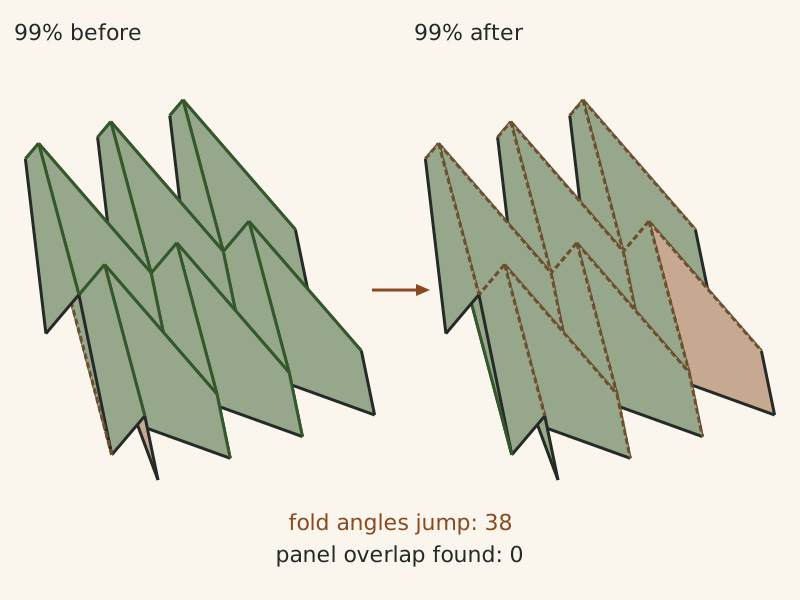
A motion the checks reject: the sheet at 99% is pushed past fully folded and back to 99% on the other side, and the rust-tinted panel marks one corner panel. The panels pass through each other between two samples, so the overlap test finds nothing; the fold-angle check catches all 38 creases jumping. Paper thickness is not modeled.
Check level Rigid-panel model of a motion the checks reject (fold angles jump at 38 creases when the motion is pushed past fully folded; the panel-overlap test finds nothing); paper thickness not modeled.
"Miura fold pushed past fully folded, a motion the checks reject" by Fold, Knot & Bind — https://foldknotbind.com/paper-mechanisms/miura-fold/ — licensed under CC BY 4.0: https://creativecommons.org/licenses/by/4.0/
That is why the folding models on this site get two collision tests, not one. The volvelle page runs the same kind of check on its stacked paper discs.
Real sheets also move in ways the rigid model cannot show. Schenk and Guest note that twisting a Miura sheet, or bending it into a saddle shape, makes the panels themselves bend, and paper models can even form new diagonal creases across them. This page could not read a test of how many times a paper Miura sheet can open and close before its creases wear, so it gives no number.
Sources
- Mark Schenk and Simon D. Guest, "Geometry of Miura-folded metamaterials," Proceedings of the National Academy of Sciences 110, no. 9 (2013): 3276–3281, doi:10.1073/pnas.1217998110. pmc.ncbi.nlm.nih.gov/articles/PMC3587190/Read: full text; paraphrased
Cite this page
“Miura Fold: In the Rigid Model, No Panel Bends.” Fold, Knot & Bind. Published Nov. 15, 2026. https://foldknotbind.com/paper-mechanisms/miura-fold/. Accessed on the date you read it.
How diagrams and claims are checked All corrections Report an error on this page (contact@foldknotbind.com)
Next on the bench:
- How pop-up books work: the same rigid-sheet model, used on a pop-up that rises as the pages turn.
- Saddle stitching: real paper thickness, which this model leaves out, pushes the inner pages of a folded stack outward.
More in Pop-Ups & Folds
 Illustration
Pop-Ups & Folds
How Pop-Up Books Work: A V-Fold Needs Only the Turning Page
Picture credit (illustration)
Illustration: Fold, Knot & Bind. Generated schematic illustration — not a photograph or historical record. Reuse: CC BY 4.0 (https://creativecommons.org/licenses/by/4.0/), to the extent Fold, Knot & Bind holds rights in this image.
Pop-Ups & Folds
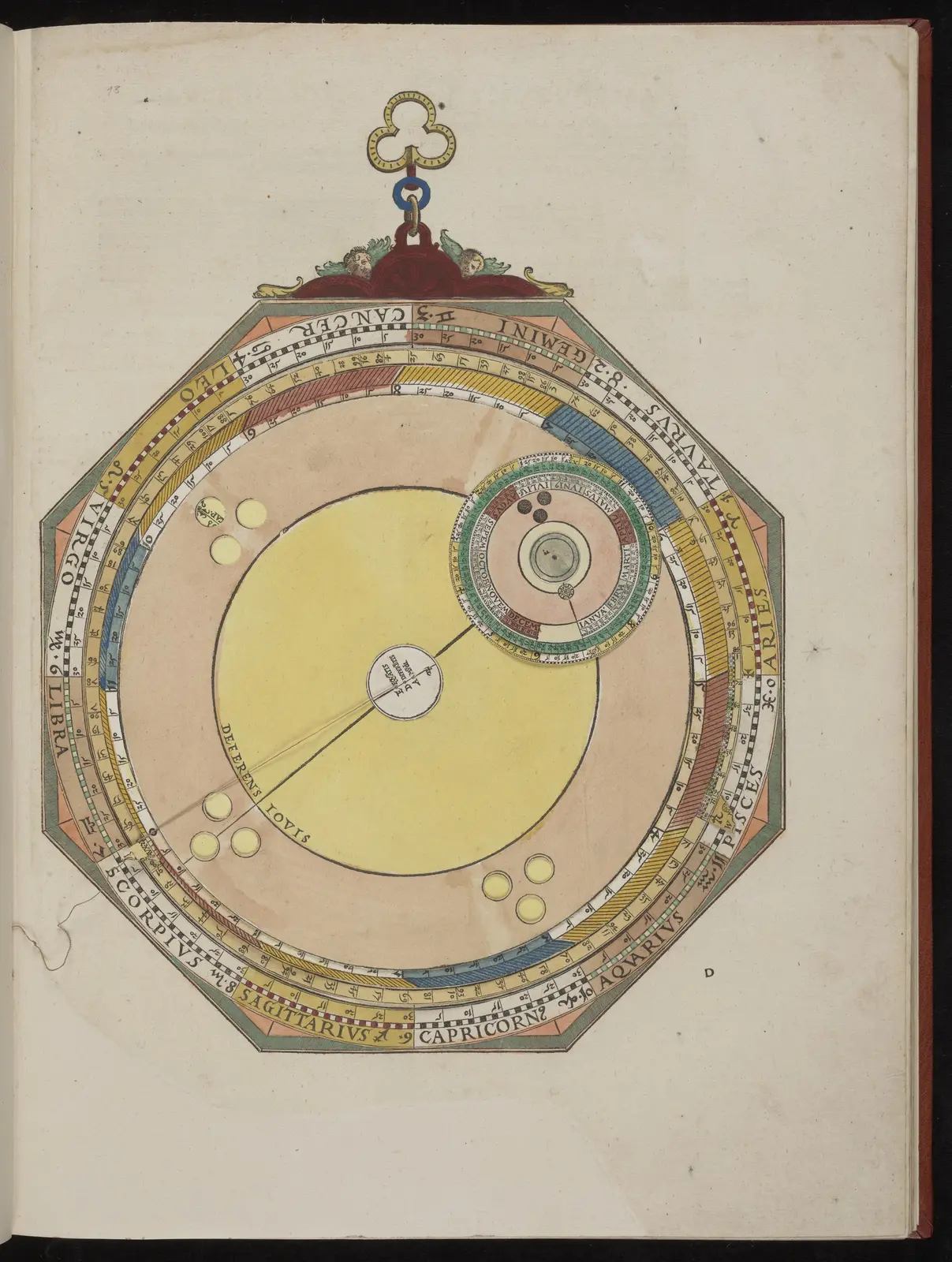
Volvelle: Apian’s 1540 Book Had Paper Wheels That Turn
Picture credit
"Volvelle page, leaf 18r, from Astronomicum Caesareum" (1540), Petrus Apianus — https://commons.wikimedia.org/wiki/File:Astronomicum_Caesareum._1540_(149346554).jpg — Public domain in US: published 1540; EU: author Petrus Apianus d. 1552; Public Domain Mark by the National Library of Poland; modified: reduced in size
Pop-Ups & Folds
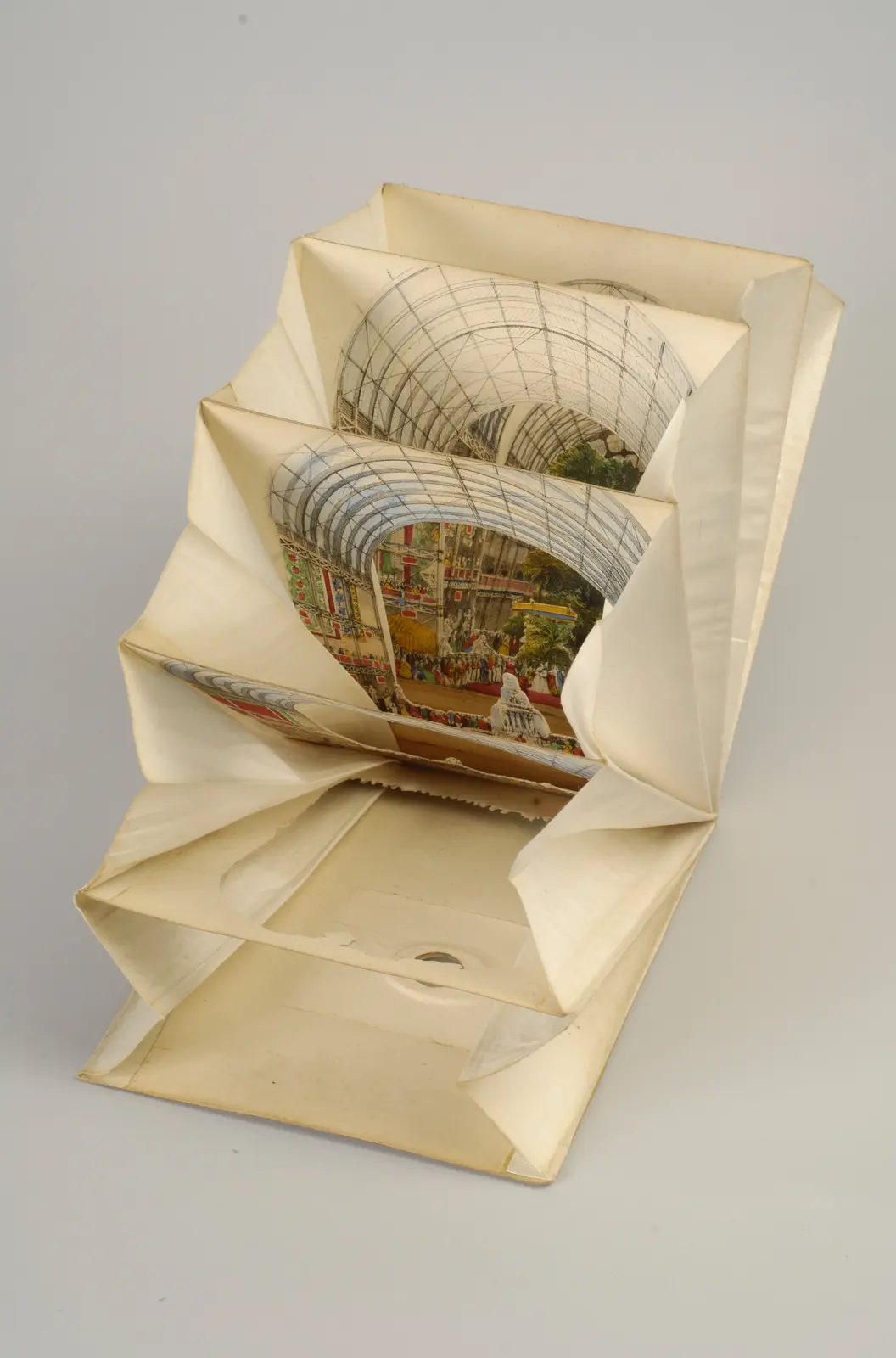
Tunnel Book: Cut Panels on Folded Side Strips, as in 1851
Picture credit
"Lane's Telescopic View: The Ceremony of Her Majesty Opening the Great Exhibition (partially open)" by Special Collections at Johns Hopkins University from Baltimore City, United States — https://commons.wikimedia.org/wiki/File:Lane%27s_Telescopic_View_-_The_Ceremony_of_Her_Majesty_Opening_the_Great_Exhibition_(partially_open).jpg — CC BY 2.0 (https://creativecommons.org/licenses/by/2.0/)