How Pop-Up Books Work: A V-Fold Needs Only the Turning Page
Fold, Knot & Bind Published
In brief
Open a pop-up spread and a v-fold climbs off the page. Its folded piece is glued to both pages across the gutter, the fold between them, so turning the pages alone lifts it upright and lays it down again, as a 2011 geometric study of pop-ups describes.
Materials: Two pages joined at the spine and one folded piece of card with two glue tabs. Glue on the tabs only. No pull tabs, no cuts in the pages.
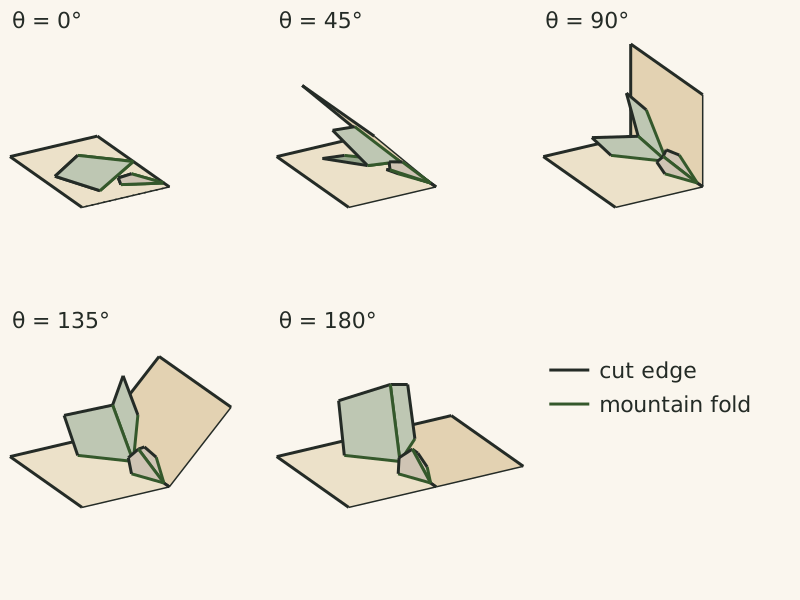
Two v-fold pieces on one spread at openings (θ) of 0°, 45°, 90°, 135° and 180°. The opening angle alone sets where each piece stands. Near closing, 5 mm out from the spine corner, the model leaves piece A 0.07 mm from the facing page at a 2° opening and 0.36 mm at 10°, model numbers with no paper thickness.
Check level Rigid-sheet model, checked every 2° for collisions and for closing inside the page; paper thickness not modeled.
"Two v-fold pieces at five opening angles" by Fold, Knot & Bind — https://foldknotbind.com/paper-mechanisms/v-fold-pop-up/ — licensed under CC BY 4.0: https://creativecommons.org/licenses/by/4.0/
The gutter is the fold where the two pages meet at the spine. This page runs two v-fold pieces through a rigid-sheet model in 2° steps, open and shut, then shows two ways a wrong angle breaks the design. That model is what this site calls paper logic: each piece is a flat sheet with no thickness, turning only at its creases. Li, Ju, Gu and Hu make the same simplification in their 2011 geometric study of v-style pop-ups, the main source for this page.
What is a V-fold?
A v-fold is a piece of card folded once down its middle and glued to both pages, one tab on each side of the gutter. On the open spread, the two glue lines form a V. Its point sits on the spine. The 2011 study lists this piece among its pop-up mechanisms and says v-fold is its usual name.
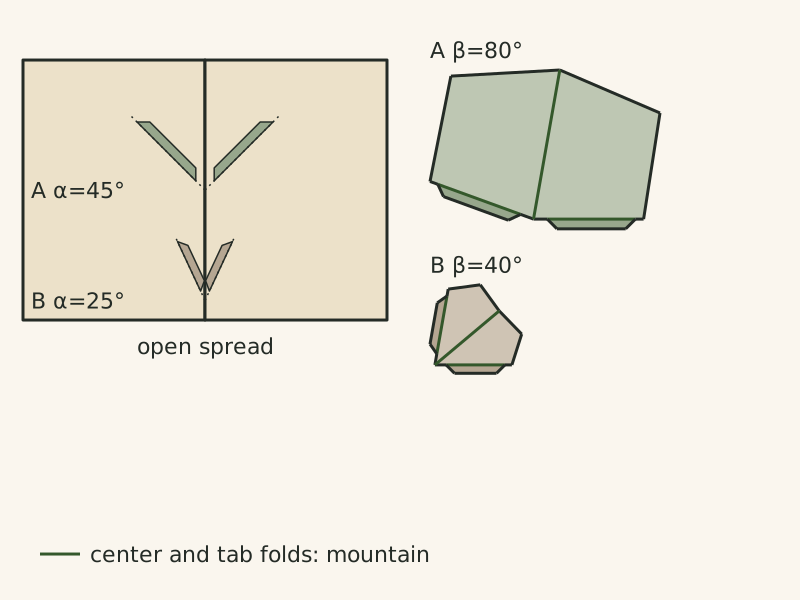
The two pieces cut flat, with their glue tabs, and the glue lines they take on the open spread. Each glue line leaves the spine at angle α (45° for piece A, 25° for piece B), and each piece’s center fold leaves its glue line at angle β (80° and 40°). The diagram treats the paper as rigid sheets with no thickness.
Check level Rigid-sheet model, checked every 2° for collisions and for closing inside the page; paper thickness not modeled.
"Flat nets and glue lines of two v-fold pieces" by Fold, Knot & Bind — https://foldknotbind.com/paper-mechanisms/v-fold-pop-up/ — licensed under CC BY 4.0: https://creativecommons.org/licenses/by/4.0/
Two angles define the piece. Alpha (α) is the angle between the spine and each glue line, and beta (β) is the angle between a glue line and the center fold. Piece A uses α = 45° and β = 80°, and piece B uses 25° and 40°.
Here the glue does real work. Without its two tabs the piece would not move with the pages at all, so this site counts glue in a v-fold as a fair structural choice. The glued spine in bookbinding methods gets the same treatment; there, glue is one of three ways a book holds its leaves.
How does opening the book lift it?
Open the book and the two glue tabs travel apart with their pages. The center fold is joined to both tabs, so it has to swing up to keep angle β from each glue line. Four creases meet at one point on the spine: the spine itself, both glue lines and the center fold.
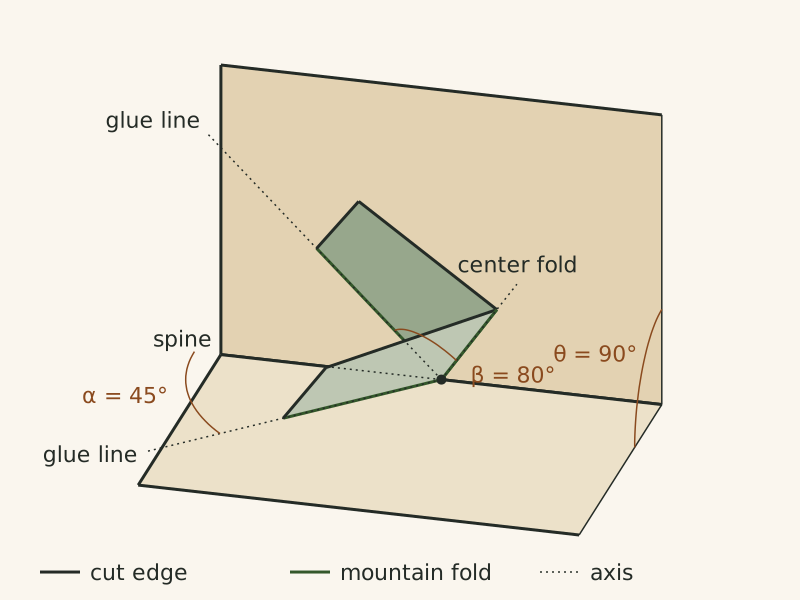
Piece A at a 90° opening. The spine, both glue lines and the center fold pass through one point, so the piece moves like four hinges joined at one corner. α is the angle from the spine to each glue line (45°), β from a glue line to the center fold (80°), and θ is the opening of the book.
Check level Rigid-sheet model, checked every 2° for collisions and for closing inside the page; paper thickness not modeled.
"The four creases of a v-fold meet at one point" by Fold, Knot & Bind — https://foldknotbind.com/paper-mechanisms/v-fold-pop-up/ — licensed under CC BY 4.0: https://creativecommons.org/licenses/by/4.0/
That shared corner is why a v-fold needs only the turning page. Once α and β are set, the opening angle fixes where the piece stands, and the model checks at every step that the piece has no way to move while the pages are held still. Li and colleagues list this as one of four properties of a pop-up: its closing and opening “do not need extra forces other than holding and turning the two book pages” (page 1).
In the model, a short formula places the center fold, which must keep angle β to both glue lines as they swing apart. The 2011 study builds its proof on the same rule, with the rising crease held at fixed angles to the crease on each page while one page turns.
Does it fold flat again?
Close the book and the piece has to fold back down between the pages. For this part of the motion, the 2011 study lists two more properties. A pop-up closes flat and opens again without tearing or new creases, and when it is closed, every piece lies inside the page.
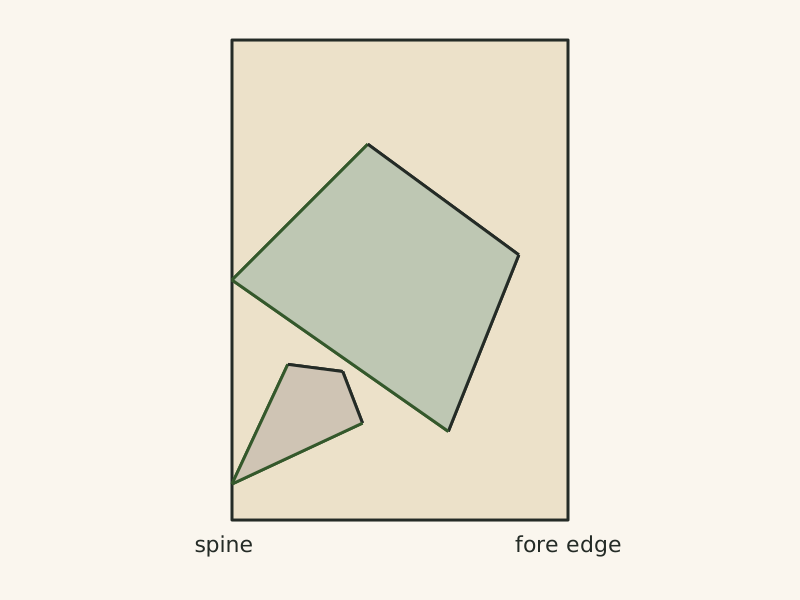
The closed book seen from above, with the top page lifted away. Both pieces lie folded inside the page outline, between the spine and the fore edge, which is the storage check every design must pass. In the model the folded pieces have no thickness; real card adds bulk that the drawing does not show.
Check level Rigid-sheet model, checked every 2° for collisions and for closing inside the page; paper thickness not modeled.
"Both v-fold pieces folded inside the closed page" by Fold, Knot & Bind — https://foldknotbind.com/paper-mechanisms/v-fold-pop-up/ — licensed under CC BY 4.0: https://creativecommons.org/licenses/by/4.0/
Both pieces on this page pass every check, from shut to fully open and shut again. They stay rigid and need no new crease. Neither passes through the other or through a page, and both fold away inside the page edges.
Each crease also keeps one direction the whole way. A mountain fold forms a ridge, a valley fold a trough. No fold in this design has to flip from one to the other partway through.
How it fails: when the angles are off
Two rejected designs show what the checks catch. In the first, two v-fold pieces sit too close together along the spine. At small openings they clear each other, but by 162° one passes through the other.
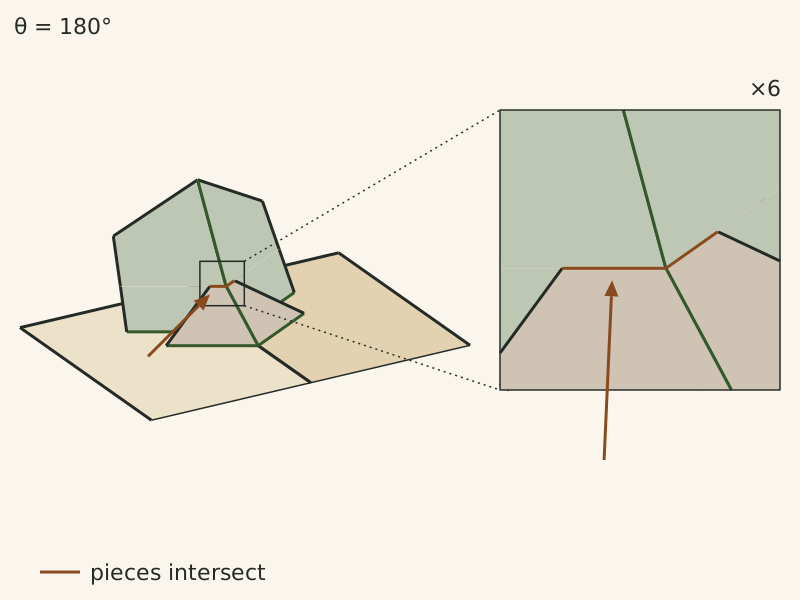
A design the checks reject. Two v-fold pieces are placed so close that, by a 162° opening, one passes through the other. The rust line marks where the two sheets cross at 180°; the box on the right enlarges that spot about six times. Paper thickness is not modeled.
Check level Rigid-sheet model of a design the checks reject (pieces collide by 162°); paper thickness not modeled.
"A rejected v-fold design whose pieces collide" by Fold, Knot & Bind — https://foldknotbind.com/paper-mechanisms/v-fold-pop-up/ — licensed under CC BY 4.0: https://creativecommons.org/licenses/by/4.0/
In the second design, β is smaller than α: 40° against 50°. Once the pages open wide, no position keeps the center fold at angle β from both glue lines. Past about 114° the piece has no position at all in the rigid model. The book could open further only by bending or tearing the piece or by forcing a new crease into it.
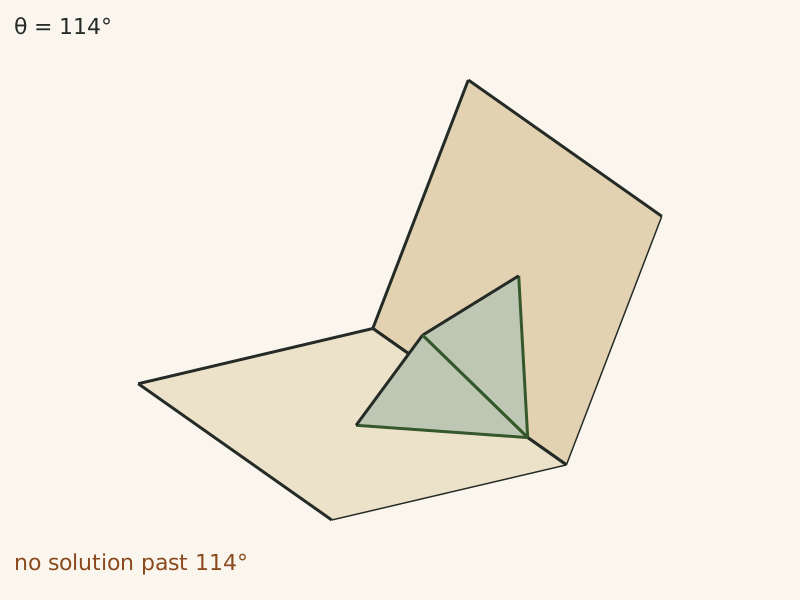
A design the checks reject. With β (40°) smaller than α (50°), the rigid piece has no position past about 114°, so the book could open further only by bending or tearing the piece or giving it a new crease. The diagram shows it at 114°, the last 2° step before that limit. Paper thickness is not modeled.
Check level Rigid-sheet model of a design the checks reject (no solution past 114.09°, so the piece would have to bend, tear or take a new crease); paper thickness not modeled.
"A rejected v-fold design that jams at 114 degrees" by Fold, Knot & Bind — https://foldknotbind.com/paper-mechanisms/v-fold-pop-up/ — licensed under CC BY 4.0: https://creativecommons.org/licenses/by/4.0/
The 2011 study gives an angle condition for structures like this. Written in this page’s notation for a v-fold with the same angles on both sides, it comes down to two tests: β must be larger than α, and α plus β must stay under 180°. A check on this page tried 561 pairs of angles, and the model’s formula opened all the way in exactly the cases that pass both tests.
The angle tests are not enough, though. Both pieces in the colliding design pass them and still hit each other. The study handles collisions with a separate set of conditions; the model tests for overlap at every step.
V-fold vs parallel fold
A parallel fold is another piece driven by the pages. Its creases all run parallel to the spine, so seen from the end it works like a flat linkage of two panels. The two drawings below share one scale and one view.
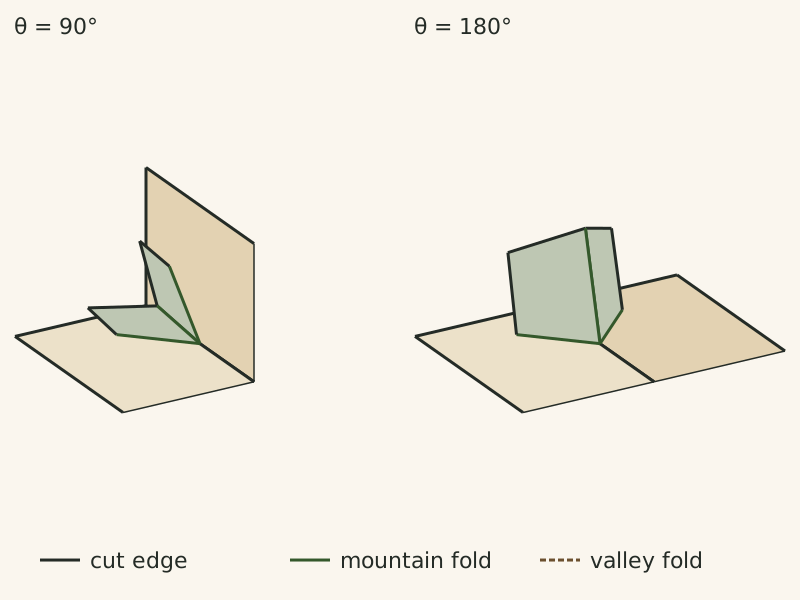
"V-fold piece at 90 and 180 degrees, for comparison" by Fold, Knot & Bind — https://foldknotbind.com/paper-mechanisms/v-fold-pop-up/ — licensed under CC BY 4.0: https://creativecommons.org/licenses/by/4.0/
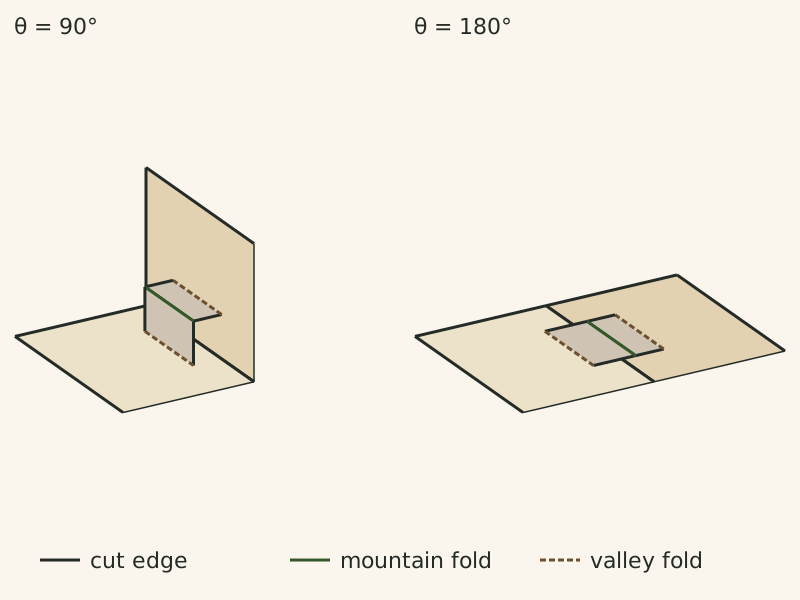
"Parallel-fold piece at 90 and 180 degrees, for comparison" by Fold, Knot & Bind — https://foldknotbind.com/paper-mechanisms/v-fold-pop-up/ — licensed under CC BY 4.0: https://creativecommons.org/licenses/by/4.0/
The first drawing is a v-fold piece, the second a parallel-fold piece, each at a 90° opening and on the open spread, at the same scale and from the same view. On the open spread the v-fold still stands up, while the parallel fold lies flat on the pages. Both are rigid-sheet models with no paper thickness.
Check level Rigid-sheet model, checked every 2° for collisions and for closing inside the page; paper thickness not modeled.
The difference shows when the book lies open. The parallel fold’s panels are 45 mm and 30 mm long, which exactly fills the 75 mm between its two hinges on the flat spread, so at 180° it lies flat. The v-fold keeps standing because no direction lying in the flat spread is 80° from both of its glue lines, so its center fold has to point up out of the page.
| Piece | Height above the open spread at 180°, rigid model |
|---|---|
| V-fold A (α 45°, β 80°) | 106.6 mm |
| V-fold B (α 25°, β 40°) | 32.1 mm |
| Parallel fold (panels 45 mm and 30 mm) | 0.0 mm |
Download the opening path table (CSV) (what the file holds)
Both pieces pass the same checks in the model. The same rigid-sheet model, applied to a whole folded sheet instead of a glued piece, is behind the Miura fold.
Page-driven or hand-pulled: Meggendorfer’s movables
Not every moving page is a pop-up in the 2011 study’s sense. Its definition allows no force beyond holding and turning the two pages. Some movable books add parts the reader pulls, turns or lifts, parts the pages alone do not move.
The German illustrator Lothar Meggendorfer (1847–1925) is named as the maker of Attention!, a movable book. An English edition calls itself “A Movable Amusing Toy-Book” on its cover, under imprints in London and New York. A photo of the back of one of its pages shows what sits behind the picture.
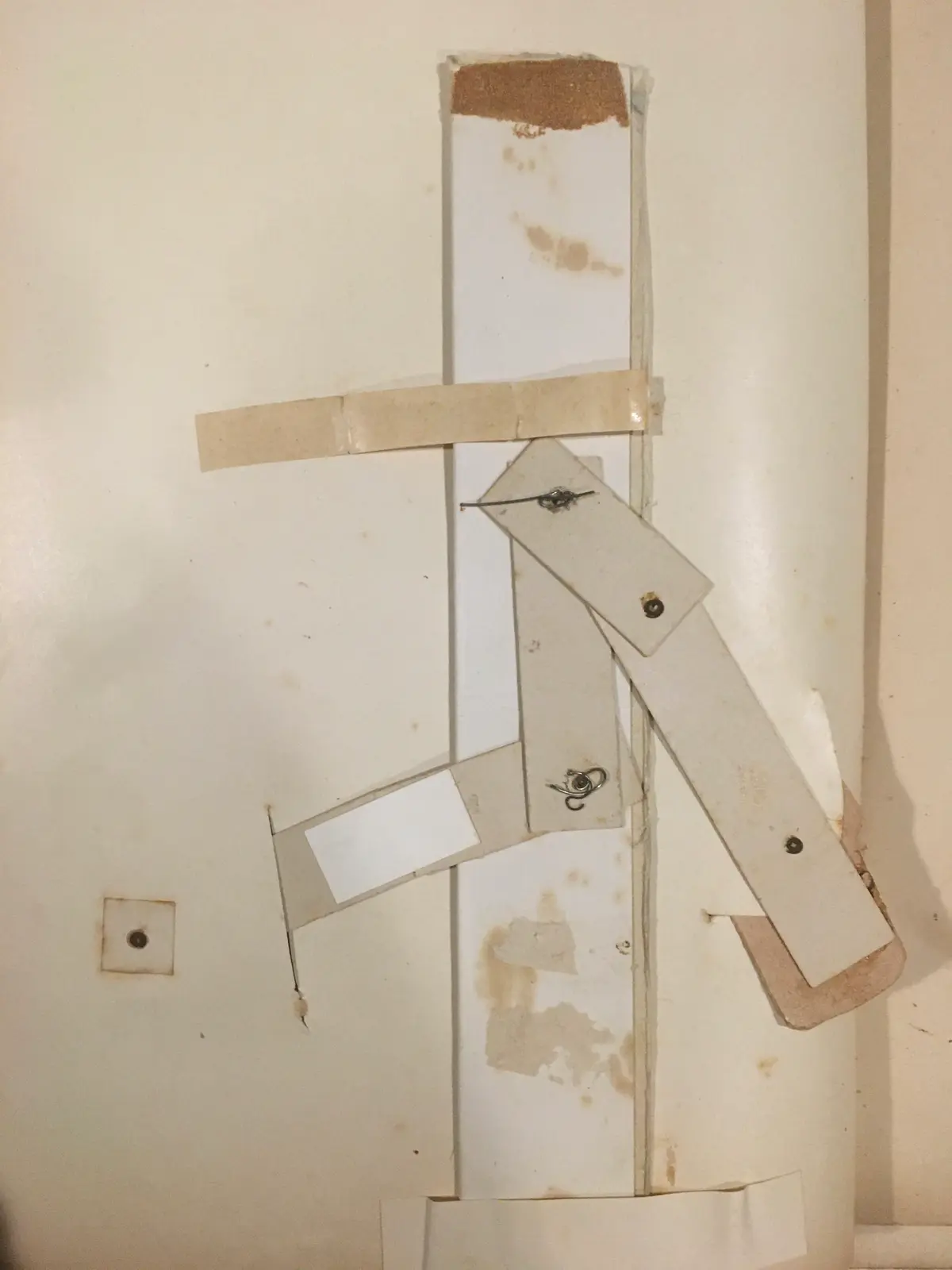
The back of one page of Meggendorfer’s Attention!, photographed in 2021. Strips of card are joined by small metal rivets and wire loops, next to a long strip that runs down the page. The file page for the photo says a pull tab moves the figure’s arms up and down.
"Mechanism behind The Moor from Attention! Lothar Meggendorfer 1906" by Nicolet1327 — https://commons.wikimedia.org/wiki/File:Attention!_Lothar_Meggendorfer_1906_The_Moor_mechanisms.jpg — CC BY-SA 4.0 (https://creativecommons.org/licenses/by-sa/4.0/); modified: metadata stripped (camera and location data removed; image unchanged)
The photo shows the parts, not how far each one travels. Beyond that one-line note, this page did not read a description of the mechanism, so it does not claim how the strips move one another.
This site splits paper mechanisms into two groups by what drives them, a grouping of its own. A v-fold or a parallel fold is driven by the pages, so it must pass the checks above. Pull tabs, turning paper wheels and tunnel books are worked by hand, so they are checked for how far they travel, whether layers collide, whether they fit inside the closed book and whether each part follows the control. The volvelle and the tunnel book pages use that second set.
As for who made the earliest pop-up book, a 2011 study notes that the history of movable books can be traced back to Ramon Llull, a Catalan writer of the early 14th century. That note is secondhand: the study describes no object from that time, and this page did not read an older source.
Paper logic: what the model leaves out
Paper logic leaves out two things real paper has: thickness and bend. The 2011 study makes the same choice and treats paper as rigid with no thickness. It also says that in practice the physical properties of paper matter, and that many pop-up artworks involve bending the paper.
The gap near closing shows where the model stops matching paper. As the book shuts, the space between a folded piece and the facing page shrinks with the opening angle. All the sheets meet at the spine corner, so the gap is measured 5 mm out from it. There, the narrower of the two gaps is 0.07 mm at 2° and 0.36 mm at 10°, numbers that hold only for sheets with no thickness, as the model assumes.
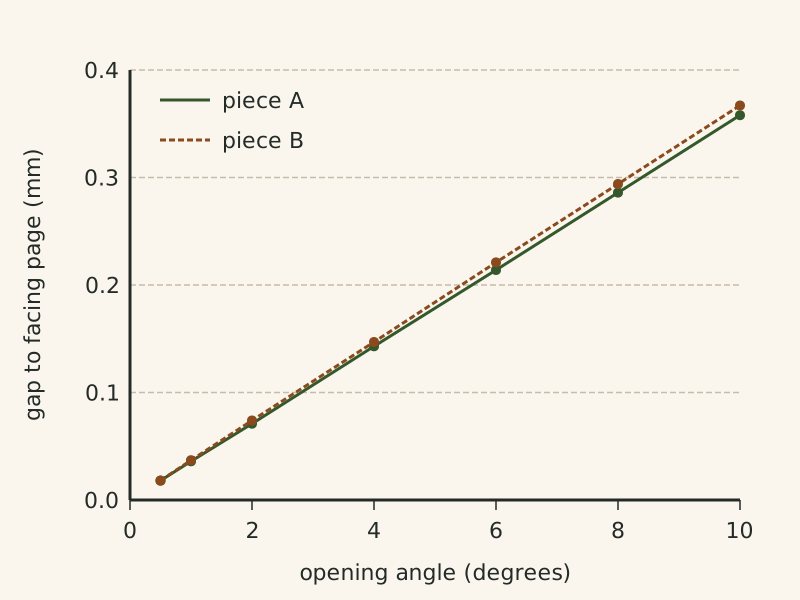
The gap between each v-fold piece and the facing page, measured 5 mm out from the spine corner, as the book opens from 0.5° to 10°, from the path table on this page. Both gaps grow almost in step with the angle and stay under 0.4 mm.
Check level Each point taken from this page's CSV, computed in the rigid-sheet model; paper thickness not modeled.
"Gap between each v-fold piece and the facing page near closing" by Fold, Knot & Bind — https://foldknotbind.com/paper-mechanisms/v-fold-pop-up/ — licensed under CC BY 4.0: https://creativecommons.org/licenses/by/4.0/
| Opening angle | Model gap 5 mm from spine, piece A | Model gap 5 mm from spine, piece B |
|---|---|---|
| 2° | 0.071 mm | 0.074 mm |
| 4° | 0.143 mm | 0.147 mm |
| 6° | 0.214 mm | 0.221 mm |
| 8° | 0.286 mm | 0.294 mm |
| 10° | 0.358 mm | 0.367 mm |
Download the opening path table (CSV) (what the file holds)
So in the last few degrees of closing, the drawings show the model, not a sheet of card. A real piece is card folded double, glued onto pages with a thickness of their own. The model’s clearances there are not to be taken at face value.

An open pop-up book with one folded piece glued to both pages across the gutter, so the turning pages lift it.
Illustration: Fold, Knot & Bind. Generated schematic illustration — not a photograph or historical record. Reuse: CC BY 4.0 (https://creativecommons.org/licenses/by/4.0/), to the extent Fold, Knot & Bind holds rights in this image.
Sources
- Xian-Ying Li, Tao Ju, Yan Gu and Shi-Min Hu, "A Geometric Study of V-style Pop-ups: Theories and Algorithms," ACM Transactions on Graphics 30, no. 4 (2011), article 98. cg.cs.tsinghua.edu.cn/people/~xianying/Papers/V-Popup/Read: full text (10 pages); paraphrased, with one short quotation from page 1
- Lothar Meggendorfer, Attention! A Movable Amusing Toy-Book (London: H. Grevel & Co.; New York: Frederick A. Stokes Company), cover, photographed by Nicolet1327, 2021; file page on Wikimedia Commons. commons.wikimedia.org/wiki/File:Attention!_A_Movable_…Read: file page and the photograph of the cover; image not reproduced
- Lothar Meggendorfer, Attention! A Movable Amusing Toy-Book, back of the page for The Moor, photographed by Nicolet1327, 2021; file page on Wikimedia Commons. commons.wikimedia.org/wiki/File:Attention!_Lothar_Meg…Read: file page and the photograph
- Lothar Meggendorfer, illustration from Travels of Little Lord Thumb and His Man Damien (1891); file page on Wikimedia Commons, after Cynthia Burlingham, Picturing Childhood (1997), p. 34. commons.wikimedia.org/wiki/File:Travels_of_Little_Lor…Read: file page and the image; holding library record not consulted


Cite this page
“How Pop-Up Books Work: A V-Fold Needs Only the Turning Page.” Fold, Knot & Bind. Published Nov. 15, 2026. https://foldknotbind.com/paper-mechanisms/v-fold-pop-up/. Accessed on the date you read it.
How diagrams and claims are checked All corrections Report an error on this page (contact@foldknotbind.com)
Next on the bench:
- Volvelle: another paper mechanism, turned by hand instead of driven by the pages.
- Tunnel book: a different kind of depth, with cut layers held apart by two folded concertinas.
More in Pop-Ups & Folds
Pop-Ups & Folds
Volvelle: Apian’s 1540 Book Had Paper Wheels That Turn
Picture credit
"Volvelle page, leaf 18r, from Astronomicum Caesareum" (1540), Petrus Apianus — https://commons.wikimedia.org/wiki/File:Astronomicum_Caesareum._1540_(149346554).jpg — Public domain in US: published 1540; EU: author Petrus Apianus d. 1552; Public Domain Mark by the National Library of Poland; modified: reduced in size
Pop-Ups & Folds
Tunnel Book: Cut Panels on Folded Side Strips, as in 1851
Picture credit
"Lane's Telescopic View: The Ceremony of Her Majesty Opening the Great Exhibition (partially open)" by Special Collections at Johns Hopkins University from Baltimore City, United States — https://commons.wikimedia.org/wiki/File:Lane%27s_Telescopic_View_-_The_Ceremony_of_Her_Majesty_Opening_the_Great_Exhibition_(partially_open).jpg — CC BY 2.0 (https://creativecommons.org/licenses/by/2.0/)
 Illustration
Pop-Ups & Folds
Miura Fold: In the Rigid Model, No Panel Bends
Picture credit (illustration)
Illustration: Fold, Knot & Bind. Generated schematic illustration — not a photograph or historical record. Reuse: CC BY 4.0 (https://creativecommons.org/licenses/by/4.0/), to the extent Fold, Knot & Bind holds rights in this image.