Volvelle: Apian’s 1540 Book Had Paper Wheels That Turn
Fold, Knot & Bind Published
In brief
A volvelle is a paper disc fixed at its center to a book page, so it turns. Peter Apian’s Astronomicum Caesareum of 1540 has them on 22 full-page pictures, by the John Carter Brown Library’s count, many of them with silk threads attached at the center.
Materials: Paper discs cut out and laid over a printed page, each turning on its own center, plus threads in Apian’s book. The model on this page adds one rivet and leaves out paper thickness.
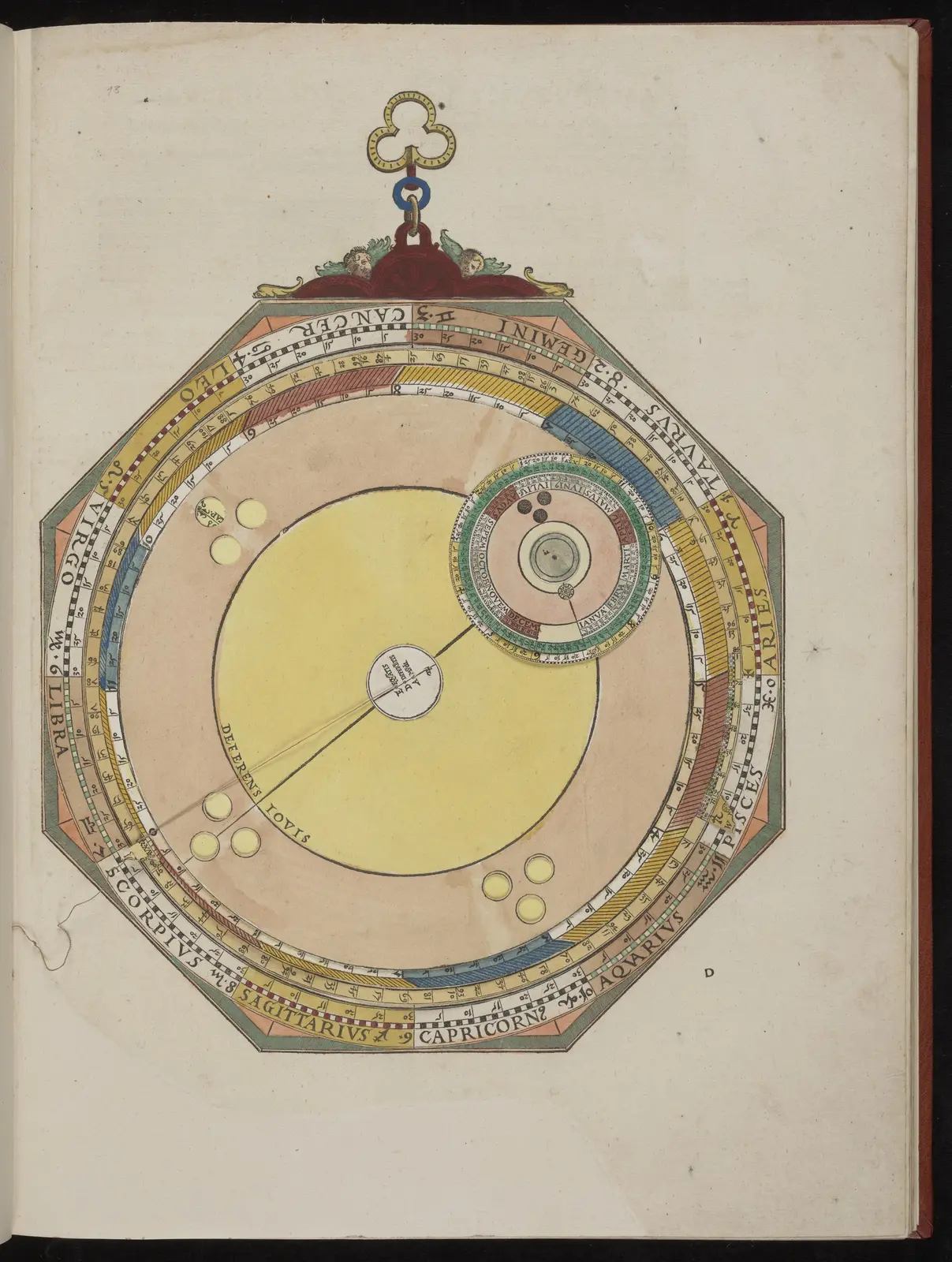
Leaf 18r of the National Library of Poland copy of Apian’s Astronomicum Caesareum (1540), hand colored. The large yellow disc is lettered DEFERENS IOVIS, a smaller disc with the names of the months sits near its rim, and a thread runs from the center out past the edge of the figure.
"Volvelle page, leaf 18r, from Astronomicum Caesareum" (1540), Petrus Apianus — https://commons.wikimedia.org/wiki/File:Astronomicum_Caesareum._1540_(149346554).jpg — Public domain in US: published 1540; EU: author Petrus Apianus d. 1552; Public Domain Mark by the National Library of Poland; modified: reduced in size
Turn the top paper disc and a pointer slides to a new mark. That is the whole idea of a volvelle. Apian’s book stacks the idea several layers deep. This page looks closely at two leaves from one surviving copy, builds a simple model of the mechanism, and checks where a reading can go wrong.
What is a volvelle?
The library catalog for Apian’s book describes its volvelles in two words: “moving discs.” Each disc is a separate piece of cut paper. It sits on a page, or on another disc, and turns around one point near its center.
A simple model shows how a reading comes out. It has a printed scale on the page and two discs held by one rivet, and the top disc carries both a window and a pointer.
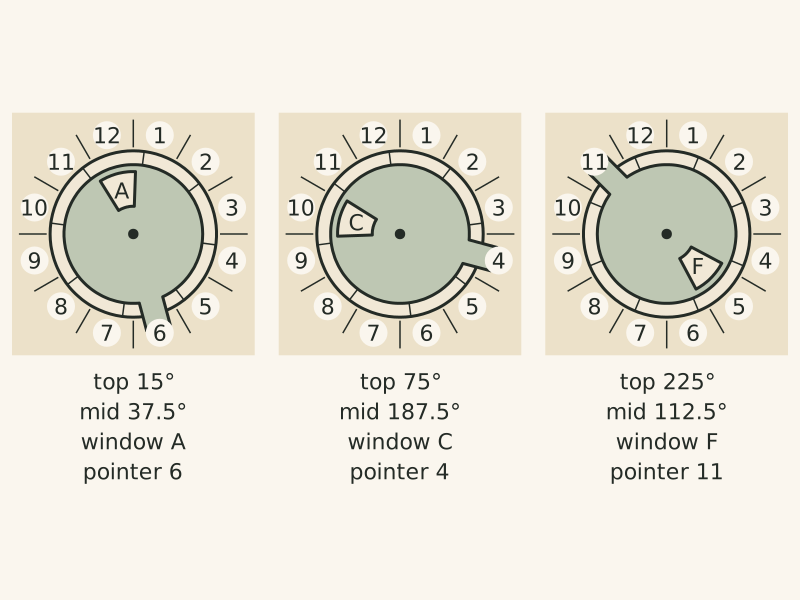
Three settings of the same two-disc volvelle. Turning the top disc moves its window over the eight letters of the middle disc and its pointer around the twelve-part scale printed on the page; the reading under the window and the number under the pointer follow from the two turn angles alone. In each setting shown, the window sits squarely on one letter. The model is a stack of flat layers with no paper thickness.
Check level Layered model; travel, collision, storage and linkage checked at 2° steps; in 2.2% of the sampled settings the window sits centered on a dividing line, so two readings are possible; paper thickness not modeled, nor friction or pivot wear.
"Three settings of a two-disc volvelle model" by Fold, Knot & Bind — https://foldknotbind.com/paper-mechanisms/volvelle/ — licensed under CC BY 4.0: https://creativecommons.org/licenses/by/4.0/
Set the two angles and the answer is fixed, because nothing else in the model can change it. The model checks this “linkage” at every 2° step of both discs.
How do the discs stack and turn?
In the model, the order runs from the bottom up. The scale printed on the page comes first. Next is a middle disc with eight letters, 48 mm in radius. On top sits a disc 40 mm in radius, with a window cut 16 to 36 mm from the center and a pointer reaching out to 62 mm.
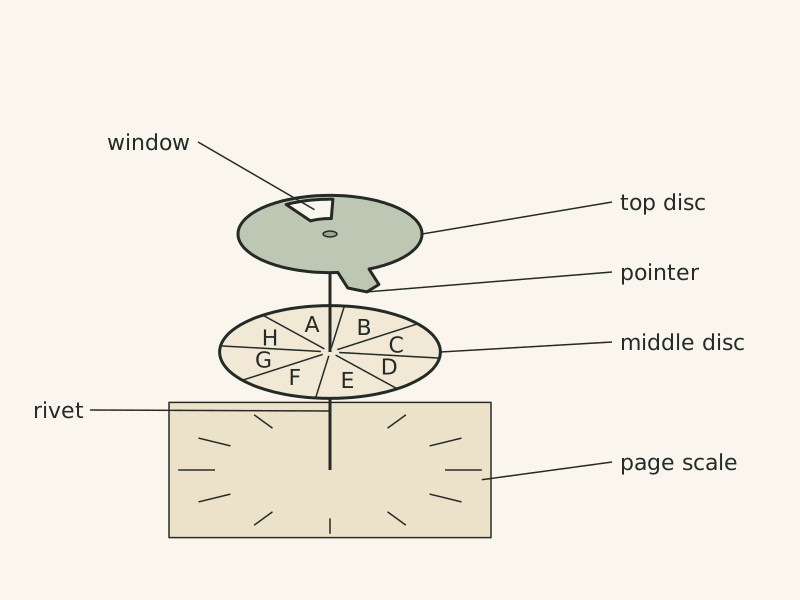
The layers pulled apart along the rivet: the scale printed on the page, the middle disc with eight letters, and the top disc with its window and pointer, the two discs turning on one rivet. The setting is top disc 15°, middle disc 37.5°, the first setting of the drawing above. The layers are drawn apart only to show their order; the model gives them no thickness.
Check level Layered model; travel, collision, storage and linkage checked at 2° steps; in 2.2% of the sampled settings the window sits centered on a dividing line, so two readings are possible; paper thickness not modeled, nor friction or pivot wear.
"Exploded view of a two-disc volvelle model" by Fold, Knot & Bind — https://foldknotbind.com/paper-mechanisms/volvelle/ — licensed under CC BY 4.0: https://creativecommons.org/licenses/by/4.0/
The layers are modeled as separate flat planes, so the collision check is a plain one: the window must clear the rivet head and stay over the middle disc. The model also checks that every part stays inside the page edge at every 2° step, which matters each time the book shuts. The Miura fold page needs a fuller collision test, because its panels turn in three dimensions.
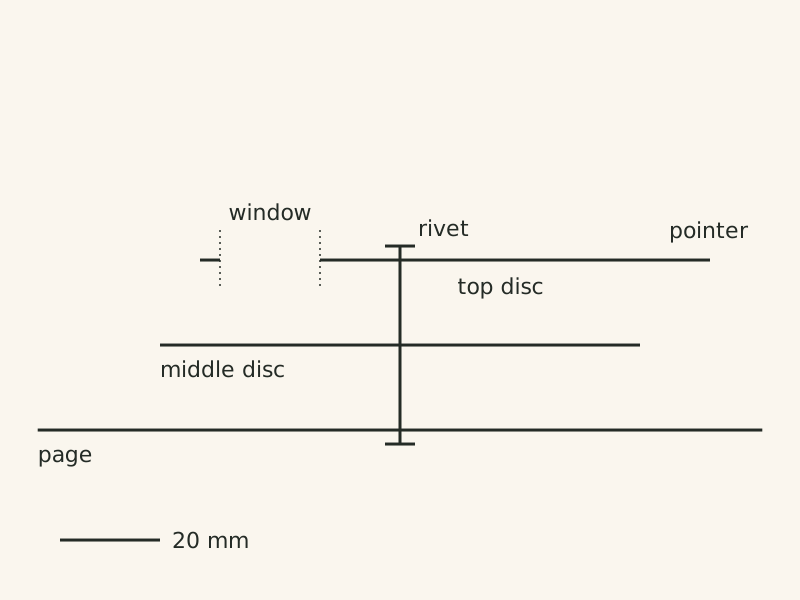
A cut through the rivet along the line of the window and the pointer. The top disc shows a gap where the window is (16 to 36 mm from the rivet) and runs out to the pointer tip (62 mm) on the other side; the middle disc spans 48 mm each way. The vertical spacing is for clarity only: the model has no paper thickness, and it does not model friction or rivet wear.
Check level Layered model; travel, collision, storage and linkage checked at 2° steps; in 2.2% of the sampled settings the window sits centered on a dividing line, so two readings are possible; paper thickness not modeled, nor friction or pivot wear.
"Section through the rivet of a volvelle model" by Fold, Knot & Bind — https://foldknotbind.com/paper-mechanisms/volvelle/ — licensed under CC BY 4.0: https://creativecommons.org/licenses/by/4.0/
This flat, zero-thickness view of the paper is what this site calls paper logic. The page under the discs is held in the book by its binding, a separate structure covered in bookbinding methods.
What do Apian’s wheels show?
The John Carter Brown Library catalog counts 38 full-page pictures in the book, 22 of them with volvelles. It adds that many have silk threads attached at the center. The two leaves here belong to another copy, one scanned by the National Library of Poland.
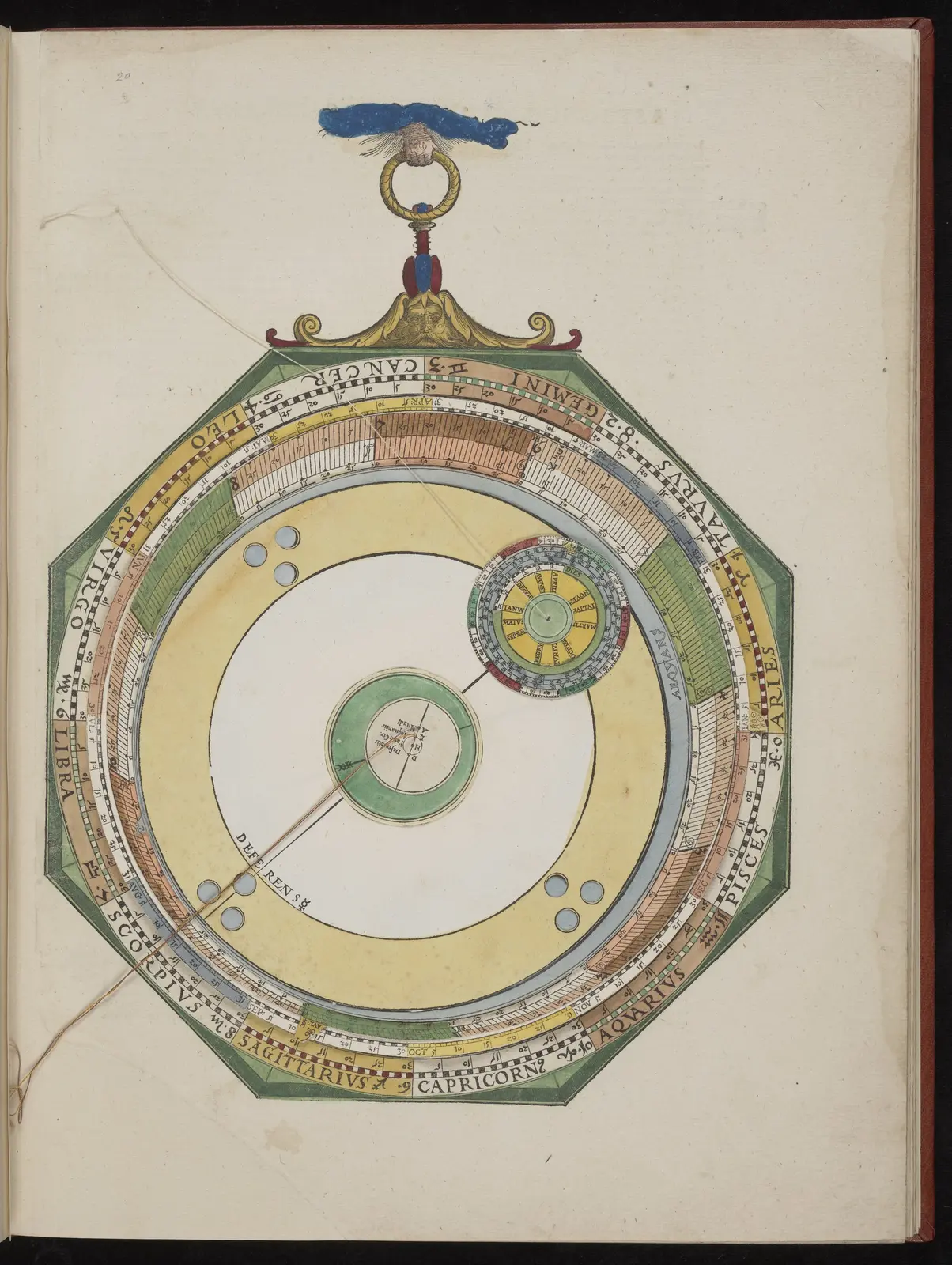
Leaf 34r of the same copy. The large white disc is lettered DEFERENS with the symbol for Mercury, a ring around it is lettered AEQVANS, and the small disc near the rim carries month names and the word DIES. Two threads cross the page.
"Volvelle page, leaf 34r, from Astronomicum Caesareum" (1540), Petrus Apianus — https://commons.wikimedia.org/wiki/File:Astronomicum_Caesareum._1540_(149346680).jpg — Public domain in US: published 1540; EU: author Petrus Apianus d. 1552; Public Domain Mark by the National Library of Poland; modified: reduced in size
Look at the cut edges and the layers become clear, because each disc throws a thin shadow on the paper beneath it. The small disc has its own center, near the rim of the large one, so it can turn by itself.
The labels point to the job. The outer printed ring names the twelve signs of the zodiac, the large discs are lettered for a planet (Jupiter on leaf 18r, Mercury on leaf 34r), and the small discs carry month names.
This page did not read Apian’s Latin instructions, so it does not say how a reader set the discs or what each reading meant.
How big are Apian’s discs?
The scan of leaf 18r can be measured in pixels. Turning pixels into millimeters, though, needs a real size for the leaf, and the Polish library’s record that comes with the scan does not give one. So the radii below are given as a share of the leaf’s height on the scan. They are approximate.
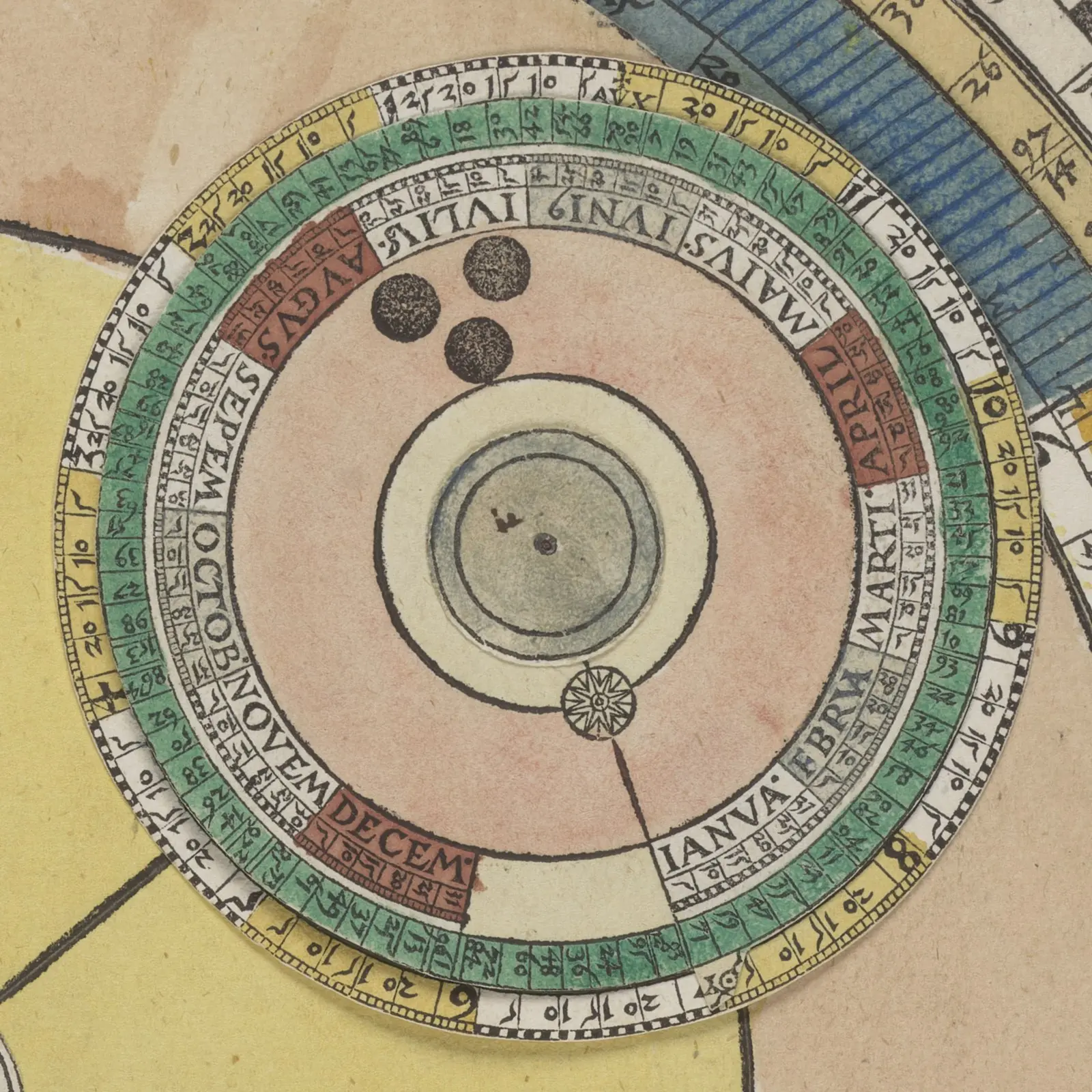
Detail of leaf 18r: the small disc with the month names IANUA to DECEM in a ring, inside a wider outer ring. Where one ring of cut paper lies over another, its edge casts a thin shadow.
"Month disc, detail of leaf 18r, from Astronomicum Caesareum" (1540), Petrus Apianus — https://commons.wikimedia.org/wiki/File:Astronomicum_Caesareum._1540_(149346554).jpg — Public domain in US: published 1540; EU: author Petrus Apianus d. 1552; Public Domain Mark by the National Library of Poland; modified: cropped, lightly smoothed, reduced in size
| Layer | Radius | Basis |
|---|---|---|
| Model top disc | 40 mm | site model |
| Model middle disc | 48 mm | site model |
| Apian 18r small disc, outer ring | about 8.7% of the leaf height | scan, approx |
| Apian 18r ring of month names | about 7.9% of the leaf height | scan, approx |
| Apian 18r yellow disc (DEFERENS IOVIS) | about 15.8% of the leaf height | scan, approx |
| Apian 18r pink-washed disc | about 23.6% of the leaf height | scan, approx |
| Apian 18r frame around the zodiac signs (half-width) | about 30.6% of the leaf height | scan, approx |
Download the volvelle layers table (CSV) (what the file holds)
The printed eight-sided frame around the ring of zodiac signs is about three and a half times the width of the small disc, and it spans about 61% of the leaf’s height.
Were there earlier paper wheels?
Apian’s book is not the earliest record of a volvelle that this page could read. The Library of Congress holds a woodcut it titles “A volvelle showing the movement of the moon throughout the calendar year” and dates to 1474.
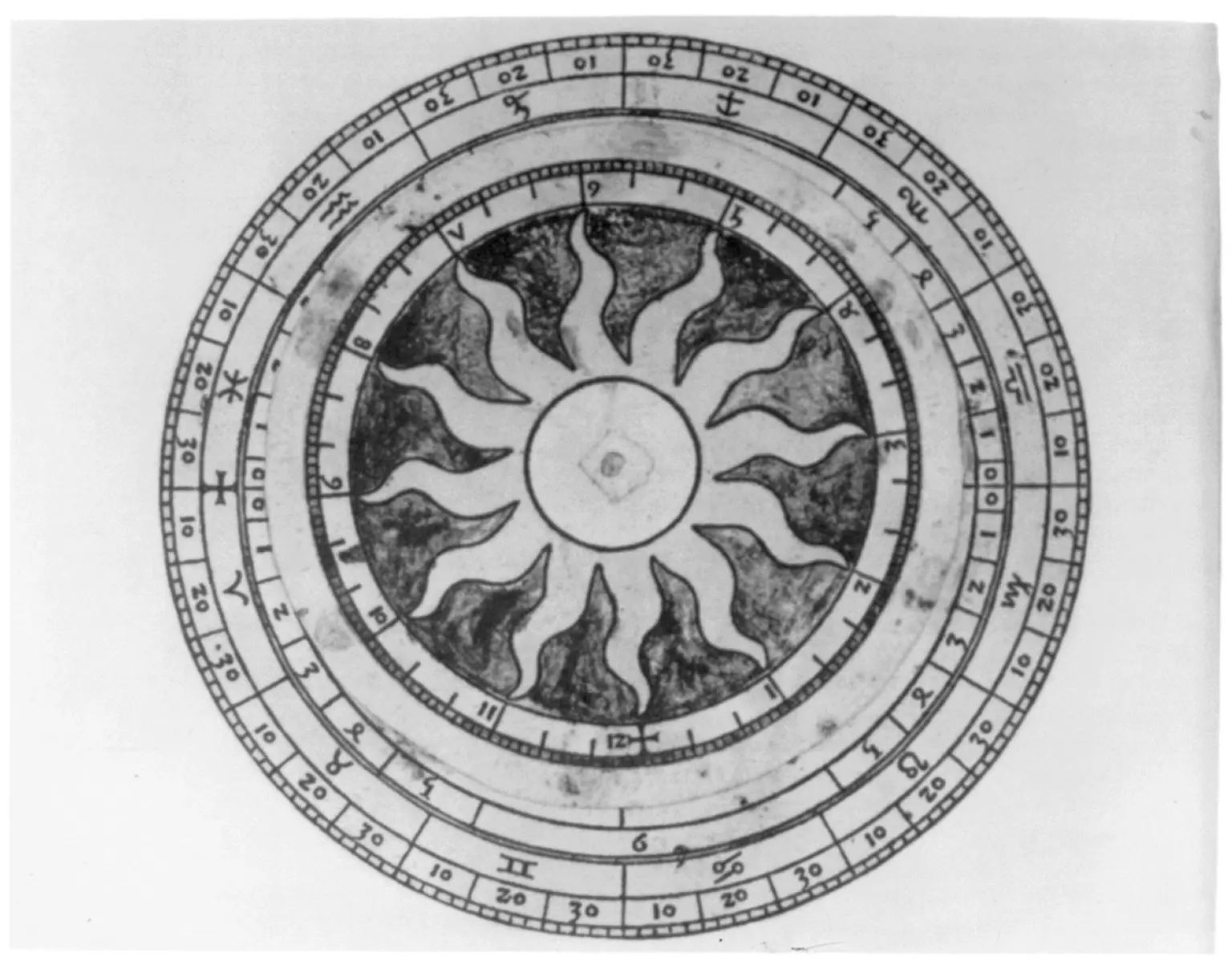
A woodcut the Library of Congress dates to 1474 and titles a volvelle showing the movement of the moon through the year. A sun with wavy rays fills the center, inside rings of numbers and zodiac signs.
"A volvelle showing the movement of the moon throughout the calendar year (woodcut)" (1474), Unknown author — https://commons.wikimedia.org/wiki/File:A_volvelle_showing_the_movement_of_the_moon_throughout_the_calendar_year_LCCN2007681105.jpg — Public domain in US: published 1474 (Library of Congress record); EU: anonymous woodcut published 1474, term long expired; faithful reproduction of a two-dimensional public-domain work (EU Directive 2019/790, Art. 14)
The library’s record ties the print to the first edition of Regiomontanus’s Calendarium, printed in Nuremberg. But the same record warns that it holds unverified, old data from a caption card, so the date and this link both rest on that card. The picture alone does not show whether the rings were ever cut out to turn.
Older claims are thinner still. A 2011 study of pop-up geometry notes, as background, that the history of movable books is traced back to the Catalan writer Ramon Llull in the early 14th century. This page has not read a source from that period.
How it fails: lost discs and readings on the line
Two plain kinds of failure show up here: parts of a volvelle can go missing, and its reading can land between two answers.
The first is on record. The John Carter Brown Library catalog notes that its copy lacks the volvelles on one leaf, folio [9] recto. The catalog does not say how they were lost.
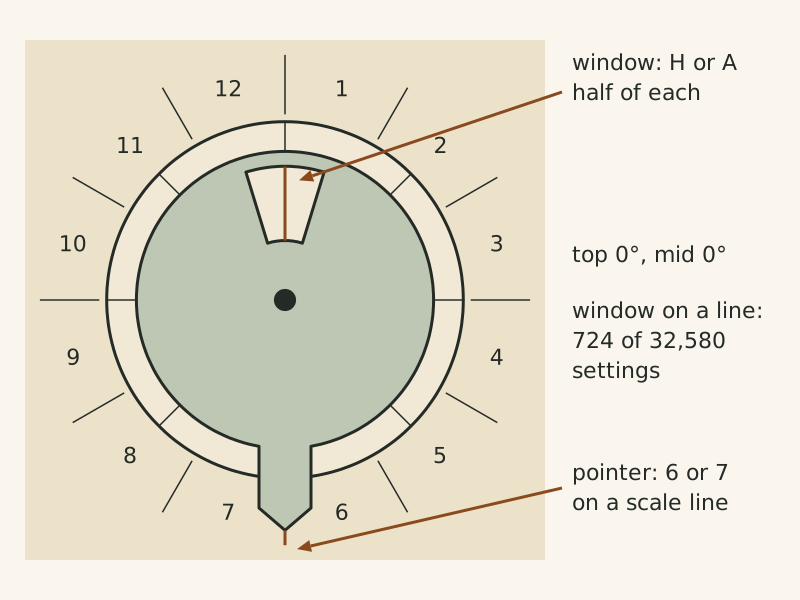
Both discs at 0°. A dividing line of the middle disc runs through the middle of the window, so half of A and half of H show, and the reading could be either. Across the 32,580 settings sampled at 2° steps, this happens in 724, about 2.2%, or roughly one setting in 45. In the same setting the pointer sits exactly on a scale line, between 6 and 7; that second kind of tie comes once every 30° of the top disc’s turn. The model does not include paper thickness, friction or a worn pivot.
Check level Layered model; travel, collision, storage and linkage checked at 2° steps; in 2.2% of the sampled settings the window sits centered on a dividing line, so two readings are possible; paper thickness not modeled, nor friction or pivot wear.
"A volvelle model setting with the reading on a dividing line" by Fold, Knot & Bind — https://foldknotbind.com/paper-mechanisms/volvelle/ — licensed under CC BY 4.0: https://creativecommons.org/licenses/by/4.0/
The second failure is built into the geometry. In the model, 724 of the 32,580 settings sampled at 2° steps put a dividing line straight through the middle of the window, so a reader sees half of one letter and half of the next. The disc turned correctly, but the answer is still a tie. A tie needs an exact angle, so that share belongs to the 2° grid and would change with a different step.
Pivot wear and friction are left out of the model, so this page gives no number for how either one changes the reading.
Sources
- Petrus Apianus, Astronomicum Caesareum (Ingolstadt: Peter and Georg Apian, 1540). National Library of Poland copy, SD XVI.F.2947, leaves 18r and 34r. commons.wikimedia.org/wiki/Category:Astronomicum_Caes…Read: page images of leaves 18r and 34r only; the Latin text was not read
- John Carter Brown Library, catalog description of its copy of Apian, Astronomicum Caesareum (1540), call number 2-SIZE J540 .A642a, as given with Internet Archive item astronomicumcsar00apia. archive.org/details/astronomicumcsar00apiaRead: catalog record only (item metadata)
- "A volvelle showing the movement of the moon throughout the calendar year," woodcut, dated 1474. Library of Congress Prints and Photographs Division, LCCN 2007681105. commons.wikimedia.org/wiki/File:A_volvelle_showing_th…Read: file page (Library of Congress catalog data); image viewed
- Xian-Ying Li, Tao Ju, Yan Gu and Shi-Min Hu, "A Geometric Study of V-style Pop-ups: Theories and Algorithms," ACM Transactions on Graphics 30, no. 4 (2011), article 98. cg.cs.tsinghua.edu.cn/people/~xianying/Papers/V-Popup/Read: full text (10 pages); paraphrased, with one short quotation from page 1

Cite this page
“Volvelle: Apian’s 1540 Book Had Paper Wheels That Turn.” Fold, Knot & Bind. Published Nov. 15, 2026. https://foldknotbind.com/paper-mechanisms/volvelle/. Accessed on the date you read it.
How diagrams and claims are checked All corrections Report an error on this page (contact@foldknotbind.com)
Next on the bench:
- How pop-up books work: A v-fold rises because the pages turn; a volvelle moves only when a hand turns it.
- Tunnel book: Another paper mechanism worked by hand, pulled open rather than turned.
More in Pop-Ups & Folds
 Illustration
Pop-Ups & Folds
How Pop-Up Books Work: A V-Fold Needs Only the Turning Page
Picture credit (illustration)
Illustration: Fold, Knot & Bind. Generated schematic illustration — not a photograph or historical record. Reuse: CC BY 4.0 (https://creativecommons.org/licenses/by/4.0/), to the extent Fold, Knot & Bind holds rights in this image.
Pop-Ups & Folds
Tunnel Book: Cut Panels on Folded Side Strips, as in 1851
Picture credit
"Lane's Telescopic View: The Ceremony of Her Majesty Opening the Great Exhibition (partially open)" by Special Collections at Johns Hopkins University from Baltimore City, United States — https://commons.wikimedia.org/wiki/File:Lane%27s_Telescopic_View_-_The_Ceremony_of_Her_Majesty_Opening_the_Great_Exhibition_(partially_open).jpg — CC BY 2.0 (https://creativecommons.org/licenses/by/2.0/)
 Illustration
Pop-Ups & Folds
Miura Fold: In the Rigid Model, No Panel Bends
Picture credit (illustration)
Illustration: Fold, Knot & Bind. Generated schematic illustration — not a photograph or historical record. Reuse: CC BY 4.0 (https://creativecommons.org/licenses/by/4.0/), to the extent Fold, Knot & Bind holds rights in this image.