Tunnel Book: Cut Panels on Folded Side Strips, as in 1851
Fold, Knot & Bind Published
In brief
Look through the window in a tunnel book's cover and cut scenes stand one behind another. In the plan-view model on this page, a concertina-folded strip on each side joins the panels, and pulled fully open, the strips lie straight and set every gap at 24 mm.
Materials: Paper or card: a front cover with a window, three cut panels, a back cover and two folded side strips. The model counts no glue and no paper thickness.
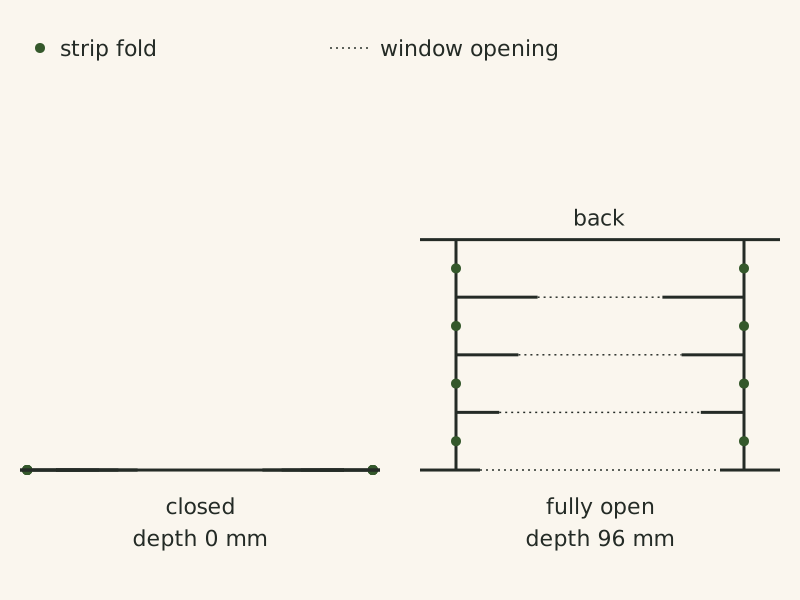
The tunnel book seen from above, closed and fully open: two concertina strips join the covers and three cut layers, and fully open each panel stands 24 mm behind the one in front. Part way open, the middle layers could sit anywhere within a range, so only these two states are drawn. Paper thickness is not modeled.
Check level Plan-view model; panel spacing is fixed only when closed and fully open; paper thickness not modeled.
"Tunnel book seen from above, closed and fully open" by Fold, Knot & Bind — https://foldknotbind.com/paper-mechanisms/tunnel-book/ — licensed under CC BY 4.0: https://creativecommons.org/licenses/by/4.0/
A concertina fold, in a 1982 Library of Congress dictionary of bookbinding terms by Matt Roberts and Don Etherington, folds a sheet “first to the right and then to the left,” so it opens and closes the way the instrument does. In the tunnel book modeled on this page, one such strip runs down each side, and the panels sit between its folds.
What is a tunnel book?
As this page uses the name, a tunnel book is a stack of panels, each cut with an opening, behind a front cover with a window. Look in through the window and each layer is framed by the one in front of it. The back cover closes the stack.
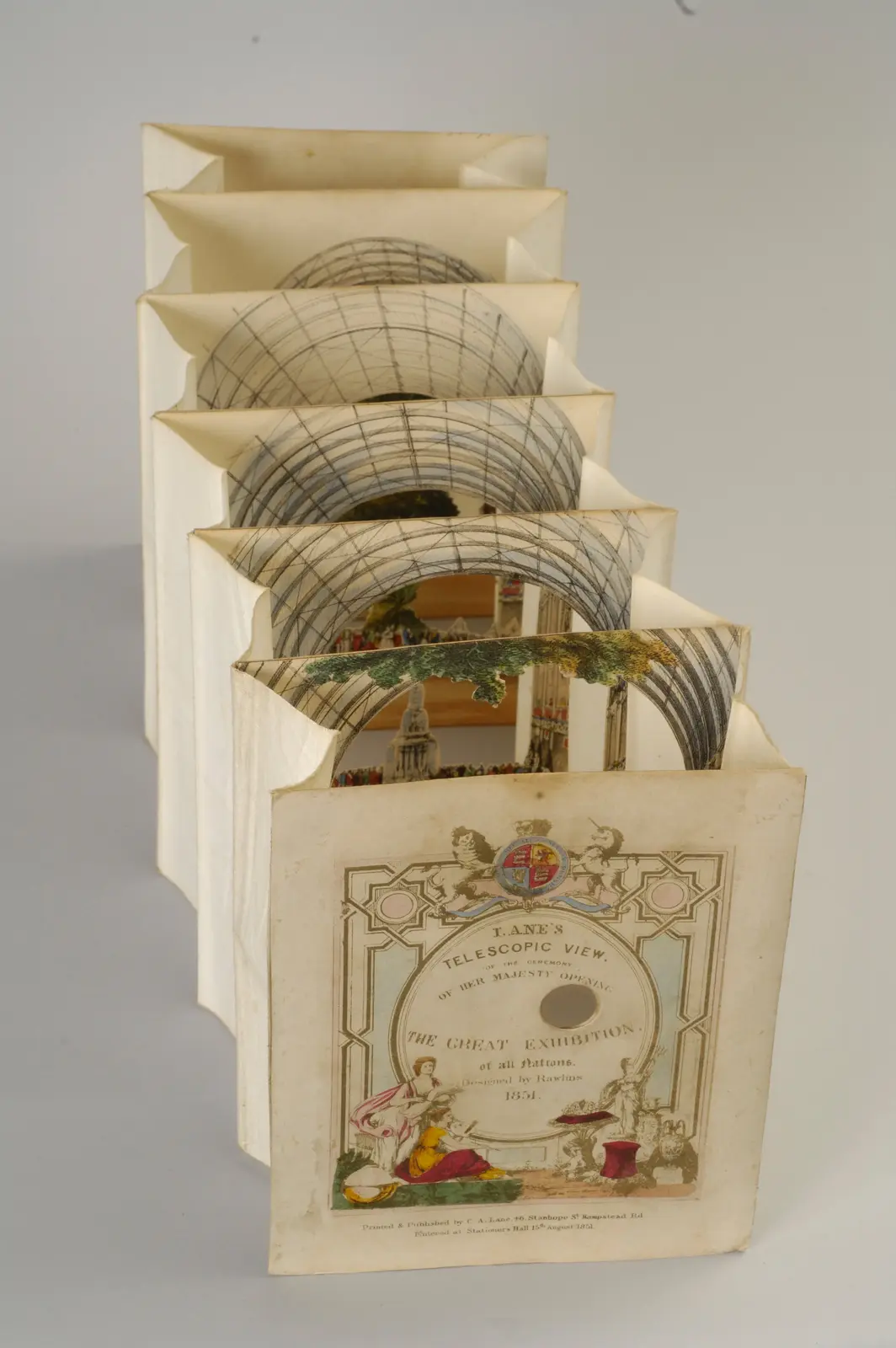
One surviving example is Lane's Telescopic View, published in 1851 and now in the Johns Hopkins University library; Wikimedia Commons files its photographs under tunnel books. The library's catalog record, quoted on its Commons file page, says it opens with a concertina action and is viewed through a small peephole in the cover.
This site groups the tunnel book with hand-operated paper mechanisms. A 2011 geometric study of pop-ups by Xian-Ying Li, Tao Ju, Yan Gu and Shi-Min Hu lists, as one property of a pop-up, that it opens and closes with no force beyond holding and turning the two pages. A tunnel book does not work that way: the reader pulls the covers apart. A V-fold pop-up is the opposite case, lifted by the turning pages alone.
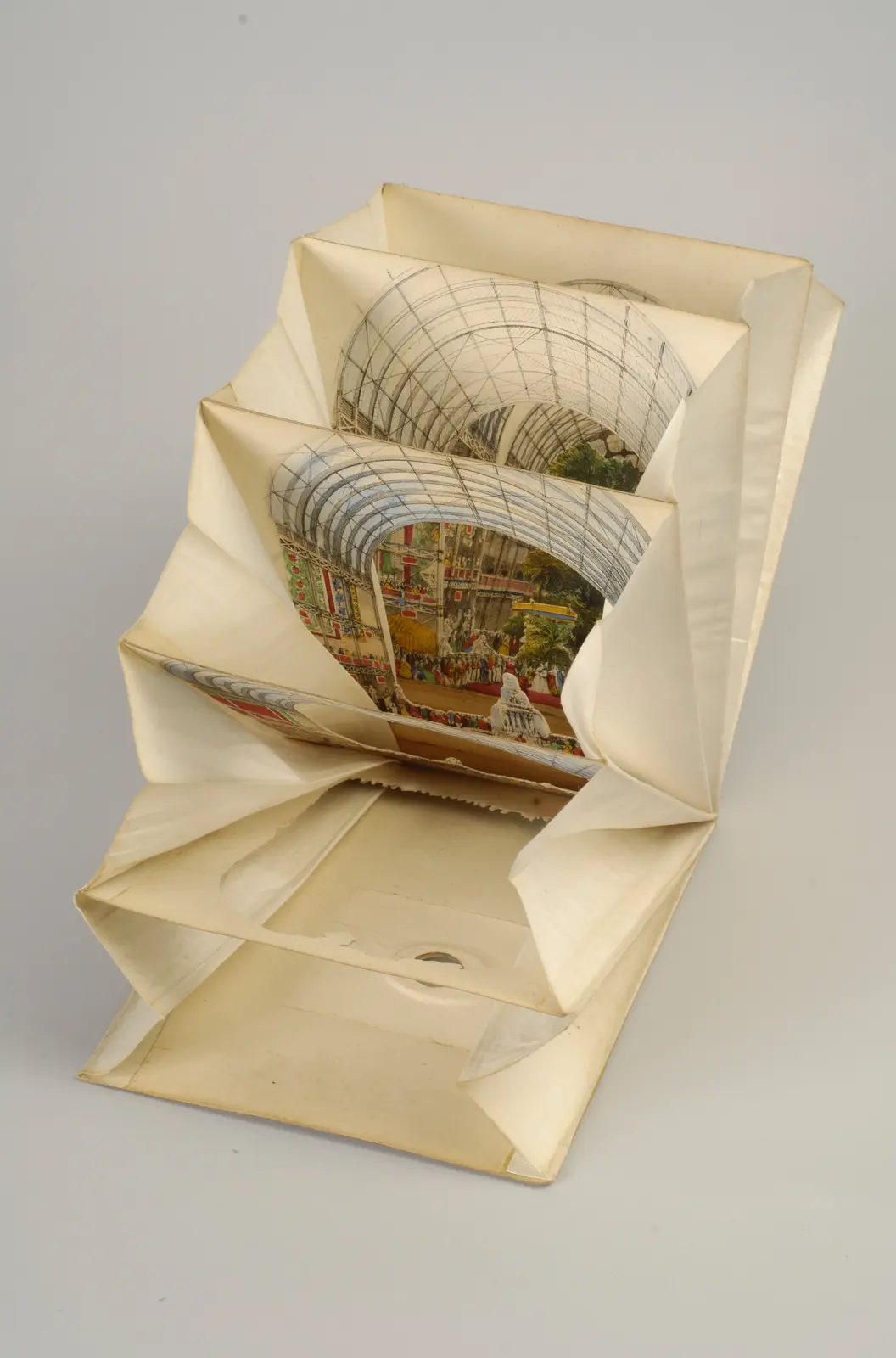
Lane's Telescopic View, published in 1851, partly drawn out. The piece with the small round peephole lies flat in front, the folded side strips are bunched up, and cut layers with arched openings stand behind.
"Lane's Telescopic View: The Ceremony of Her Majesty Opening the Great Exhibition (partially open)" by Special Collections at Johns Hopkins University from Baltimore City, United States — https://commons.wikimedia.org/wiki/File:Lane%27s_Telescopic_View_-_The_Ceremony_of_Her_Majesty_Opening_the_Great_Exhibition_(partially_open).jpg — CC BY 2.0 (https://creativecommons.org/licenses/by/2.0/)
How two concertinas hold the panels apart
The model on this page uses paper logic: every piece is a rigid sheet with no thickness that turns only at its folds. Each side strip is made of 12 mm panels, two between each pair of neighboring layers. The two panels are hinged to the layer edges and to each other at a fold that points outward, so the folds alternate mountain and valley down the strip.
As the covers draw apart, each pair of strip panels opens like a hinge. At full stretch the pair lies straight, so each gap is 2 × 12 = 24 mm. Four gaps make 96 mm from front cover to back cover.
Closed, every pair folds shut and all five panels lie in one plane. The strips then poke out to 72 mm from the center line. The covers reach 75 mm, so the strips stay inside.
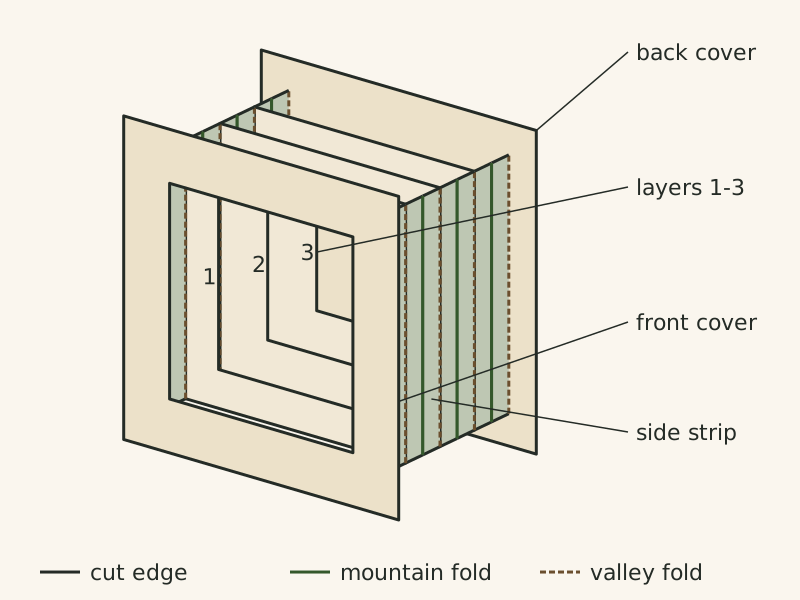
The fully open book seen at an angle, its side strips straight and their folds (solid for mountain, dashed for valley) running up the side. Panel heights are an assumption for this drawing; the checks use the plan-view model, which has no height. Paper thickness is not modeled.
Check level Plan-view model; panel spacing is fixed only when closed and fully open; paper thickness not modeled.
"Fully open tunnel book seen at an angle" by Fold, Knot & Bind — https://foldknotbind.com/paper-mechanisms/tunnel-book/ — licensed under CC BY 4.0: https://creativecommons.org/licenses/by/4.0/
Why it has no fixed half-open position
At a pull of 48 mm, the strips no longer decide where the middle panels sit. Each gap can take any value from 0 to 24 mm, as long as the four gaps add up to the pull. In the model, layer 2 can then sit anywhere from 0 to 48 mm behind the cover. Only at 0 mm and at 96 mm does every gap have one value, so the figures on this page show only those two states.
The model leaves out paper stiffness and friction, so it says nothing about where a real book's layers settle part way open, only that the folds alone do not decide it. The Miura fold is different: in its rigid model, every panel moves together in one linked motion.
| Panel | Closed (mm) | Fully open (mm) | Window half-width (mm) |
|---|---|---|---|
| Front cover | 0 | 0 | 50 |
| Layer 1 | 0 | 24 | 42 |
| Layer 2 | 0 | 48 | 34 |
| Layer 3 | 0 | 72 | 26 |
| Back cover | 0 | 96 | none |
Download the tunnel book model (CSV) (what the file holds)
Why the windows shrink toward the back
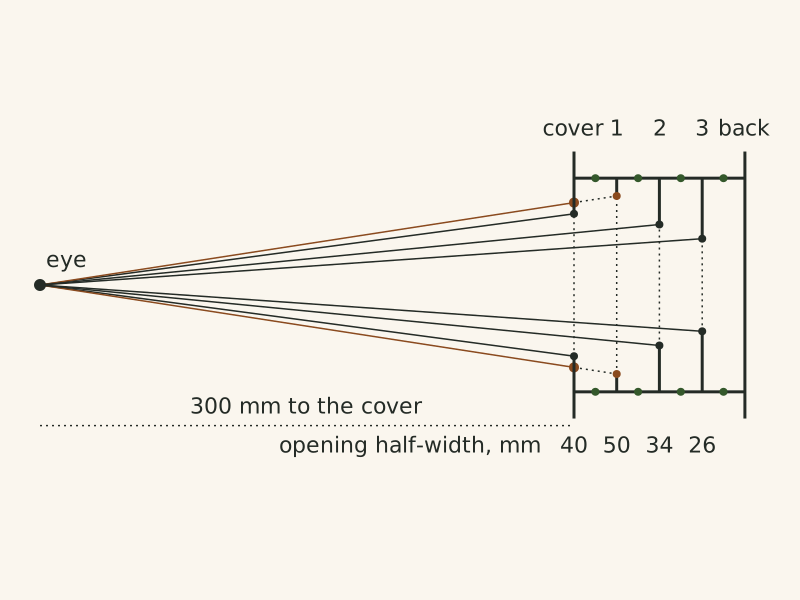
Every opening edge has to show past the edge in front of it, or part of that layer hides. The check puts the eye 300 mm in front of the cover, a viewing distance chosen for the model. It scales each edge for its distance: an edge w mm from the center, d mm behind the cover, looks like w × 300 / (300 + d) at the cover.
With half-widths of 50, 42, 34 and 26 mm, the edges look like 50, 38.9, 29.3 and 21.0 mm from the center line. Each one falls inside the one before, so every edge shows. Distance alone shrinks a back window a little: a 50 mm half-width set 24 mm back looks like 46.3 mm. What counts is the edge as the eye sees it, and cutting each window smaller than the one in front keeps every edge clear.
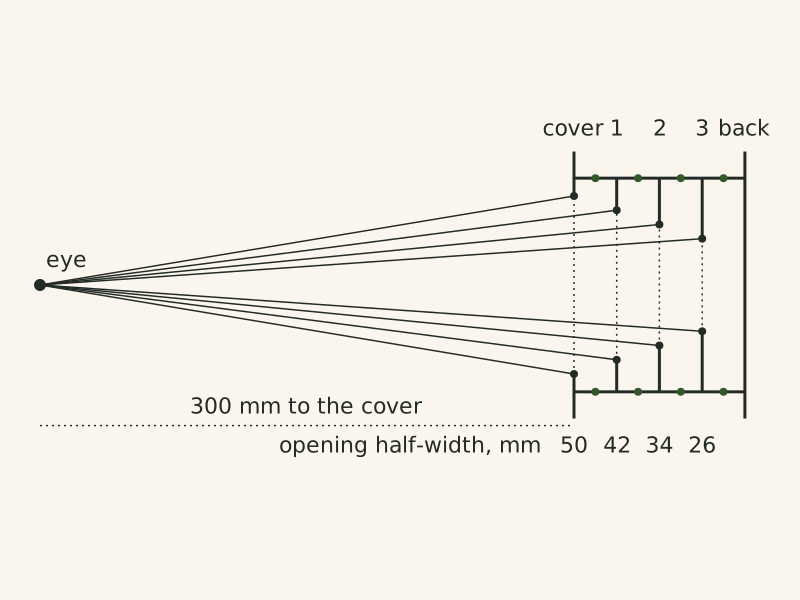
Seen from above, fully open, with the eye 300 mm in front of the cover. The openings narrow toward the back (half-widths 50, 42, 34 and 26 mm), and from the eye their edges stand 50, 38.9, 29.3 and 21.0 mm from the center line, each inside the last. Paper thickness is not modeled.
Check level Plan-view model; panel spacing is fixed only when closed and fully open; paper thickness not modeled.
"Sight lines through a fully open tunnel book" by Fold, Knot & Bind — https://foldknotbind.com/paper-mechanisms/tunnel-book/ — licensed under CC BY 4.0: https://creativecommons.org/licenses/by/4.0/
How it fails: wide strips and oversized windows
The checks reject two designs. In the first, each strip panel is 20 mm instead of 12 mm, so the closed strips fold out to 80 mm from the center line. That is 5 mm past the 75 mm cover edge. The closed book no longer fits inside its covers.
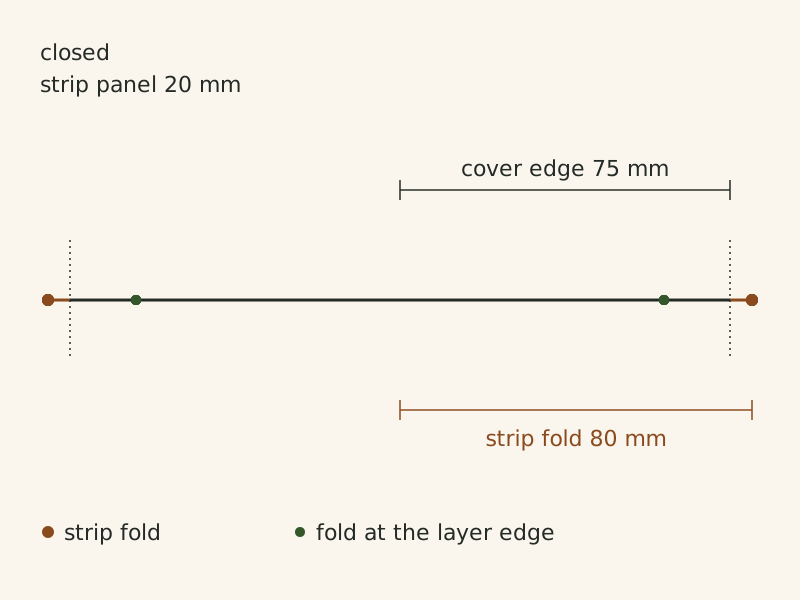
A design the checks reject. With strip panels 20 mm wide instead of 12 mm, the closed strips fold out to 80 mm from the center line, 5 mm past the 75 mm cover edge, so the closed book does not fit inside its covers. Paper thickness is not modeled.
Check level Plan-view model of a design the checks reject (the side strips stick out 5 mm past the cover edge when closed); paper thickness not modeled.
"Rejected tunnel-book design: side strips too wide" by Fold, Knot & Bind — https://foldknotbind.com/paper-mechanisms/tunnel-book/ — licensed under CC BY 4.0: https://creativecommons.org/licenses/by/4.0/
In the second, layer 1's window is wider than the cover's: a 50 mm half-width behind a 40 mm one. From 300 mm away, that edge looks like 46.3 mm, outside the cover's window, so the cover hides it.
A design the checks reject. The first layer's opening (half-width 50 mm) is wider than the cover's (40 mm). The sight line to its edge (rust) meets the front cover before it gets there, so from 300 mm away that edge stays hidden. Paper thickness is not modeled.
Check level Plan-view model of a design the checks reject (the first layer's opening edge is hidden behind the front cover); paper thickness not modeled.
"Rejected tunnel-book design: a window wider than the one in front" by Fold, Knot & Bind — https://foldknotbind.com/paper-mechanisms/tunnel-book/ — licensed under CC BY 4.0: https://creativecommons.org/licenses/by/4.0/
A third limit sits at the end of the pull. At full stretch the strips have no more to give, because each pair of panels already lies straight. The model has no position at the next 2 mm step, 98 mm. Going farther would take strips longer than the book has, and the model does not say how real paper or glue would give way.
An 1851 example, fully open
The same Lane's Telescopic View, drawn out all the way, shows the structure from the front. The printed cover reads “Designed by Rawlins” and “1851,” with a small round peephole in the middle. Behind it, a row of cut layers with arched openings stands between the side strips, which zigzag in and out between the layers.
The photograph shows the build, not its measurements. This page does not measure the strip widths or the spacing in this copy, so the model's numbers do not describe it.
The same 1851 Lane's Telescopic View, fully open. The cover with its peephole stands in front, and a row of cut layers with arched openings stands behind it, joined at each side by a strip folded in and out.
"Lane's Telescopic View: The Ceremony of Her Majesty Opening the Great Exhibition (open)" by Special Collections at Johns Hopkins University from Baltimore City, United States — https://commons.wikimedia.org/wiki/File:Lane%27s_Telescopic_View_-_The_Ceremony_of_Her_Majesty_Opening_the_Great_Exhibition_(open).jpg — CC BY 2.0 (https://creativecommons.org/licenses/by/2.0/)
Sources
- Matt T. Roberts and Don Etherington, "concertina fold," in Bookbinding and the Conservation of Books: A Dictionary of Descriptive Terminology (Washington: Library of Congress, 1982). cool.culturalheritage.org/don/dt/dt0809.htmlRead: full entry
- Xian-Ying Li, Tao Ju, Yan Gu and Shi-Min Hu, "A Geometric Study of V-style Pop-ups: Theories and Algorithms," ACM Transactions on Graphics 30, no. 4 (2011), article 98. cg.cs.tsinghua.edu.cn/people/~xianying/Papers/V-Popup/Read: full text (10 pages); paraphrased, with one short quotation from page 1
- Lane's Telescopic View, of the Ceremony of Her Majesty Opening the Great Exhibition, of All Nations, designed by Rawlins, printed and published by C. A. Lane (1851); George Peabody Library, Johns Hopkins University, call no. 606 L248 1851; photographs by Special Collections at Johns Hopkins University on Wikimedia Commons. commons.wikimedia.org/wiki/File:Lane%27s_Telescopic_V…Read: file pages for the partly open and the fully open photographs, including the catalog description quoted there, and Category:Tunnel books; library record not consulted

Cite this page
“Tunnel Book: Cut Panels on Folded Side Strips, as in 1851.” Fold, Knot & Bind. Published Nov. 15, 2026. https://foldknotbind.com/paper-mechanisms/tunnel-book/. Accessed on the date you read it.
How diagrams and claims are checked All corrections Report an error on this page (contact@foldknotbind.com)
Next on the bench:
- Volvelle: Another paper mechanism worked by hand, turned instead of pulled.
- Saddle stitching: Folded sheets nested one inside another, a second way paper turns at its folds.
More in Pop-Ups & Folds
 Illustration
Pop-Ups & Folds
How Pop-Up Books Work: A V-Fold Needs Only the Turning Page
Picture credit (illustration)
Illustration: Fold, Knot & Bind. Generated schematic illustration — not a photograph or historical record. Reuse: CC BY 4.0 (https://creativecommons.org/licenses/by/4.0/), to the extent Fold, Knot & Bind holds rights in this image.
Pop-Ups & Folds
Volvelle: Apian’s 1540 Book Had Paper Wheels That Turn
Picture credit
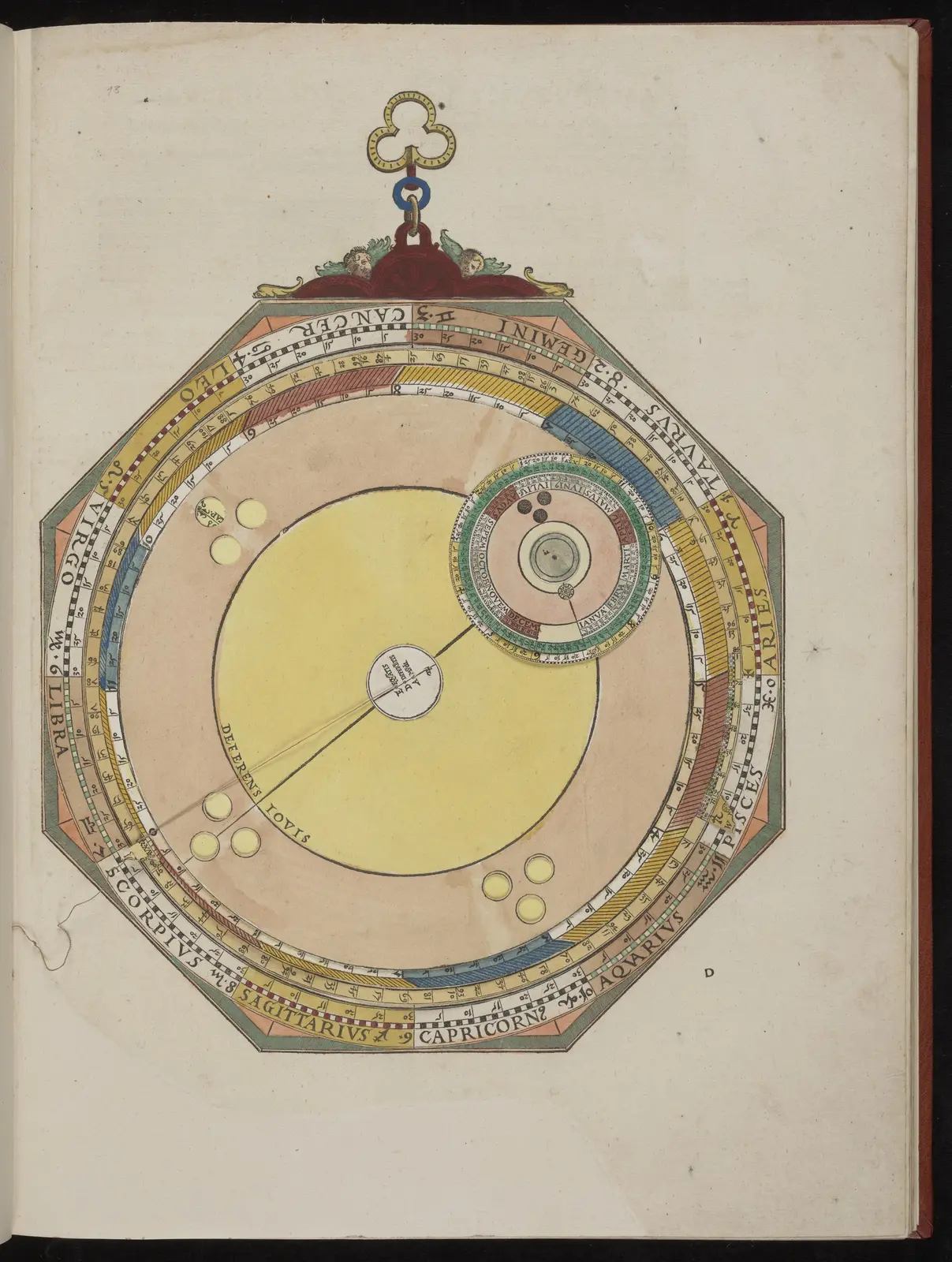
"Volvelle page, leaf 18r, from Astronomicum Caesareum" (1540), Petrus Apianus — https://commons.wikimedia.org/wiki/File:Astronomicum_Caesareum._1540_(149346554).jpg — Public domain in US: published 1540; EU: author Petrus Apianus d. 1552; Public Domain Mark by the National Library of Poland; modified: reduced in size
 Illustration
Pop-Ups & Folds
Miura Fold: In the Rigid Model, No Panel Bends
Picture credit (illustration)
Illustration: Fold, Knot & Bind. Generated schematic illustration — not a photograph or historical record. Reuse: CC BY 4.0 (https://creativecommons.org/licenses/by/4.0/), to the extent Fold, Knot & Bind holds rights in this image.